Remote work has transformed how millions of people approach their careers. However, flexibility can create new challenges when professional and personal spaces overlap. Understanding effective work life balance tips for remote workers helps employees create healthier routines, avoid burnout, and maintain consistent productivity.
Unlike traditional offices, remote workers often face blurred boundaries. A laptop at home can make it tempting to answer messages late at night, extend meetings beyond working hours, or continue unfinished tasks during personal time.
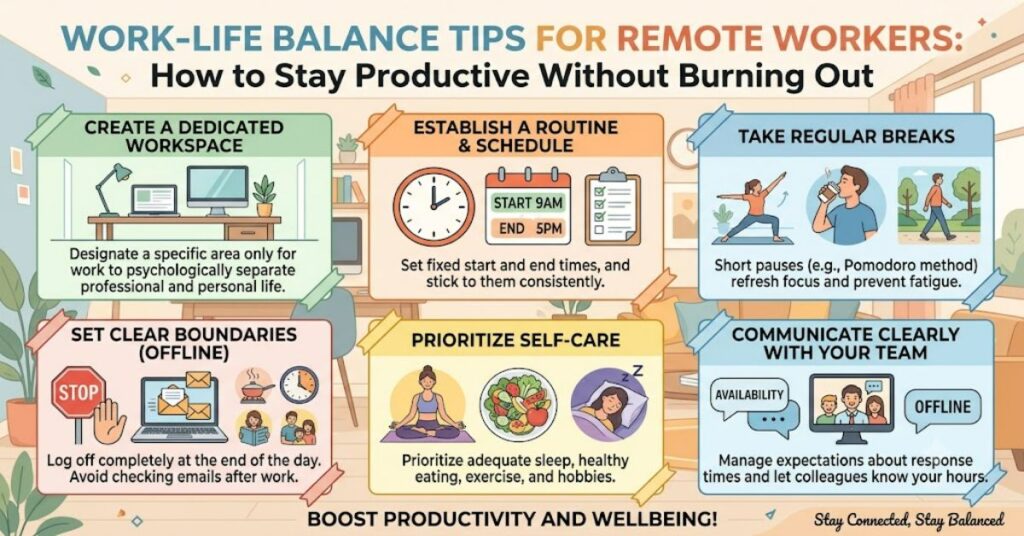
The solution is not working harder. It is creating systems that separate work from life. This includes maintaining a fixed daily schedule, designing a dedicated workspace, managing communication expectations, and developing a shutdown ritual that signals the end of the workday.
According to research from organisations studying workplace wellbeing, flexibility can improve employee satisfaction, but only when workers have autonomy and clear expectations. Without structure, remote employees may experience longer working hours and increased psychological pressure.
Remote work is most effective when people treat their home office as a professional environment while still protecting personal boundaries. Balance is not about dividing every hour equally. It is about creating a routine where work supports life rather than controlling it.
Why Remote Workers Struggle With Work-Life Balance
Remote work removes many traditional workplace boundaries. The commute that once separated professional and personal time disappears, making transitions more difficult.
Common challenges include:
- Difficulty switching off after work.
- Constant notifications from digital communication tools.
- Lack of physical separation between office and home.
- Pressure to appear available at all times.
- Reduced social interaction with colleagues.
A remote employee may complete their assigned tasks but still feel mentally connected to work throughout the evening. This creates cognitive fatigue because the brain does not receive a clear signal that the working day has ended.
Creating boundaries is therefore not only a productivity strategy but also a psychological requirement.
Create Physical Boundaries With a Dedicated Workspace
One of the most effective ways to improve remote work habits is creating a specific area for professional activities.
A dedicated workspace does not need to be a large office. It can be a small desk, a quiet corner, or any consistent location associated with work.
The purpose is behavioural conditioning. When someone repeatedly works in the same place, the brain begins associating that environment with focus and productivity.
| Workspace Approach | Benefits | Possible Limitation |
| Separate home office | Strong separation between work and personal life | Requires available space |
| Dedicated desk area | Creates professional routine | May still share household space |
| Flexible workspace rotation | Provides variety | Can weaken work boundaries |
A physical workspace also helps communicate boundaries to family members or housemates. It creates a visible reminder that professional time requires concentration.
Maintain a Fixed Schedule Instead of Working Anytime
Flexibility is one of remote work’s biggest advantages, but unlimited flexibility can become a problem.
A structured schedule helps remote workers maintain consistency. This does not mean copying traditional office hours exactly. Instead, employees should identify their most productive periods and create predictable routines.
A balanced remote schedule often includes:
- A clear starting time.
- Planned breaks.
- Defined meeting hours.
- A consistent finishing time.
Many productivity issues come from extending work because there is no physical signal that the day is complete.
A reliable schedule protects energy and makes personal activities easier to plan.
Build a Shutdown Ritual to End the Workday
A shutdown ritual is a simple routine that tells your mind that professional responsibilities are finished.
Examples include:
- Closing all work applications.
- Writing tomorrow’s task list.
- Turning off work notifications.
- Taking a short walk.
- Changing clothes after work.
These actions may appear small, but they create a psychological transition between work mode and personal time.
Research on workplace recovery suggests that detachment from work during non-working hours supports better mental recovery and reduces exhaustion.
The goal is not simply leaving the computer behind. The goal is allowing the mind to disconnect.
Managing Digital Communication Without Constant Availability
Remote teams often depend on messaging platforms, video calls, and collaboration software. While these tools improve connection, they can also create pressure to respond immediately.
A healthier approach includes setting communication expectations.
| Digital Habit | Better Alternative |
| Checking messages constantly | Review messages at planned intervals |
| Responding immediately to everything | Prioritise urgent tasks |
| Keeping notifications active all day | Disable unnecessary alerts |
| Attending unnecessary meetings | Use written updates when possible |
Companies that build strong remote cultures usually focus on outcomes rather than constant online presence.
Being available every minute does not always mean being productive.
The Hidden Risks of Poor Remote Work Boundaries
Although remote work offers flexibility, poor boundaries can create several problems.
Burnout Through Invisible Overtime
Many remote workers unintentionally increase their working hours because the office is always nearby. Without a clear ending point, tasks expand into personal time.
Reduced Social Connection
Working remotely can reduce informal conversations and relationship-building opportunities. Employees may need intentional efforts to maintain workplace connections.
Productivity Pressure
Some workers feel they must prove their productivity because managers cannot physically observe their work. This can lead to unnecessary stress.
The solution is creating trust-based systems where performance is measured through outcomes rather than online activity.
Comparison: Traditional Office Work vs Remote Work Balance
| Factor | Traditional Office | Remote Work |
| Physical separation | Naturally created by commuting | Requires intentional boundaries |
| Social interaction | Built into workplace environment | Needs planned connection |
| Schedule control | Usually limited | More flexible |
| Distraction sources | Office interruptions | Home and digital interruptions |
Remote work provides greater control, but that control requires stronger personal management.
Data Insights: Remote Work Balance Strategies
| Strategy | Primary Benefit | Impact |
| Fixed schedule | Better routine | Reduces decision fatigue |
| Dedicated workspace | Stronger separation | Improves focus |
| Shutdown ritual | Mental recovery | Supports relaxation |
| Notification control | Less distraction | Improves concentration |
| Regular breaks | Energy management | Prevents exhaustion |
These practices work together. No single habit creates perfect balance, but combined systems produce stronger results.
The Future of Work Life Balance for Remote Workers in 2027
By 2027, remote and hybrid work models are expected to remain important parts of many industries. Organisations are increasingly focusing on employee wellbeing, flexible policies, and technology-supported collaboration.
Artificial intelligence tools may reduce repetitive administrative work, but they may also increase expectations for faster communication. This makes digital boundaries even more important.
Future remote workers will likely need stronger skills in self-management, communication, and technology use. Companies that create clear policies around availability, workload, and employee wellbeing will have an advantage in attracting and retaining talent.
The future of remote work will not depend only on where people work. It will depend on how effectively organisations and individuals create sustainable working systems.
Key Takeaways
- Remote work requires deliberate boundaries to prevent burnout.
- A dedicated workspace strengthens the separation between professional and personal life.
- Fixed schedules improve consistency and reduce unnecessary overtime.
- Shutdown rituals help the brain transition away from work.
- Digital communication should support productivity, not create constant pressure.
- Sustainable performance depends on protecting wellbeing.
Conclusion
Maintaining balance while working remotely requires more than simply having flexible working arrangements. It requires intentional habits that protect both productivity and personal wellbeing.
The most effective remote workers create clear boundaries, manage their time carefully, and recognise the importance of recovery. A dedicated workspace, structured schedule, and shutdown ritual can transform remote work from a source of stress into a sustainable career model.
As workplaces continue adopting flexible approaches, individuals and organisations must focus on healthier systems rather than simply increasing availability. True productivity comes from focused work combined with enough time to rest, recharge, and maintain a fulfilling personal life.
Frequently Asked Questions
What are the best work life balance tips for remote workers?
The best approaches to work life balance include maintaining a fixed schedule, creating a dedicated workspace, limiting digital distractions, and developing a clear end-of-day routine.
How can remote workers avoid burnout?
Remote workers can reduce burnout by setting boundaries, taking regular breaks, disconnecting after work hours, and managing workload expectations.
Should remote workers follow traditional office hours?
Not always. Remote workers can create flexible schedules, but consistent working patterns help maintain productivity and personal balance.
Why is a shutdown ritual important?
A shutdown ritual creates a psychological signal that work has ended, helping employees mentally separate professional responsibilities from personal time.
How can companies support remote employee wellbeing?
Companies can support wellbeing through realistic workloads, clear communication policies, flexible schedules, and trust-based performance management.
Methodology
This article was prepared using research from workplace wellbeing studies, remote work analysis, and organisational behaviour sources. The recommendations combine established productivity principles with documented remote work challenges.
The analysis recognises that remote work experiences vary depending on job type, household environment, and company culture. No single approach works for every worker, but structured boundaries remain a consistent factor in maintaining healthier work patterns.
References (APA Style)
World Economic Forum. (2023). The Future of Jobs Report 2023. World Economic Forum.
Microsoft. (2024). Work Trend Index Annual Report: AI at Work Is Here. Now Comes the Hard Part. Microsoft.
International Labour Organization. (2021). Working from Home: From Invisibility to Decent Work. International Labour Organization.