
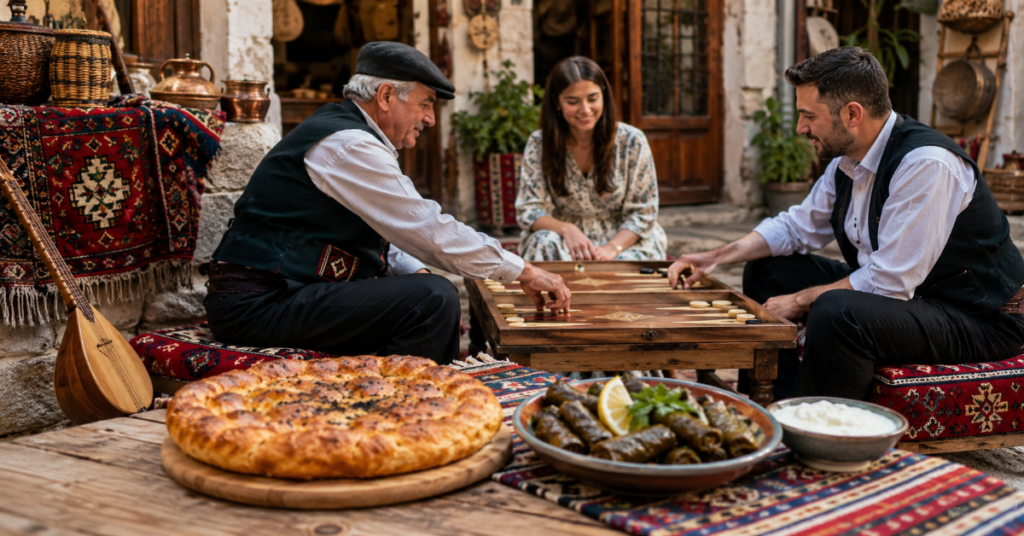
Çbiri is best understood as a cultural keyword with layered meaning. It is often described online as a tradition that brings together strategy games, shared food, symbolism and communal identity. The problem is that the term itself is not widely documented in major academic or heritage databases, which means responsible coverage must separate verified cultural context from modern interpretation.
That does not make the idea empty. It makes it more interesting.
Across Central Asia and the wider Turkic world, games, meals and festivals have long worked together as social technologies. They teach memory, sharpen reasoning, transmit values and gather families around shared ritual. UNESCO’s work on nomadic games in Kyrgyzstan notes that traditional games became endangered after forced sedentarization during the Soviet era, leading practitioners to organize documentation and safeguarding efforts beginning in 2007.
That verified context helps explain why a word like çbiri can attract attention today. Readers are not only searching for a definition. They are looking for a way to understand how a single tradition can carry play, food, ancestry and social order at once. This article treats the term carefully: not as a confirmed UNESCO-listed practice but as a modern search term attached to real patterns in Central Asian and Turkic cultural life.
What Çbiri Means in Cultural Context
The most useful way to approach çbiri is not as a dictionary entry but as a container concept. It points toward a cultural pattern where games are not merely entertainment and food is not merely nutrition. Both become social instruments.
In many nomadic and semi-nomadic societies, practical life shaped cultural design. Games trained patience, calculation and observation. Shared dishes reinforced hospitality, hierarchy and family continuity. Festivals combined competition, performance, storytelling and feasting into one communal experience.
This matters because modern readers often separate these categories. A board game belongs in one box. A dish belongs in another. A ritual belongs somewhere else. Traditional cultures rarely worked so neatly. A seasonal gathering could include strategic play, music, meat preparation, oral history and intergenerational teaching without treating them as separate events.
The Verified Heritage Behind the Idea
There is strong evidence for the broader cultural environment associated with the term. The clearest example is the traditional intelligence and strategy game known across different Turkic communities as Togyzqumalaq, Toguz Korgool and Mangala or Göçürme. UNESCO identifies it as a traditional strategy game playable on special boards or improvised pits in the ground.
That detail matters. A game that can be played on a carved board or in earth pits reflects mobility, adaptation and shared rule systems. It does not require a permanent building or expensive equipment. It can travel with people.
Central Asian sports and games also had social purposes beyond recreation. Akyildiz’s 2022 study of Central Asia’s Turkic Muslim peoples describes traditional sport and recreation as deeply rooted practices connected to training, hunting, festivals, family bonding and seasonal life between 1400 and 1850.
Food has a similar function. A 2024 research paper on “Making Beshbarmak” presents a digital cooking game built around Central Asian culinary heritage, using step-by-step interaction and storytelling to help users connect with nomadic ancestry, especially among immigrant communities.
Together, these sources do not prove that çbiri is an ancient formal institution. They do support the cultural logic behind it.
Çbiri as a System: Game, Food, Symbol and Community
| Layer | Cultural Function | Real-World Parallel | Why It Matters |
| Strategy game | Teaches patience, memory and calculation | Togyzqumalaq, Toguz Korgool and Mangala | Preserves reasoning through play |
| Shared food | Builds hospitality and family continuity | Beshbarmak and other communal dishes | Makes identity edible and repeatable |
| Festival setting | Creates public participation | World Nomad Games and local gatherings | Turns heritage into performance |
| Symbolic language | Compresses values into a word or ritual | Oral storytelling and naming traditions | Helps culture survive migration |
| Digital revival | Repackages heritage for younger audiences | Cultural games and online explainers | Expands reach but risks distortion |
The strongest insight here is that çbiri functions as a cultural shortcut. It gives a name to the way communities combine practical skills, pleasure and moral instruction. That is why the word can feel bigger than a single activity.
Why the Game Layer Matters
Traditional strategy games are cultural archives. Their boards, stones and rules hold assumptions about order, patience, luck, foresight and social conduct.
Mangala-style games are especially important because they are simple to set up yet intellectually demanding. Players move pieces through pits, count outcomes and anticipate the opponent’s pattern. That mix of arithmetic, memory and tactical judgment makes the game portable education.
The 5th World Nomad Games, held in Astana from September 8 to 13, 2024, included equestrian events, wrestling, traditional archery and mind games. UNESCO described the event as centered on the traditional games of historically nomadic peoples of Central Asia and linked it to cultural preservation and dialogue.
That modern visibility matters. It shows that traditional games are not frozen museum pieces. They still operate as identity systems, tourism assets and diplomatic cultural platforms.
Why the Food Layer Matters
Food carries memory differently from games. A game teaches rules. A meal teaches belonging.
Central Asian communal dishes often emphasize shared preparation and collective eating. The digital “Making Beshbarmak” project is useful because it shows how food heritage can be translated into interactive media without reducing it to a recipe card. The project’s authors describe it as an educational tool and platform for cultural preservation.
This helps explain the food dimension attached to çbiri. When people describe it as both dish and tradition, they may not mean that one fixed recipe exists under that name. They may be describing a broader meal-centered practice where food anchors memory, storytelling and group identity.
That distinction is important for editors. Calling it “a dish” may be too narrow. Calling it “a cultural food tradition” is more accurate, provided the article explains the limits of verification.
Strategic and Practical Implications
The rise of niche cultural keywords creates both opportunity and risk for publishers.
For Postcard.fm, the opportunity is search intent. Readers typing unfamiliar terms are usually looking for clarity, not academic density. A good article can meet that need while correcting weak online claims. Postcard’s coverage of undefined digital terms already shows how unclear words can gain visibility through repeated online use.
The risk is overclaiming. Many articles online treat obscure words as ancient, universal or fully established without evidence. That may attract clicks in the short term but damages trust. A better editorial strategy is to say what is known, what is plausible and what remains unverified.
For cultural writers, çbiri is useful because it opens a broader conversation about heritage packaging. Modern audiences often discover culture through search engines before they encounter elders, museums or fieldwork. That changes the responsibility of the writer.
Risks and Trade-Offs
| Risk | What Can Go Wrong | Editorial Safeguard |
| False authority | Presenting the term as fully verified history | State documentation limits clearly |
| Cultural flattening | Reducing diverse Turkic traditions into one label | Identify regional variation |
| SEO distortion | Repeating claims from weak sources | Use primary heritage and academic sources |
| Romantic framing | Treating nomadic culture as timeless or exotic | Include historical disruption and modern context |
| Digital mislabeling | Confusing a trend term with a formal tradition | Separate modern usage from historical evidence |
The main trade-off is readability versus precision. Readers want a clean definition. The evidence demands a more careful answer. The article must satisfy curiosity without inventing certainty.
Market, Cultural and Real-World Impact
Interest in terms like çbiri reflects a wider pattern: cultural heritage is being rediscovered through digital search.
The World Nomad Games show one institutional version of that trend. UNESCO reported that the 2024 Astana event expected at least 2,000 participants from more than 85 countries and included cultural and scientific programming alongside sport.
Digital heritage projects show another version. A small interactive game about Beshbarmak may not reach millions immediately, but it points toward a real future: younger diaspora audiences learning culture through screens before they learn it through home practice.
The real-world impact is therefore not limited to tourism or festivals. It includes education, diaspora identity, language preservation and responsible publishing. Postcard’s article on Koriandri and culinary meaning follows a similar path by connecting a word to food, usage and cultural context rather than treating it as a flat translation.
Original Insights Editors Should Preserve
First, the uncertainty around çbiri is not a weakness. It is the core editorial angle. A responsible article can rank precisely because it does what thin explainers avoid: it clarifies that the word’s online meaning is emerging while the surrounding cultural practices are real.
Second, the strongest cultural bridge is not between “game” and “dish.” It is between rule and ritual. Games organize behavior through rules. Meals organize behavior through etiquette. Both teach people how to belong.
Third, the 2027 opportunity is educational packaging. If heritage groups, museums or diaspora creators formalize the term through documented practice, digital lessons or festival programming, the word could shift from vague search term to recognized cultural label.
The Future of Çbiri in 2027
The future of çbiri depends on documentation. By 2027, the term could follow one of three paths.
The first path is cultural clarification. Scholars, community practitioners or heritage organizations may define the word more carefully, connecting it to a specific region, language family or practice. That would strengthen its legitimacy.
The second path is digital expansion. Online publishers may continue using the term as a broad cultural explainer. This increases visibility but also raises the risk of repetition without verification.
The third path is educational adaptation. Projects like “Making Beshbarmak” show how food and heritage can move into interactive formats. If similar tools appear around traditional strategy games, the game-food-memory framework could become a useful teaching model.
The most realistic forecast is cautious growth. The term may remain niche, but the ideas attached to it will become more relevant as Central Asian cultural heritage gains visibility through festivals, digital archives and diaspora storytelling.
Key Takeaways
- Çbiri should be presented as a layered cultural keyword, not as a fully verified ancient institution.
- The strongest evidence comes from related traditions in Central Asian games, food heritage and nomadic cultural preservation.
- Strategy games such as Togyzqumalaq and Mangala show how play can preserve logic, memory and communal identity.
- Food traditions such as Beshbarmak show how meals carry family memory, migration history and belonging.
- The main editorial risk is making the term sound more historically fixed than the evidence allows.
- The best 2027 opportunity is responsible digital heritage education, not hype.
Conclusion
Çbiri is powerful because it sits at the edge of definition. It is not easy to reduce to one game, one dish or one ceremony. That ambiguity is exactly why it deserves careful treatment.
The most responsible interpretation is to see it as a modern cultural keyword attached to older and better documented traditions of play, food and communal memory. Central Asian and Turkic heritage offers rich evidence for that world: strategy games that teach reasoning, shared dishes that preserve identity and festivals that turn memory into public life.
What should be avoided is false certainty. A writer should not pretend the term is fully documented if the record does not support that claim. The better article is more honest and more useful. It gives readers a meaningful definition while showing how culture actually works: through movement, adaptation, repetition and care.
FAQ
What does çbiri mean?
Çbiri is best understood as a layered cultural keyword associated with strategy games, communal food, symbolism and shared heritage. The exact term has limited formal documentation, so it should be explained carefully rather than treated as a fully verified ancient tradition.
Is çbiri a board game?
It is often described as having a game dimension, but there is not enough reliable evidence to define it as one specific board game. Its closest verified cultural parallels are Central Asian strategy games such as Togyzqumalaq, Toguz Korgool and Mangala.
Is çbiri a dish?
Some online descriptions connect it with food, but it is safer to describe it as food-related cultural symbolism rather than a confirmed recipe. The food layer likely reflects broader traditions of communal meals and hospitality.
Where did çbiri originate?
The term is often linked to Turkic and Central Asian cultural settings, but its precise origin is not firmly verified. The surrounding traditions of nomadic games, festivals and communal dishes are well documented across Central Asia.
Why is çbiri becoming popular online?
It fits a growing search pattern around obscure cultural words, heritage identity and undefined digital terms. Readers are drawn to words that seem to carry history, mystery and cultural depth.
How should publishers write about çbiri?
Publishers should avoid overclaiming. The best approach is to define the term as an emerging cultural keyword, cite verified related traditions and clearly explain which claims remain uncertain.
Methodology
This article was prepared by reviewing the supplied Postcard.fm production brief, then checking the term against available web results, UNESCO heritage pages, academic material on Central Asian games and recent research on digital cultural heritage. The strongest verified sources support the broader cultural context: nomadic games, Turkic strategy games, communal food heritage and preservation efforts.
Known limitation: the exact term çbiri does not appear to have strong formal documentation in major heritage or academic sources available during review. For that reason, this article avoids presenting it as a confirmed UNESCO-listed practice or a single fixed historical tradition. Claims about related games, festivals and heritage preservation are grounded in cited sources.
References
Akyildiz, S. (2022). Traditional sports and games among Central Asia’s Turkic Muslim peoples, 1400 to 1850 AD: Training, hunting, and festivals. Vakanüvis, 7(2), 571–601.
Kobenova, A., & Kaiymova, A. (2024). Making Beshbarmak: Games for Central Asian cultural heritage. arXiv.
UNESCO. (2021). Nomad Games: Rediscovering heritage, celebrating diversity. UNESCO Multimedia Archives.
UNESCO. (2024). The 5th World Nomad Games to take place under UNESCO’s patronage.
UNESCO Intangible Cultural Heritage. (n.d.). Traditional intelligence and strategy game: Togyzqumalaq, Toguz Korgool, Mangala/Göçürme.