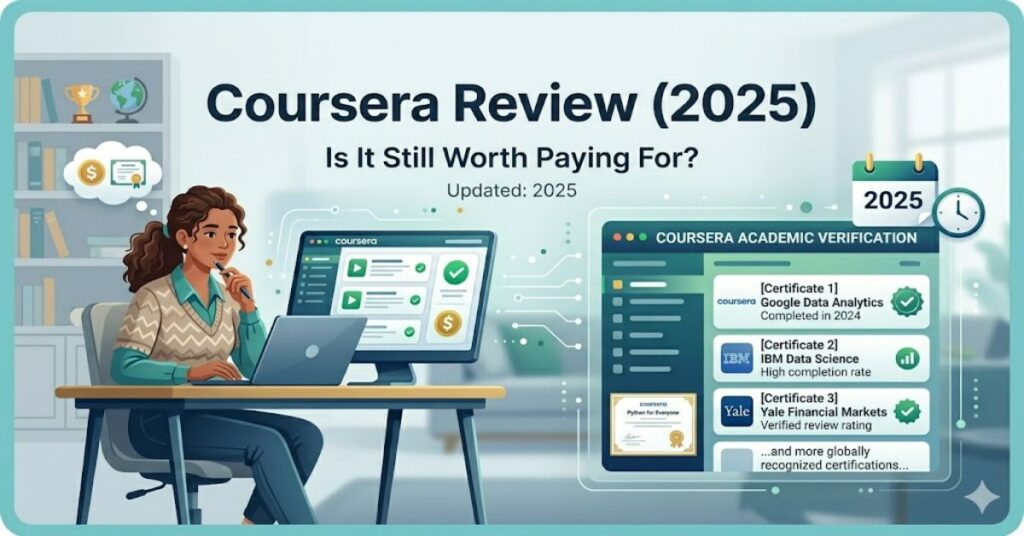
Anyone searching for a coursera review usually wants answers to three questions: Is the platform legitimate? Is it worth the money? And will employers actually value the certificates?
Coursera has evolved from a university-focused online course provider into one of the world’s largest digital education ecosystems. Founded in 2012 by Stanford professors Andrew Ng and Daphne Koller, the platform now hosts thousands of courses, professional certificates, guided projects, specializations, bachelor’s degrees, and master’s programs from leading institutions including Stanford University, Yale University, Google, IBM, Meta, Microsoft, and many others.
Unlike many low-cost learning marketplaces, Coursera positions itself as a bridge between academic education and workforce development. Its professional certificates target in-demand skills such as data analytics, cybersecurity, cloud computing, project management, artificial intelligence, and software engineering.
The platform’s appeal is simple: learners can access content created by respected universities and major employers at a fraction of traditional education costs.
However, reputation alone does not guarantee value. Completion rates, employer recognition, subscription pricing, and practical outcomes all matter.
This review examines how Coursera works, where it excels, where it struggles, and whether it deserves a place in your professional development strategy in 2025.
What Is Coursera?
Coursera is an online learning marketplace and education platform that partners with universities, corporations, and nonprofit organizations to deliver structured educational programs.
The platform offers:
- Individual courses
- Professional certificates
- Guided projects
- Specializations
- MasterTrack programs
- Online degrees
Unlike platforms primarily driven by independent instructors, much of Coursera’s content originates from recognized educational institutions and industry leaders.
This distinction is important because it influences perceived credential value and content quality.
How Coursera Works
The learning model combines recorded lectures, quizzes, assignments, peer-reviewed projects, and certificates.
Most courses follow a structured pathway:
- Enroll in a course.
- Watch lectures.
- Complete assessments.
- Pass graded assignments.
- Earn a certificate.
For professional certificates, learners complete multiple courses organized around a career skill set.
Examples include:
- Google Data Analytics Professional Certificate
- IBM Data Science Professional Certificate
- Meta Front-End Developer Certificate
- Google Cybersecurity Certificate
These programs often simulate workplace tasks rather than relying solely on theoretical instruction.
Coursera Pricing Breakdown
One reason Coursera attracts millions of learners is pricing flexibility.
| Plan Type | Typical Cost | Best For |
| Individual Course | Free to $99 | Casual learners |
| Guided Project | Around $10–$30 | Quick skill acquisition |
| Professional Certificate | Subscription model | Career development |
| Coursera Plus | Annual subscription | Frequent learners |
| Online Degrees | Thousands of dollars | Formal credentials |
Pricing varies by region and provider.
A learner pursuing multiple certificates often receives better value through Coursera Plus than paying for separate subscriptions.
Coursera vs Other Learning Platforms
| Feature | Coursera | Udemy | LinkedIn Learning |
| University Partnerships | Excellent | Limited | Moderate |
| Professional Certificates | Strong | Moderate | Strong |
| Degree Programs | Yes | No | No |
| Instructor Quality Control | High | Variable | High |
| Career-Oriented Content | Excellent | Good | Excellent |
| Free Learning Options | Available | Limited | Trial-based |
Coursera’s primary advantage is credential credibility.
Udemy often provides lower prices, while LinkedIn Learning integrates directly with professional networking.
Content Quality and Learning Experience
The strongest aspect of Coursera Review is course quality.
Because universities and corporations develop most programs, instructional design tends to be more structured than many competing platforms.
Strengths
- Academic rigor
- Clear learning objectives
- Professional assessments
- Industry-aligned skills
- Recognized instructors
Weaknesses
- Some courses become outdated
- Peer-reviewed assignments vary in quality
- Academic content can feel slower than bootcamp-style learning
The experience generally rewards learners seeking depth rather than speed.
Professional Certificates: The Biggest Value Driver
Professional certificates have become Coursera’s flagship product.
Google, IBM, Meta, Microsoft, and other organizations use the platform to create career-focused programs that teach practical workplace skills.
Why They Matter
Traditional degrees remain valuable, but employers increasingly prioritize demonstrated skills.
Professional certificates help bridge this gap.
Popular programs focus on:
- Data analytics
- Project management
- UX design
- Cybersecurity
- IT support
- Artificial intelligence
Many learners use these programs to transition careers without returning to university.
Real-World Career Impact
The effectiveness of any learning platform ultimately depends on outcomes.
Documented learner stories published by Coursera and participating organizations frequently highlight promotions, career transitions, and skill upgrades.
However, a certificate alone rarely secures employment.
Employers generally evaluate:
- Portfolio quality
- Practical projects
- Work experience
- Interview performance
- Communication skills
Certificates function best as supporting evidence rather than standalone qualifications.
Practical Observation
Recruiters often recognize major credentials from Google, IBM, or Meta more readily than certificates issued by unknown providers.
This gives Coursera a credibility advantage compared to many alternative platforms.
Hidden Advantages Most Reviews Miss
Many reviews focus only on certificates and pricing.
Several overlooked benefits deserve attention.
1. Structured Learning Reduces Decision Fatigue
A common problem in self-directed learning is course hopping.
Coursera’s specializations and certificates create a guided roadmap that reduces distractions.
2. Employer-Branded Programs Have Signaling Value
A Google or IBM credential carries stronger recognition than a generic online course certificate.
While not equivalent to employment experience, employer branding matters.
3. Degree Sampling Before Major Investment
Learners can experience university-level coursework before committing to expensive degree programs.
This lowers educational risk.
Risks and Trade-Offs
No platform is perfect.
Several limitations deserve careful consideration.
| Risk | Impact | Mitigation |
| Subscription Costs Accumulate | Medium | Set learning deadlines |
| Course Abandonment | High | Follow structured schedules |
| Outdated Content | Medium | Check recent reviews |
| Credential Overestimation | High | Build practical projects |
| Peer Assessment Quality | Low-Medium | Focus on instructor-led feedback |
The largest risk is paying for subscriptions while failing to complete programs.
Many learners underestimate the discipline required for self-paced education.
Market Impact and Industry Position
Coursera occupies a unique position between higher education and workforce training.
Several trends support its continued relevance:
- Rising tuition costs
- Demand for continuous upskilling
- Remote learning adoption
- AI-driven job transformation
- Employer emphasis on skills-based hiring
As labor markets evolve, short-form credentials and targeted learning pathways are becoming increasingly important.
Coursera benefits directly from this shift.
Structured Insight Table
| Evaluation Area | Rating (Out of 10) | Comments |
| Course Quality | 9 | Strong academic standards |
| Instructor Expertise | 9 | University and industry experts |
| Career Relevance | 9 | Excellent professional programs |
| User Experience | 8 | Generally intuitive |
| Pricing Value | 8 | Strong if courses are completed |
| Certificate Credibility | 8.5 | Above average industry recognition |
| Overall Score | 8.7 | One of the strongest learning platforms available |
The Future of Coursera in 2027
The future of Coursera will likely be shaped by three major developments.
AI-Powered Personalization
Artificial intelligence will increasingly customize learning pathways, assessment methods, and skill recommendations.
Skills-Based Hiring Expansion
Employers are placing greater emphasis on demonstrated competencies rather than degree credentials alone.
This trend supports professional certificate growth.
Hybrid Education Models
Universities continue exploring blended educational frameworks that combine traditional instruction with digital learning environments.
Coursera is well-positioned to support these initiatives.
However, competition is intensifying. Platforms such as LinkedIn Learning, Udacity, Skillshare, and emerging AI-powered learning systems are fighting for the same audience.
Whether Coursera maintains leadership will depend on content quality, employer partnerships, and continued innovation.
Key Takeaways
- Coursera Review offers some of the most credible online credentials available today.
- Professional certificates provide stronger employment signaling than many generic online courses.
- Learners gain the greatest value when pursuing structured programs rather than isolated classes.
- Subscription costs remain reasonable compared with traditional education.
- Practical projects matter more than certificates alone.
- University and employer partnerships continue to differentiate the platform.
- The rise of skills-based hiring strengthens Coursera’s long-term relevance.
Conclusion
This coursera review finds that the platform remains one of the strongest choices for learners seeking credible, career-focused education.
Its greatest strengths come from partnerships with respected universities and major employers. These relationships help maintain course quality while giving certificates more recognition than many competing platforms.
The platform is not a shortcut to employment. Success still depends on skill application, portfolio development, and consistent learning effort. Learners expecting a certificate alone to transform their careers may be disappointed.
For professionals looking to upgrade skills, switch industries, or gain structured training without committing to a traditional degree, Coursera continues to offer compelling value.
While pricing requires discipline and some content can become dated, the overall combination of educational quality, flexibility, and credential recognition makes it one of the most complete online learning ecosystems available today.
FAQ
Is Coursera worth paying for in 2025?
Yes. For learners pursuing professional certificates, specializations, or career-focused programs, Coursera offers strong value relative to cost.
Are Coursera certificates recognized by employers?
Many employers recognize certificates from major providers such as Google, IBM, Meta, and leading universities. Recognition varies by industry and role.
Is Coursera better than Udemy?
Coursera generally offers stronger credential credibility and academic rigor, while Udemy provides lower-cost and often more practical short-form courses.
Can I get a job with a Coursera certificate?
A certificate alone is rarely enough. Combining certificates with projects, portfolios, and practical experience significantly improves outcomes.
Does Coursera offer free courses?
Yes. Many courses can be audited for free, although graded assignments and certificates often require payment.
Is Coursera Plus worth it?
For learners planning to complete multiple certificates or courses annually, Coursera Plus frequently delivers better value than individual purchases.
Methodology
This Coursera Review was developed using publicly available information from Coursera, university partner documentation, employer-sponsored certificate programs, industry reports, and workforce development research.
The Coursera Review evaluated platform structure, pricing models, credential offerings, university partnerships, employer partnerships, and learner outcomes reported through official channels.
Limitations include the absence of independent access to internal learner completion data and employer hiring databases. Because career outcomes depend heavily on individual effort, certificates should be viewed as one factor among many influencing professional advancement.
A balanced assessment recognizes both the strengths of Coursera’s educational ecosystem and the reality that no online credential guarantees employment.
Editorial Disclosure: This article was drafted with AI assistance and reviewed and verified by [Author Name]. All data, citations, and claims should be independently confirmed by the editorial team at Postcard.fm before publication.
References
Coursera. (2025). Coursera for learners. https://www.coursera.org
Google. (2025). Google Career Certificates. https://grow.google
IBM. (2025). IBM SkillsBuild and professional learning resources. https://skillsbuild.org
Meta. (2025). Meta Career Programs. https://www.meta.com
World Economic Forum. (2025). Future of Jobs Report 2025. https://www.weforum.org
OECD. (2024). Skills Outlook. Organisation for Economic Co-operation and Development.