
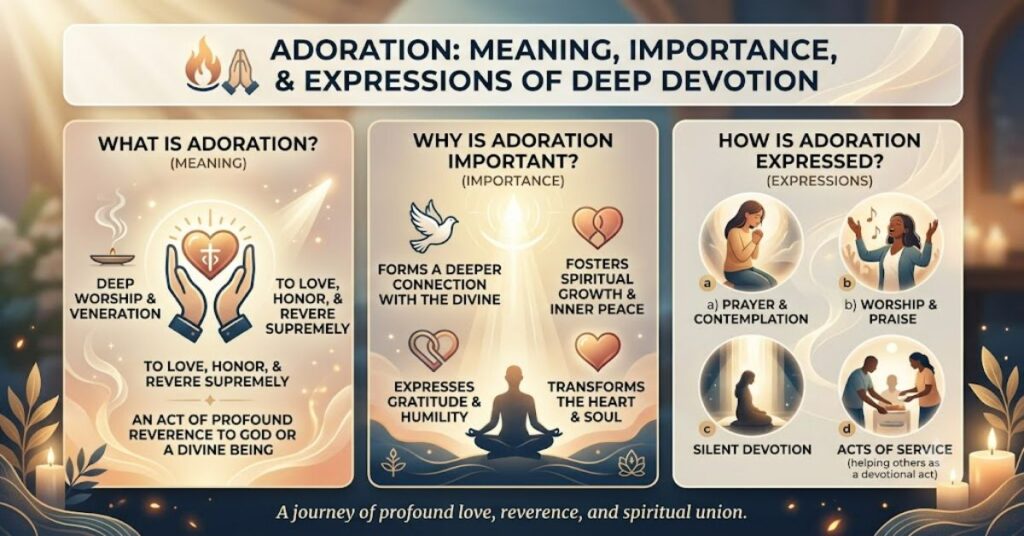
Adoration is a powerful word used to describe a deep and intense feeling of love, respect, or devotion. In everyday language, someone may adore a person, place, activity, or even a particular object because of the strong affection they feel towards it. In religious settings, however, the meaning becomes more specific. Adoration can describe the worship and profound reverence directed towards a divine being.
The word has roots in the Latin expression associated with honouring or praying to a divine being. This history helps explain why the term can carry both emotional and spiritual meanings.
Unlike ordinary appreciation, adoration suggests a much stronger response. A person who admires something may recognise its value or beauty, while someone who feels adoration experiences a deeper emotional attachment or reverence.
Understanding this distinction is useful because the word appears in several contexts. It can describe affection between people, admiration for someone’s qualities, artistic or cultural devotion, and religious practices centred on worship.
What Does Adoration Mean?
At its simplest, adoration means intense love, admiration, or reverence. It communicates a feeling that goes beyond ordinary liking.
In personal relationships, adoration may describe the strong affection someone feels towards a partner, child, family member, friend, or another important person. It can be expressed through words, attention, care, respect, and supportive behaviour.
The emotional side of adoration is often associated with appreciation. A person may adore someone because of their kindness, character, achievements, or the emotional connection they share.
In religious contexts, the word takes on a deeper meaning. Adoration is associated with worship and recognition of the greatness or holiness of a divine being.
Adoration and Religious Worship
Religious adoration is closely connected with reverence. It may involve prayer, silence, contemplation, ritual, music, or other forms of worship.
In traditions where adoration is directed towards God, the practice is not simply admiration. It represents a relationship between the worshipper and the divine. Humility is therefore an important element.
A person engaged in religious adoration may focus on the nature of God, express gratitude, seek spiritual connection, or simply remain in quiet contemplation.
Different religions and denominations understand worship in different ways, so the precise practice of adoratio’n varies across traditions. The underlying idea, however, is a profound recognition of something considered sacred or divine.
Adoration in Everyday Relationships
Outside religion, adoratio”n usually has a more personal meaning.
Parents may describe their feelings towards their children as adoratio’n. Partners may use the word to express deep affection and appreciation. People can also adore close friends whose presence has a meaningful influence on their lives.
This kind of affection is generally demonstrated through behaviour rather than words alone. Listening carefully, providing support, remembering important details, showing kindness, and celebrating another person’s achievements can all communicate deep affection.
| Context | Meaning of Adoration | Common Expression |
| Romantic relationship | Deep affection and admiration | Care, praise and attention |
| Family | Powerful emotional attachment | Support and protection |
| Friendship | Strong appreciation and affection | Loyalty and encouragement |
| Religion | Reverence and worship | Prayer and contemplation |
| Culture or art | Intense admiration | Appreciation and devotion |
Adoration vs. Admiration
Adoratio’n and admiration are related, but they are not identical.
Admiration generally means recognising and appreciating someone’s qualities, abilities, appearance, achievements, or character. A person can admire a successful athlete without feeling personally connected to them.
Adoration usually suggests a stronger emotional response. It can involve affection, devotion, reverence, or love in addition to admiration.
This difference can be understood through intensity. Admiration may be based primarily on appreciation, while adoration often combines appreciation with a deeper emotional or spiritual attachment.
How Is Adoration Expressed?
Adoration does not have one universal form. Its expression depends on the relationship and context.
In personal life, it may appear through affection, thoughtful gestures, compliments, emotional support, or simply spending meaningful time with someone.
In religious life, it may involve prayer, worship services, meditation, silence, sacred music, or rituals. The outward form can differ considerably between religious communities.
The important element is the underlying attitude. Adoration involves giving significant emotional or spiritual attention to someone or something considered deeply valuable.
The Cultural Meaning of Adoration
The idea of adoratio’n has played a role in literature, art, music, and religious history for centuries. Artists have often used visual representations of worshippers, saints, sacred figures, and moments of reverence to communicate devotion.
In secular culture, the word has also developed a lighter meaning. Someone might say they “adore” a particular film, food, musician, or hobby. In these situations, adoratio’n is usually an emphatic way of expressing enthusiasm rather than literal worship.
This demonstrates how language changes according to context. The same word can communicate profound religious devotion in one situation and strong personal enthusiasm in another.
Three Important Insights About Adoration
Intensity matters: Adoratio’n generally communicates a stronger emotional response than ordinary appreciation or liking.
Context changes meaning: The word can describe romantic affection, family love, cultural enthusiasm, or religious worship.
Expression is personal: Adoratio’n may be shown through speech, actions, prayer, contemplation, care, or other forms of attention depending on the situation.
The Future of Adoration in 2027
The concept of adoratio’n is unlikely to disappear because it addresses a basic human experience: the desire to express profound affection, admiration, and reverence.
By 2027, the ways people communicate these feelings may continue to change as relationships increasingly involve digital communication. Messages, photographs, online communities, and virtual spaces can all provide new ways for people to express affection or shared devotion.
Religious expressions will continue to depend on individual traditions and communities. At the same time, secular uses of the word are likely to remain common in everyday language.
The important distinction will continue to be context. Digital expressions of enthusiasm may use the language of adoration casually, while religious traditions may preserve its deeper meaning of worship and reverence.
Key Takeaways
- Adoration is stronger than ordinary appreciation.
- It can describe both emotional affection and religious reverence.
- Religious adoration is closely associated with worship and humility.
- Personal adoration can be expressed through care, respect, attention, and support.
- Admiration and adoration overlap but differ in emotional intensity.
- Cultural context strongly influences how the word is understood.
Conclusion
Adoration represents one of the strongest ways language can describe affection, admiration, and reverence. Its meaning changes according to context, but the central idea remains a profound appreciation for someone or something considered deeply valuable.
In personal relationships, adoration can express powerful love and emotional attachment. In religious settings, it can refer to worship and reverence directed towards the divine. In everyday speech, the word may simply communicate an especially strong enthusiasm for a person, activity, or object.
Understanding these different uses helps explain why adoration remains such a versatile word. Whether expressed through affection, respect, prayer, contemplation, or enthusiastic appreciation, it describes a feeling that goes well beyond ordinary liking.
FAQ
What is the simple meaning of adoration?
Adoration means a deep and intense feeling of love, respect, admiration, or devotion towards someone or something.
What does adoration mean in religion?
In religion, adoration generally refers to profound reverence or worship directed towards a divine being. It may involve prayer, contemplation, ritual, or other forms of worship.
Is adoration stronger than admiration?
Generally, yes. Admiration involves recognising someone’s qualities or achievements, while adoratio’n usually suggests a deeper emotional attachment, love, devotion, or reverence.
Can you feel adoration for a person?
Yes. People can experience adoratio’n for romantic partners, family members, friends, children, or other people they deeply value.
What is an example of adoratio’n?
A person showing deep affection for a partner through consistent care, respect, appreciation, and emotional support could be described as expressing adoratio’n.
What is the difference between love and adoratio’n?
Love is a broad emotional experience that can include affection, attachment, care, and commitment. Adoratio’n often emphasises intense admiration, reverence, or devotion within that emotional experience.
Methodology
This article was developed from the supplied editorial brief, which defines adoratio’n as a deep and intense feeling of love, respect, or religious worship. The discussion follows that framing and distinguishes personal affection from religious reverence without claiming firsthand research or invented observations.
Because the supplied material provides a definition and editorial requirements rather than detailed historical research, broader historical or religious claims have been kept general. A human editor should verify any specialised theological, historical, or linguistic claims before publication.
Editorial disclosure: This article was drafted with AI assistance and should be reviewed by a human editor before publication.