
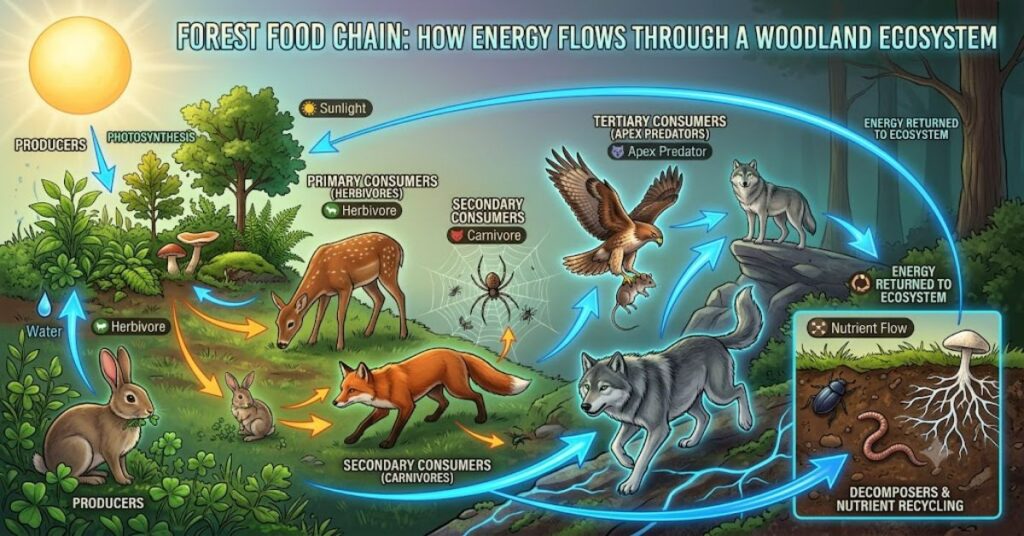
The forest food chain is one of the simplest ways to understand how life is connected in a woodland ecosystem. It describes the flow of energy and nutrients from one organism to another, beginning with plants that capture sunlight through photosynthesis and ending with decomposers that return nutrients to the soil. Every plant, insect, bird, mammal, fungus, and microorganism contributes to this continuous cycle.
Although a food chain appears straightforward, forests are among the most complex ecosystems on Earth. A single oak tree may support hundreds of insects, dozens of bird species, squirrels, fungi, and countless microorganisms. Each organism depends on others for food, shelter, or survival. When one link is removed, the effects can spread throughout the ecosystem.
Understanding forest food chains helps students, nature enthusiasts, and conservationists appreciate how forests function and why biodiversity matters. From towering trees to microscopic fungi, every living thing plays a role in maintaining ecological balance. This guide explores each level of the forest food chain, provides practical examples, compares food chains with food webs, examines threats, and explains why protecting forests protects the entire cycle of life.
What Is a Forest Food Chain?
A forest food chain is a linear sequence showing how energy passes from one organism to another.
It begins with producers that create food using sunlight and continues through several levels of consumers before ending with decomposers that recycle nutrients.
Unlike isolated organisms, every species depends on others for survival.
A simple forest food chain looks like this:
Sun → Tree → Caterpillar → Bird → Hawk → Decomposers
Each organism transfers energy to the next.
The Main Levels of a Forest Food Chain
Producers
Producers form the foundation of every forest ecosystem.
These include:
- Trees
- Shrubs
- Mosses
- Ferns
- Wildflowers
- Grasses
Through photosynthesis, producers convert sunlight into chemical energy that supports every higher level.
Without producers, no forest food chain could exist.
Primary Consumers
Primary consumers eat plants.
Common herbivores include:
- Deer
- Rabbits
- Caterpillars
- Grasshoppers
- Squirrels
- Snails
These animals transfer plant energy to predators higher in the chain.
Secondary Consumers
Secondary consumers feed on herbivores.
Examples include:
- Frogs
- Foxes
- Woodpeckers
- Snakes
- Owls
- Small wild cats
Many are omnivores, eating both plants and animals depending on seasonal availability.
Tertiary Consumers and Apex Predators
These animals occupy the highest levels of the food chain.
Examples include:
- Wolves
- Eagles
- Hawks
- Lynx
- Bears (in some ecosystems)
Because few animals hunt them, they help regulate prey populations and maintain ecological balance.
Decomposers
When plants and animals die, decomposers recycle nutrients.
Examples include:
- Mushrooms
- Fungi
- Earthworms
- Beetles
- Bacteria
- Soil microbes
Without decomposers, forests would quickly fill with dead organic matter, and essential nutrients would not return to the soil.
Forest Food Chain Example
Consider a temperate forest.
Sunlight → Oak Tree → Caterpillar → Robin → Hawk → Fungi
Here’s how energy flows:
- The oak tree captures sunlight.
- A caterpillar eats its leaves.
- A robin feeds on the caterpillar.
- A hawk hunts the robin.
- Fungi decompose the remains, returning nutrients to the soil.
This process repeats continuously throughout the forest.
Forest Food Chain vs. Forest Food Web
Although people often use the terms interchangeably, they are different.
| Feature | Food Chain | Food Web |
| Structure | Single pathway | Multiple interconnected pathways |
| Complexity | Simple | Complex |
| Organisms | One feeding sequence | Many feeding relationships |
| Stability | More vulnerable | More resilient |
| Example | Grass → Rabbit → Fox | Multiple linked chains |
Food webs provide a more realistic representation because most animals consume more than one food source.
Energy Flow in Forest Ecosystems
Only a small portion of energy transfers between trophic levels.
Scientists often describe this using the “10% Rule.”
For example:
- Plants capture sunlight.
- Herbivores receive about 10% of plant energy.
- Carnivores receive roughly 10% of herbivore energy.
- Apex predators receive even less.
Most energy is lost through movement, respiration, and heat.
This explains why forests contain many plants but relatively few top predators.
Common Forest Food Chains Around the World
Temperate Forest
Grass → Rabbit → Fox
Tropical Rainforest
Fruit Tree → Monkey → Jaguar
Boreal Forest
Pine Tree → Hare → Lynx
Mixed Woodland
Oak Leaves → Caterpillar → Blue Jay → Hawk
Different forests support different organisms, but the overall flow of energy remains the same.
Why Forest Food Chains Matter
Healthy food chains provide important ecological benefits.
These include:
- Population control
- Nutrient recycling
- Biodiversity conservation
- Soil fertility
- Pollination support
- Seed dispersal
- Ecosystem stability
Even small organisms contribute significantly to overall forest health.
Human Impact on Forest Food Chains
Human activity can disrupt natural relationships.
Major threats include:
- Deforestation
- Climate change
- Pollution
- Habitat fragmentation
- Invasive species
- Wildfires
- Illegal hunting
For example, removing apex predators often causes herbivore populations to increase rapidly, leading to overgrazing and reduced forest regeneration.
Conservation Strategies
Protecting forest food chains requires preserving entire ecosystems rather than individual species.
Effective conservation measures include:
- Sustainable forestry
- Protected wildlife reserves
- Reforestation
- Wildlife corridors
- Pollution reduction
- Invasive species management
- Environmental education
Healthy forests support both wildlife and human communities.
Comparison of Forest Organisms
| Level | Role | Examples |
| Producer | Makes food | Trees, grasses, shrubs |
| Primary Consumer | Eats plants | Deer, rabbits, insects |
| Secondary Consumer | Eats herbivores | Foxes, snakes, owls |
| Apex Predator | Controls populations | Wolves, hawks, eagles |
| Decomposer | Recycles nutrients | Fungi, bacteria, worms |
Real-World Importance
Forest ecosystems regulate climate, store carbon, protect water resources, and support countless species. The food chain is not merely an academic concept—it influences agriculture, forestry, biodiversity conservation, and even human health. Scientists often monitor changes in food chains to detect environmental problems before they become severe.
Risks and Trade-Offs
Forest ecosystems are remarkably resilient, but they have limits.
Some challenges include:
- Slow recovery after habitat destruction.
- Reduced biodiversity from monoculture plantations.
- Increased vulnerability to invasive pests.
- Changing predator-prey relationships caused by climate shifts.
Conservation efforts must balance economic development with long-term ecosystem health.
The Future of Forest Food Chains in 2027
By 2027, advances in satellite monitoring, environmental DNA (eDNA), artificial intelligence, and wildlife tracking are expected to improve scientists’ understanding of forest ecosystems. These technologies will help identify disruptions earlier and guide restoration efforts more effectively. However, continued climate change, expanding urban development, and increasing wildfire frequency remain significant challenges. The future health of forest food chains will depend on sustainable land management, biodiversity conservation, and international cooperation to protect natural habitats.
Key Takeaways
- Forest food chains begin with producers and end with decomposers.
- Every organism contributes to ecosystem stability.
- Food chains are simpler than food webs but help explain energy transfer.
- Apex predators regulate prey populations.
- Decomposers recycle nutrients essential for plant growth.
- Human activities can disrupt ecological balance.
- Conservation protects both wildlife and ecosystem services.
Conclusion
The forest food chain illustrates one of nature’s most remarkable systems: the continuous movement of energy through living organisms. From plants capturing sunlight to decomposers returning nutrients to the soil, every stage plays an essential role in sustaining life. While individual food chains appear simple, they form part of larger food webs that create resilient and diverse forest ecosystems.
Understanding these relationships helps explain why protecting forests involves much more than preserving trees alone. Healthy populations of insects, birds, mammals, fungi, and microorganisms are equally important. As environmental pressures continue to grow, conserving complete ecosystems will remain one of the most effective ways to maintain biodiversity and ensure forests continue providing food, clean water, climate regulation, and habitat for future generations.
Frequently Asked Questions
What is a forest food chain?
A forest food chain is a sequence showing how energy moves from producers to consumers and finally to decomposers within a forest ecosystem.
What is the first level of a forest food chain?
The first level consists of producers such as trees, grasses, mosses, and shrubs that create food through photosynthesis.
What is the difference between a food chain and a food web?
A food chain shows one pathway of energy transfer, while a food web connects many feeding relationships within an ecosystem.
Why are decomposers important?
Decomposers break down dead plants and animals, returning nutrients to the soil where they can be reused by producers.
Who are the apex predators in a forest?
Depending on the ecosystem, apex predators include wolves, eagles, hawks, bears, and lynx.
How does deforestation affect forest food chains?
Deforestation removes habitats and food sources, disrupting predator-prey relationships, reducing biodiversity, and weakening the entire ecosystem.