
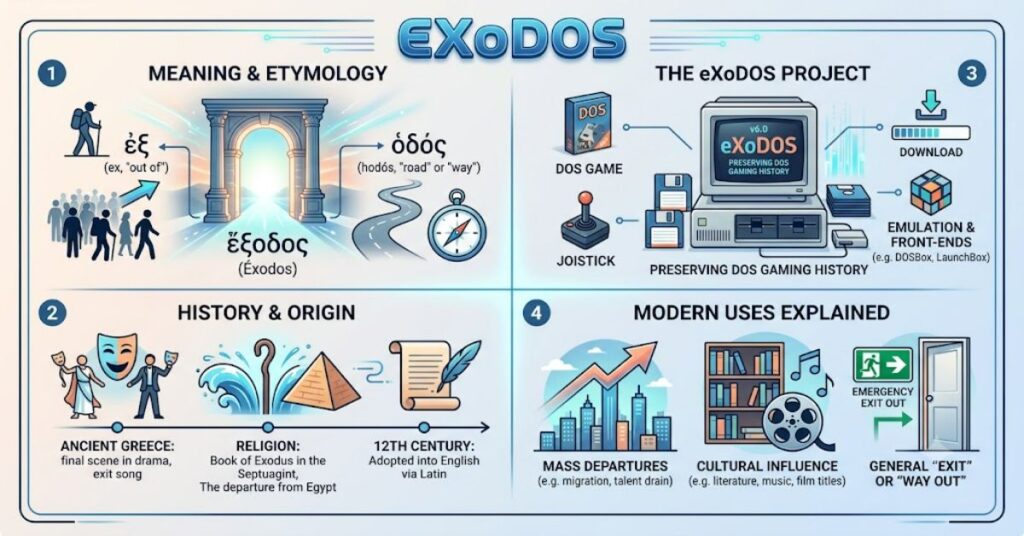
The term exodos can be confusing because it carries different meanings across history, literature, and technology. In modern online discussions, it most commonly refers to eXoDOS, a community-driven preservation project that archives thousands of classic DOS games and makes them easier to run on modern computers. Outside gaming, however, the word has much older roots. Derived from Ancient Greek, “exodos” literally means “way out,” “departure,” or “exit,” and it traditionally described the concluding section of a Greek tragedy after the chorus made its final appearance.
As digital preservation becomes increasingly important, eXoDOS has gained recognition among retro gaming enthusiasts for protecting software that might otherwise disappear. At the same time, historians and literature students continue encountering the term in discussions of classical drama and ancient language.
This guide explains the meaning of Exodos in each major context, explores the origins of the eXoDOS project, compares it with other preservation efforts, examines its cultural impact, and discusses what the future may hold for digital preservation.
What Does Exodos Mean?
The word “Exodos” originates from Ancient Greek.
Its literal meaning includes:
- Exit
- Departure
- Going out
- Final scene
Historically, it referred to the concluding portion of a Greek play after the chorus exited the stage.
Today, the spelling eXoDOS has become strongly associated with retro PC gaming preservation.
The eXoDOS Preservation Project
The best-known modern meaning of Exodos is eXoDOS, a large-scale preservation project dedicated to DOS games.
Its primary goals include:
- Preserving classic PC games
- Simplifying game installation
- Configuring DOSBox automatically
- Documenting software history
- Preventing abandoned titles from disappearing
Instead of requiring users to manually configure legacy software, eXoDOS packages games with the settings needed to run on modern systems.
This has made thousands of classic titles accessible to new generations of players.
Why eXoDOS Was Created
Running DOS software has become increasingly difficult because modern operating systems no longer support many legacy technologies.
Challenges include:
- Missing drivers
- Hardware incompatibility
- Audio configuration
- Graphics emulation
- Manual DOSBox setup
The eXoDOS project addresses these issues by creating standardized packages that include launchers, metadata, screenshots, manuals, and emulator configurations.
Key Features of eXoDOS
Some of the project’s defining characteristics include:
- Thousands of preserved DOS games
- Automated configuration
- Built-in DOSBox compatibility
- Game manuals and documentation
- Metadata organization
- Searchable launcher interface
- Community-maintained updates
The emphasis is on preservation rather than simply collecting software.
Exodos in Ancient Literature
Long before computers existed, Exodo’s was an important literary term.
In classical Greek drama, plays generally followed several stages:
- Prologue
- Parodos
- Episodes
- Stasima
- Exodo’s
The Exodo’s concluded the story, resolving the central conflict and delivering the final dramatic message.
This structure influenced Western theater for centuries.
Why Digital Preservation Matters
Software disappears surprisingly quickly.
Common reasons include:
- Physical media degradation
- Lost source code
- Hardware obsolescence
- Copyright uncertainty
- Unsupported operating systems
Without preservation projects, many historically significant PC games would become inaccessible despite their cultural importance.
eXoDOS Compared with Other Preservation Approaches
| Feature | eXoDOS | Typical Emulator Collection |
| Automatic setup | Yes | Often manual |
| Metadata included | Extensive | Limited |
| Manuals included | Frequently | Rare |
| DOSBox configuration | Preconfigured | User configured |
| Focus | Preservation | Gameplay only |
The project’s emphasis extends beyond simply launching games—it aims to preserve historical context.
Benefits for Retro Gaming Enthusiasts
The project offers several advantages.
Accessibility
Users spend less time troubleshooting.
Historical Preservation
Manuals, artwork, and documentation remain available.
Educational Value
Researchers can study software history more easily.
Community Collaboration
Volunteers continually improve compatibility and organization.
Challenges and Limitations
Despite its success, eXoDO’S faces several practical issues.
- Large storage requirements
- Ongoing maintenance
- Compatibility testing
- Copyright complexities
- Continuous updates
Preserving software also requires balancing historical access with intellectual property rights.
Real-World Impact
Digital preservation projects like eXoDO’S have become increasingly important as computing history matures. Universities, museums, researchers, and gaming historians frequently reference preserved software collections when studying the evolution of personal computing, game design, and digital culture. Beyond nostalgia, these archives provide valuable insight into programming techniques, interface design, and technological progress from the DOS era.
Data Overview
| Aspect | Importance |
| Software Preservation | Protects digital history |
| Emulator Configuration | Improves accessibility |
| Documentation | Preserves historical context |
| Community Contributions | Ensures long-term updates |
| Metadata | Simplifies discovery |
| Compatibility | Supports modern operating systems |
Risks and Trade-Offs
Digital preservation involves more than technical work.
Important considerations include:
- Long-term storage costs
- Copyright ownership questions
- Maintaining software authenticity
- Emulator accuracy
- Sustainability of volunteer projects
These challenges require collaboration between preservation communities, developers, historians, and rights holders.
The Future of Exodos in 2027
By 2027, digital preservation is expected to become even more important as additional software platforms reach legacy status. Improved emulation technologies, artificial intelligence for metadata organization, and stronger partnerships between preservation communities and cultural institutions may enhance projects like eXoDO’S. At the same time, legal questions surrounding abandoned software and copyright are likely to remain unresolved in many jurisdictions. The long-term success of preservation initiatives will depend on continued community support and responsible archival practices.
Key Takeaways
- Exodo’s has both ancient literary and modern technological meanings.
- eXoDOS focuses on preserving DOS-era PC games.
- Automated configuration makes classic software easier to use.
- Preservation includes documentation as well as executable files.
- Digital archiving protects computing history for researchers and players.
- Copyright considerations remain one of the biggest ongoing challenges.
Conclusion
Exodos is a fascinating example of how a single word can connect ancient history with modern technology. Its origins in Greek literature symbolize an ending or departure, while its contemporary association with eXoDOS reflects a commitment to preserving the beginnings of personal computer gaming. By making thousands of DOS titles accessible on current hardware, the project has become an important resource for players, historians, educators, and preservationists alike.
As digital media continues to replace physical formats, initiatives like eXoDOS demonstrate that preserving software is about more than nostalgia. It safeguards creative work, technological innovation, and cultural history for future generations. Whether encountered in a classroom discussing Greek drama or in a retro gaming forum, the term Exodos continues to represent transitions—both from the past and toward the future.
Frequently Asked Questions
What does Exodos mean?
Exodos is an Ancient Greek word meaning “departure,” “exit,” or “way out.” In literature, it refers to the concluding section of a Greek tragedy.
What is eXoDOS?
eXoDOS is a community-driven project that preserves thousands of DOS games by packaging them with emulators, documentation, and preconfigured settings for modern computers.
Is eXoDOS legal?
The project exists in a complex legal area because copyright ownership varies by game. Users should review the licensing status of individual titles before downloading or distributing them.
How is eXoDOS different from DOSBox?
DOSBox is an emulator that recreates a DOS environment. eXoDOS is a preservation project that uses DOSBox while also providing game files, metadata, documentation, and ready-to-run configurations.
Why is software preservation important?
Digital preservation protects historically significant software from being lost due to obsolete hardware, damaged media, or unsupported operating systems.
Does Exodos only refer to gaming?
No. The term also has historical, literary, and linguistic meanings dating back to Ancient Greece, where it described the final section of a theatrical performance.