
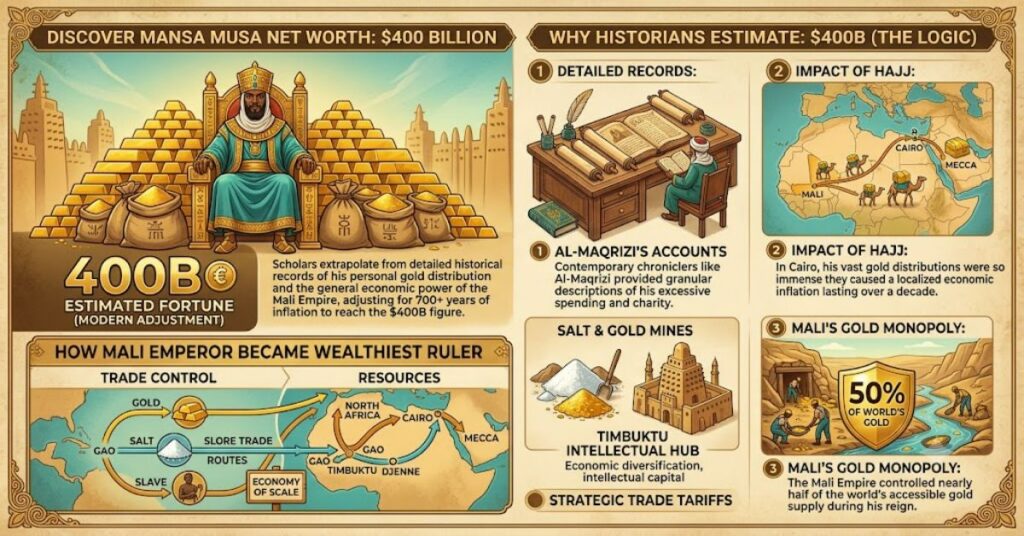
When people search for mansa musa net worth, they usually want to know whether he truly was the richest person in history. While there is no precise way to convert a 14th-century emperor’s wealth into modern dollars, historians and economists generally agree that Mansa Musa possessed a fortune unmatched by almost any other historical figure. Many modern estimates place his wealth at around $400 billion in today’s currency, although this figure should be viewed as an approximation rather than an exact valuation.
As the ruler of the Mali Empire from approximately 1312 to 1337, Mansa Musa controlled one of the world’s largest producers of gold. Combined with lucrative salt trade routes and a thriving trans-Saharan economy, his empire generated immense wealth that funded infrastructure, education, religion, and commerce.
His famous pilgrimage to Mecca became one of the most extraordinary journeys in recorded history, not only because of its scale but also because the vast amounts of gold distributed along the route affected regional economies for years afterward. Understanding his wealth requires looking beyond simple numbers and examining the economic power of the empire he ruled.
Who Was Mansa Musa?
Mansa Musa, also known as Musa I of Mali, ruled the Mali Empire during its Golden Age.
Stretching across much of present-day Mali, Senegal, Guinea, Niger, and neighboring regions, the empire became one of the largest and wealthiest states in medieval Africa. Its prosperity was built on control of major trade routes connecting West Africa with North Africa and the Mediterranean.
Besides expanding his empire, Mansa Musa invested heavily in education, Islamic scholarship, architecture, and trade, helping cities such as Timbuktu become internationally respected centers of learning.
How Did Mansa Musa Become So Wealthy?
His immense fortune came from the natural and commercial resources under his control rather than personal business ventures.
| Source of Wealth | Contribution |
| Gold Mines | Mali controlled many of the world’s richest known gold deposits. |
| Salt Trade | Salt was a valuable commodity often exchanged for gold. |
| Trade Taxes | Merchants paid taxes on goods moving through the empire. |
| Agriculture | Productive farmland supported a large population and economy. |
| Political Control | Centralized rule allowed efficient management of resources. |
Unlike many modern billionaires, Mansa Musa’s wealth represented the economic strength of an entire empire.
Why Is His Net Worth Estimated at $400 Billion?
Unlike modern fortunes based on company shares or bank accounts, medieval wealth cannot be measured precisely.
Historians estimate Mansa Musa’s fortune by considering:
- The value of gold production under Mali’s control.
- Revenue from trans-Saharan trade.
- Historical records describing his spending.
- The size and influence of the empire.
The commonly cited $400 billion estimate serves as a modern comparison rather than a documented financial statement.
Insight: The estimate illustrates his extraordinary purchasing power more effectively than suggesting he literally possessed billions of dollars in cash or gold.
The Famous Pilgrimage to Mecca
In 1324, Mansa Musa traveled to Mecca on the Islamic pilgrimage known as the Hajj.
According to historical accounts, his caravan included thousands of attendants, soldiers, servants, and camels carrying large quantities of gold.
During the journey he generously donated gold to communities along the route and rewarded merchants, scholars, and religious leaders.
Although these gifts enhanced his reputation, they also had unexpected economic consequences.
Economic Impact of His Wealth
| Event | Historical Impact |
| Pilgrimage to Mecca | Increased international awareness of the Mali Empire. |
| Large Gold Donations | Reduced the value of gold in Cairo for several years. |
| Investment in Timbuktu | Expanded education, libraries, and Islamic scholarship. |
| Trade Expansion | Strengthened commercial links across Africa and the Middle East. |
Modern historians often describe this pilgrimage as one of history’s greatest displays of personal wealth.
Why Historians Cannot Calculate His Exact Fortune
Several factors make precise calculations impossible.
- No complete financial records survive.
- Medieval economies differed greatly from today’s markets.
- Gold prices have changed dramatically over centuries.
- Much of his wealth consisted of land, trade networks, and political authority rather than liquid assets.
For these reasons, estimates vary, but nearly all place him among the richest individuals ever documented.
Comparing Mansa Musa to Modern Billionaires
| Figure | Estimated Wealth | Primary Source of Wealth |
| Mansa Musa | ~$400 billion (estimated) | Empire, gold, trade |
| Elon Musk* | Varies with market value | Technology companies |
| Jeff Bezos* | Varies with market value | E-commerce and cloud computing |
| Bernard Arnault* | Varies with market value | Luxury goods |
*Modern fortunes fluctuate with financial markets, while Mansa Musa’s wealth represented sovereign control over natural resources and trade.
The Future of Mansa Musa’s Legacy in 2027
Interest in Mansa Musa continues to grow as historians and educators highlight the achievements of pre-colonial African civilizations. By 2027, digital archives, museum projects, and academic research are expected to make more historical sources accessible to the public.
While no new evidence is likely to produce an exact valuation of his fortune, scholarship increasingly focuses on his broader legacy—economic leadership, educational investment, and the global significance of the Mali Empire—rather than a single dollar figure.
Key Takeaways
- Mansa Musa is widely regarded as the wealthiest ruler in recorded history.
- The often-cited $400 billion figure is a modern estimate, not a documented balance sheet.
- His wealth came from gold production, salt trade, taxation, and imperial control.
- His pilgrimage to Mecca became one of history’s most famous displays of wealth.
- His investments helped make Timbuktu a major center of education and scholarship.
- His historical significance extends far beyond estimates of personal wealth.
Conclusion
The fascination with mansa musa net worth stems from more than the enormous figures attached to his name. His story represents the remarkable economic strength of the Mali Empire during the 14th century and challenges common assumptions about medieval history. Although historians cannot calculate his fortune with mathematical precision, the consensus is clear: Mansa Musa controlled extraordinary wealth that surpassed nearly every ruler before or since.
More importantly, his legacy was defined not only by riches but also by how he used them. Through investments in education, religion, trade, and infrastructure, he transformed his empire into one of the world’s leading centers of commerce and learning. Whether the true equivalent of his fortune was $400 billion or another amount, his influence on history remains immeasurable.
Frequently Asked Questions
What was Mansa Musa net worth?
Most historians estimate Mansa Musa’s wealth at roughly $400 billion in today’s money, although no exact calculation is possible.
Was Mansa Musa richer than today’s billionaires?
Many historians believe so because he controlled the vast natural resources and economic output of the Mali Empire, making direct comparisons with modern billionaires difficult.
How did Mansa Musa become wealthy?
His wealth came from gold mines, salt trade, taxes on commerce, agriculture, and control of important trans-Saharan trade routes.
Why is the $400 billion estimate uncertain?
There are no surviving financial records from the 14th century, and converting medieval wealth into modern currency involves many assumptions.
Why is Mansa Musa still famous today?
He is remembered for his immense wealth, his historic pilgrimage to Mecca, and his contributions to education, trade, and the development of Timbuktu.
Methodology
This article Mansa Musa net worth synthesizes information from historical scholarship, museum publications, and academic references on the Mali Empire and Mansa Musa’s reign. Because no complete financial records from the 14th century exist, modern wealth estimates are based on historical accounts, the empire’s economic output, and comparative analysis rather than exact calculations. The analysis acknowledges this limitation and distinguishes between documented historical facts and modern approximations.
References
Encyclopaedia Britannica. (2024). Mansa Musa. https://www.britannica.com/biography/Mansa-Musa
Metropolitan Museum of Art. (2023). The Mali Empire and Mansa Musa. https://www.metmuseum.org/
National Geographic. (2023). Mansa Musa: The richest person in history? https://www.nationalgeographic.com/
UNESCO World Heritage Centre. (2024). Timbuktu. https://whc.unesco.org/