If you’ve ever wondered what emotionally unavailable means, you’re not alone. The term is often used to describe someone who struggles to express feelings, avoids emotional intimacy, or finds it difficult to commit to meaningful relationships. While emotional distance can sometimes appear intentional, it is frequently rooted in past experiences, learned coping mechanisms, or fear of vulnerability rather than a lack of affection.
Being emotionally unavailable doesn’t automatically make someone uncaring or incapable of love. Instead, it often reflects challenges with trust, communication, or emotional regulation. Some people become emotionally distant after painful relationships, childhood experiences, or prolonged stress, while others simply have never learned healthy ways to express emotions.
Understanding emotional availability is important because it influences romantic relationships, friendships, family dynamics, and even workplace communication. Recognizing the signs can help individuals develop healthier boundaries, improve communication, and make more informed decisions about their relationships.
What Does Emotionally Unavailable Mean?
An emotionally unavailable person has difficulty sharing emotions, accepting emotional closeness, or responding consistently to another person’s emotional needs.
This can appear in different ways:
- Avoiding vulnerable conversations.
- Struggling to express affection.
- Keeping relationships superficial.
- Pulling away during emotional conflict.
- Avoiding long-term commitment.
Emotional unavailability exists on a spectrum. Some people experience it temporarily after major life events, while others develop long-term patterns that require intentional personal growth.
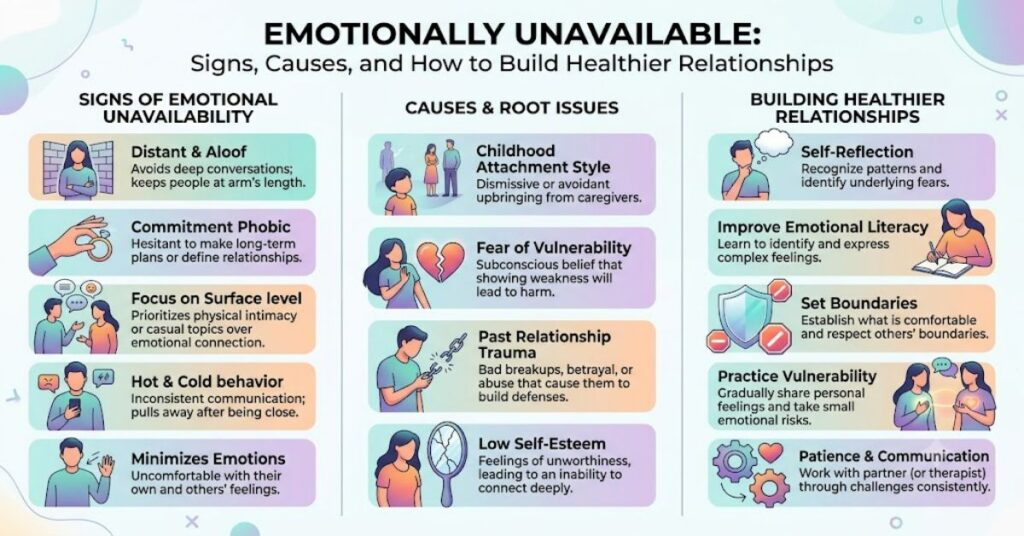
Common Signs of Emotional Unavailability
| Sign | What It May Look Like |
| Avoids vulnerability | Changes the subject when conversations become emotional. |
| Fear of commitment | Hesitates to define or deepen relationships. |
| Limited emotional expression | Rarely discusses personal feelings. |
| Inconsistent communication | Alternates between closeness and distance. |
| Discomfort with intimacy | Keeps emotional or physical distance despite affection. |
No single behavior confirms emotional unavailability, but repeated patterns often indicate deeper emotional barriers.
Why Do People Become Emotionally Unavailable?
Several psychological and life experiences may contribute to emotional distance.
Common causes include:
- Childhood attachment experiences.
- Fear of rejection or abandonment.
- Previous relationship trauma.
- Chronic stress or burnout.
- Depression or anxiety.
- Difficulty identifying or expressing emotions.
In many cases, emotional distance develops as a protective strategy. Avoiding vulnerability can temporarily reduce emotional pain, even though it may also limit healthy relationships.
Emotional Unavailability vs. Healthy Independence
Being emotionally unavailable is not the same as valuing personal space.
| Healthy Independence | Emotional Unavailability |
| Communicates openly | Avoids emotional discussions |
| Sets respectful boundaries | Creates emotional distance |
| Enjoys alone time | Uses distance to avoid intimacy |
| Handles conflict constructively | Withdraws during conflict |
| Builds trust gradually | Resists emotional closeness |
This distinction is important because independence supports healthy relationships, while emotional avoidance often creates misunderstanding and frustration.
How Emotional Unavailability Affects Relationships
Relationships depend on trust, communication, and emotional responsiveness.
When one partner consistently avoids emotional connection, the other may experience:
- Uncertainty about the relationship.
- Difficulty resolving conflicts.
- Feelings of loneliness.
- Reduced trust.
- Emotional exhaustion.
Over time, these patterns can weaken even otherwise compatible relationships.
Insight: Emotional unavailability often creates a cycle where one person seeks more connection while the other withdraws, increasing frustration for both individuals rather than resolving the underlying issue.
Can Someone Become More Emotionally Available?
Yes. Emotional availability is a skill that many people can strengthen through self-awareness and practice.
Helpful approaches include:
- Learning to identify emotions.
- Practicing honest communication.
- Building trust gradually.
- Reflecting on past relationship patterns.
- Seeking professional counseling when needed.
Personal growth usually happens gradually rather than through dramatic change.
Risks of Mislabeling Someone
The phrase “emotionally unavailable” is sometimes applied too quickly.
Someone may appear emotionally distant because they are:
- Grieving.
- Managing work-related stress.
- Recovering from illness.
- Processing a recent breakup.
- Naturally reserved but emotionally healthy.
Understanding the broader context helps avoid unfair assumptions.
The Future of Emotional Well-Being in 2027
Awareness of emotional health continues to grow through mental health education, workplace wellness initiatives, and greater public discussion of attachment styles and healthy communication.
By 2027, experts expect emotional intelligence training, relationship education, and digital mental health resources to become even more accessible. While technology can support self-reflection, mental health professionals emphasize that meaningful emotional growth still depends on real-life communication, trust, and supportive relationships.
Key Takeaways
- Emotional unavailability involves difficulty forming or maintaining emotional intimacy.
- Past experiences often influence emotional distance.
- Healthy independence differs from emotional avoidance.
- Honest communication strengthens emotional connection.
- Professional support can help individuals develop healthier relationship patterns.
- Understanding context prevents unfair labels and assumptions.
Conclusion
Being emotionally unavailable is more complex than simply avoiding commitment or refusing to express feelings. It often reflects learned behaviors, protective coping mechanisms, or unresolved emotional experiences rather than an absence of care. Recognizing these patterns helps individuals approach relationships with greater understanding and empathy.
Healthy relationships require openness, trust, and mutual communication. While emotional barriers can create challenges, they are not necessarily permanent. Through self-awareness, supportive relationships, and, when appropriate, professional guidance, many people develop stronger emotional connections over time. Rather than viewing emotional unavailability as a permanent personality trait, it is more accurate to see it as a pattern that can change with insight, effort, and personal growth.
Frequently Asked Questions
What does emotionally unavailable mean?
It describes someone who has difficulty expressing emotions, forming deep emotional connections, or maintaining emotional intimacy in relationships.
Can an emotionally unavailable person fall in love?
Yes. Emotional unavailability does not prevent someone from experiencing love, but it may affect how they express or maintain emotional closeness.
What causes emotional unavailability?
Common causes include childhood attachment experiences, relationship trauma, fear of vulnerability, chronic stress, and certain mental health challenges.
Can emotional unavailability change over time?
Yes. With self-awareness, healthy communication, and professional support when needed, many people become more emotionally available.
How do you know if someone is emotionally unavailable?
Repeated avoidance of emotional conversations, fear of commitment, inconsistent communication, and discomfort with vulnerability are common signs.
Methodology
This article is based on established psychological concepts related to attachment, emotional regulation, interpersonal communication, and relationship dynamics. Information was synthesized from guidance published by recognized mental health organizations and peer-reviewed psychological literature. Because emotional experiences vary widely between individuals, this article provides educational information rather than personal mental health advice.
References
American Psychological Association. (2023). Building healthy relationships. https://www.apa.org
National Institute of Mental Health. (2024). Caring for your mental health. https://www.nimh.nih.gov
Mikulincer, M., & Shaver, P. R. (2023). Attachment in Adulthood: Structure, Dynamics, and Change (3rd ed.). Guilford Press.
Mayo Clinic. (2024). Mental health: What’s normal, what’s not. https://www.mayoclinic.org