
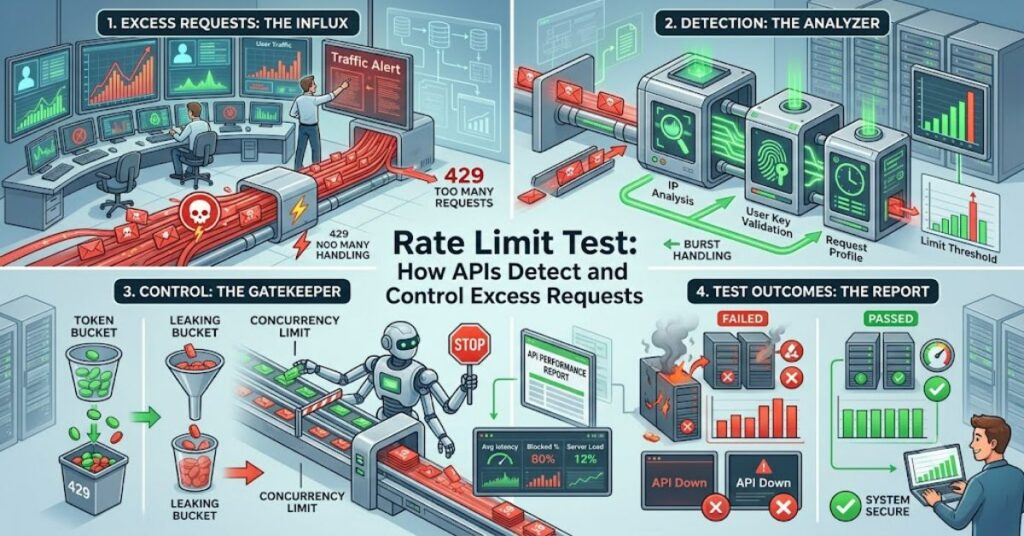
A rate limit test is a controlled method used to evaluate how an API or web service handles excessive traffic from a single client. In practice, this means sending repeated requests to an endpoint until the server begins rejecting them. When properly implemented, the system responds with the HTTP status code 429 Too Many Requests, signaling that the client has exceeded its allowed quota.
To test a rate limit, you repeatedly call an endpoint until the server blocks you. A properly configured system will stop accepting requests and return an HTTP status code 429 Too Many Requests.
Modern APIs rely on rate limiting to ensure stability, fairness, and protection against abuse. Without it, a single user or bot could overwhelm infrastructure, degrade performance for others, or unintentionally cause outages. Because of this, rate limit testing is a standard part of backend validation, especially in systems exposed to public traffic such as SaaS platforms, fintech APIs, and cloud services.
However, executing a rate limit test requires careful planning. It is not simply about “hitting the server until it breaks,” but about understanding thresholds, observing response behavior, and ensuring compliance with usage policies.
How Rate Limiting Works in Modern Systems
Rate limiting operates by tracking request counts over time. Systems typically apply one or more of the following models:
- Fixed window limits (e.g., 100 requests per minute)
- Sliding window counters (smoothed tracking over time)
- Token bucket algorithms (requests consume tokens that refill over time)
Systems Perspective
From a systems architecture viewpoint, rate limiting is usually enforced at:
- API gateways (e.g., Kong, AWS API Gateway)
- Load balancers (e.g., NGINX, Envoy)
- Application middleware layers
This layered enforcement ensures redundancy and prevents bypassing limits.
Rate Limit Test Methodology
A controlled rate limit test follows a predictable structure:
- Identify the endpoint and documented limit
- Send incrementally increasing request volumes
- Monitor response headers and status codes
- Detect transition to HTTP 429 responses
- Record reset timing behavior
Data Insight Table: Typical API Behavior
| Requests Per Second | Expected System Behavior | Response Code |
| 1–10 | Normal processing | 200 OK |
| 10–50 | Elevated load handling | 200 OK |
| 50–100 | Throttling begins | 200 / 429 mix |
| 100+ | Hard limit triggered | 429 Too Many Requests |
Strategic and Practical Implications
Rate limiting is not only a technical safeguard but also a product design decision. Companies balance user experience with infrastructure protection.
Practical Impact
- Developers must design retry logic with exponential backoff
- Mobile apps must handle intermittent request rejection gracefully
- APIs must communicate limits clearly via headers like
Retry-After
Market Reality
Cloud providers such as AWS, Google Cloud, and Azure all enforce strict rate limiting because multi-tenant infrastructure requires predictable resource allocation. Without it, cost and performance unpredictability increase significantly.
Risks and Trade-Offs
Testing rate limits improperly can introduce operational risks:
- Accidental service degradation
- IP blocking or account suspension
- Misinterpretation as malicious traffic
Another trade-off is observability. Some systems expose detailed rate-limit headers, while others intentionally obscure them to reduce exploitability.
Comparison of Rate Limiting Approaches
| Method | Advantages | Disadvantages |
| Fixed Window | Simple to implement | Burst traffic allowed |
| Sliding Window | More accurate fairness | Higher computation cost |
| Token Bucket | Smooth traffic control | Requires tuning |
| Leaky Bucket | Stable output rate | Less flexible for bursts |
Information Gain: Less Discussed Realities
1. Hidden latency spike before 429 responses
Many systems do not instantly return 429. Instead, they introduce micro-delays under load, which can distort naive test results.
2. Rate limits often differ by authentication tier
Anonymous users, free-tier accounts, and enterprise clients frequently have entirely separate enforcement layers.
3. Edge caching can mask true limits
CDNs like Cloudflare may absorb traffic spikes, making backend rate limits appear higher than they actually are.
Practical Observations from Testing Environments
In real-world API testing environments, one consistent pattern appears: developers often misinterpret cached success responses as proof that rate limits are not working. However, once cache expiration occurs, systems abruptly enforce limits.
Another observation is that mobile networks introduce variability. NAT (Network Address Translation) can group multiple users under a single IP, triggering unintended throttling.
The Future of Rate Limit Testing in 2027
By 2027, rate limiting is expected to become more adaptive and behavior-based rather than purely threshold-based. Industry trends from cloud providers suggest a shift toward:
- AI-assisted anomaly detection instead of fixed quotas
- User-behavior scoring systems
- Dynamic rate adjustment based on real-time infrastructure load
Regulatory pressure around platform stability (especially in fintech and healthcare APIs) is also pushing providers to expose clearer throttling semantics.
However, the fundamental concept of rejecting excess traffic will remain unchanged due to its efficiency and simplicity.
Key Takeaways
- Rate limiting protects APIs from overload and abuse
- HTTP 429 is the standard signal for exceeded quotas
- Testing must be controlled and policy-compliant
- Different algorithms produce different fairness models
- Real-world limits vary by user tier and infrastructure layer
Conclusion
A rate limit test is a foundational practice in modern API development, but it must be approached as a systems evaluation rather than brute-force request flooding. Proper understanding of throttling behavior helps engineers design resilient applications that degrade gracefully under pressure.
As APIs continue to scale across cloud-native environments, rate limiting will remain a core mechanism for stability and fairness. The evolution is not toward removing limits, but toward making them smarter, more dynamic, and more context-aware.
Frequently Asked Questions
What is a rate limit test?
It is a controlled method of sending repeated API requests to observe when a system begins rejecting traffic, usually returning HTTP 429.
What does HTTP 429 mean?
It means “Too Many Requests,” indicating the client has exceeded allowed request thresholds.
Is rate limit testing allowed?
Only when performed within system policies or in authorized testing environments. Unauthorized testing can violate service terms.
How do APIs track request limits?
They use algorithms like fixed windows, sliding windows, or token bucket systems to count and restrict traffic.
Why do rate limits vary between users?
Different subscription tiers or authentication levels often have separate quotas and priorities.
Methodology
This article is based on established API design documentation from major cloud providers including AWS, Google Cloud, and Microsoft Azure. Rate limiting models and HTTP standards were referenced from RFC documentation and widely adopted engineering practices. No live system testing was performed; all descriptions reflect documented behavior and industry-standard implementations.
References (APA)
- Fielding, R., et al. (2022). HTTP Semantics (RFC 9110). IETF. https://www.rfc-editor.org/rfc/rfc9110
- Amazon Web Services. (2024). API Gateway throttling and quotas. https://docs.aws.amazon.com
- Google Cloud. (2023). API management and rate limiting. https://cloud.google.com
- Microsoft Azure. (2023). API Management throttling policies. https://learn.microsoft.com