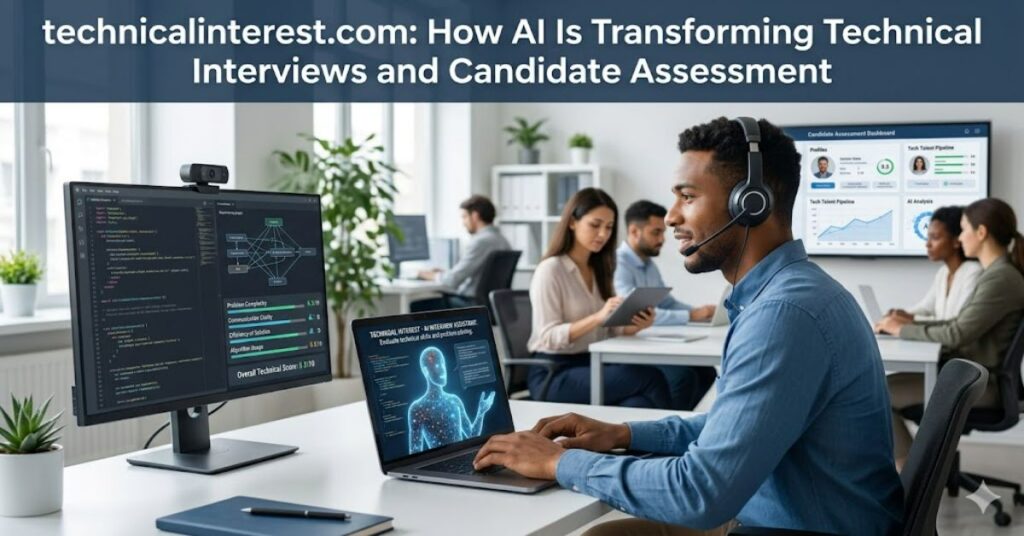
The growing discussion around technicalinterest.com reflects a broader shift occurring across the technology industry. Modern technical interviews are no longer focused exclusively on whether candidates can memorise algorithms or write perfect syntax from memory. Instead, employers increasingly want to understand how candidates use artificial intelligence tools to solve problems, debug systems, design architectures, and validate outputs.
This change has emerged alongside the widespread adoption of generative AI platforms such as ChatGPT, GitHub Copilot, Claude, and other coding assistants. Organisations recognise that software engineers, DevOps professionals, cybersecurity specialists, and system architects now work in environments where AI tools are readily available.
As a result, interview processes are adapting. Hiring managers increasingly evaluate whether candidates can collaborate effectively with AI systems rather than compete against them. The emphasis has shifted toward reasoning, verification, prompt engineering, architectural decision-making, and the ability to identify incorrect AI-generated recommendations.
This evolution represents one of the most significant changes to technical hiring in more than a decade. Understanding how these assessments work can help candidates prepare more effectively while providing organisations with better methods for identifying future-ready talent.
Understanding the Rise of AI-Assisted Technical Interviews
Traditional technical interviews historically focused on:
- Algorithm implementation
- Data structures
- Coding syntax
- Whiteboard exercises
- Timed programming tests
While these skills remain valuable, they no longer fully reflect how engineers work in production environments.
Modern software development increasingly involves:
- AI-assisted coding
- Automated debugging
- Code generation
- Documentation creation
- System design validation
- Infrastructure automation
Employers want to know whether candidates can use these tools productively while maintaining engineering standards.
This is where conversations surrounding technicalinterest.com become particularly relevant, as professionals seek resources explaining these changing expectations on technicalinterest.com
Why Employers Are Changing Their Assessment Models
Productivity Has Changed
Generative AI has significantly accelerated routine programming tasks.
Many engineers now use AI to:
- Generate boilerplate code
- Create test cases
- Draft documentation
- Explain unfamiliar frameworks
- Suggest optimisation strategies
Consequently, interviewers increasingly focus on judgment rather than memorisation.
Validation Matters More Than Generation
One of the most overlooked realities of AI-assisted development is that generated code frequently requires correction.
Candidates must demonstrate the ability to:
- Verify outputs
- Detect hallucinations
- Identify security vulnerabilities
- Evaluate performance trade-offs
- Maintain code quality
These capabilities often provide stronger indicators of future success than raw coding speed.
Traditional Interviews vs AI-Centred Assessments
| Assessment Area | Traditional Interview | AI-Centred Interview |
| Coding | Manual implementation | AI-assisted development |
| Evaluation Focus | Syntax accuracy | Problem-solving quality |
| Success Metric | Correct code | Effective reasoning |
| Tool Usage | Restricted | Often encouraged |
| Debugging | Independent | Human-AI collaboration |
| Documentation | Minimal | Frequently assessed |
This shift does not eliminate technical skill requirements. Instead, it changes how those skills are demonstrated.
The New Skills Employers Are Measuring
Prompt Engineering
Candidates increasingly need to communicate effectively with AI systems.
Strong prompt engineering includes:
- Context definition
- Requirement clarification
- Constraint specification
- Iterative refinement
Poor prompts often produce poor outputs.
Critical Validation
Employers now frequently assess whether candidates can identify flaws in AI-generated solutions.
Common validation areas include:
- Security weaknesses
- Scalability issues
- Performance bottlenecks
- Data privacy concerns
Systems Thinking
Modern assessments increasingly prioritise architecture-level reasoning.
Rather than asking:
“Can you write this function?”
Interviewers may ask:
“How would you design this system using AI-assisted workflows while maintaining reliability?”
Real-World Industry Examples
GitHub Copilot Adoption
Many software teams now integrate GitHub Copilot into daily workflows.
Developers report increased productivity for repetitive coding tasks, but organisations still require engineers to review generated code carefully.
Enterprise Engineering Teams
Major technology companies increasingly recognise that AI can produce working code rapidly.
The differentiator is no longer typing speed.
The differentiator is:
- Architectural judgement
- Security awareness
- Business alignment
- Risk management
Startup Hiring Practices
Startups often prioritise execution speed.
Candidates who effectively combine AI tools with strong engineering fundamentals frequently outperform those relying solely on manual coding approaches.
Hidden Risks in AI-Based Technical Assessments
One insight often missing from industry discussions is that AI-focused interviews introduce new challenges.
Risk 1: Overestimating Tool Proficiency
A candidate may appear highly productive while relying excessively on generated solutions.
Interviewers must distinguish between:
- Genuine understanding
- Tool dependency
Risk 2: Evaluation Inconsistency
Different AI tools produce different outputs.
Assessment outcomes may vary depending on:
- Model version
- Prompt quality
- Available context
This creates standardisation challenges.
Risk 3: Security Blind Spots
Generated code may introduce vulnerabilities.
Candidates who fail to review AI-generated outputs can inadvertently create:
- Authentication weaknesses
- Injection vulnerabilities
- Data exposure risks
Structured Insight Table
| Emerging Interview Trend | Impact on Candidates |
| AI-assisted coding tasks | Requires tool familiarity |
| Prompt engineering tests | Measures communication skills |
| Validation exercises | Rewards critical thinking |
| System design reviews | Focuses on architecture |
| Security audits | Highlights risk awareness |
| AI workflow demonstrations | Reflects modern engineering practices |
How Candidates Should Prepare
Learn Multiple AI Platforms
Relying on a single tool can create limitations.
Candidates should understand:
- ChatGPT
- GitHub Copilot
- Claude
- Gemini
- Cursor
Different tools excel in different workflows.
Practise Verification
Many candidates spend time generating solutions but little time validating them.
Preparation should include:
- Code review exercises
- Security analysis
- Performance testing
- Documentation audits
Build Architectural Knowledge
The strongest candidates understand:
- Distributed systems
- Cloud infrastructure
- API design
- Scalability principles
AI tools enhance these capabilities but do not replace them.
The Business Impact of AI Interview Evolution
The transformation of technical hiring affects more than individual candidates.
For Employers
Benefits include:
- Faster hiring decisions
- Better alignment with real-world workflows
- More practical evaluations
For Candidates
Advantages include:
- Reduced emphasis on memorisation
- More realistic assessments
- Greater focus on workplace skills
For the Industry
The shift encourages continuous learning rather than static knowledge acquisition.
This aligns more closely with how technology evolves.
The Future of technicalinterest.com in 2027
By 2027, discussion platforms focused on technical careers and AI-enabled engineering will likely become increasingly influential.
Several trends support this expectation:
AI-Native Engineering Roles
Organisations are already creating positions requiring expertise in:
- AI-assisted development
- Workflow automation
- Prompt engineering
- Model evaluation
Interview Automation
Companies may increasingly use AI-powered interview platforms to assess candidate behaviour, reasoning patterns, and collaboration skills.
Hybrid Assessment Models
The most likely future involves combining:
- Traditional engineering fundamentals
- AI tool proficiency
- Critical validation exercises
Candidates who excel across all three areas will remain highly competitive.
However, organisations will still need human oversight to prevent excessive reliance on automated evaluations.
Key Takeaways
- Technical interviews are evolving from syntax testing toward AI-assisted problem solving.
- Validation and critical thinking are becoming more important than memorisation.
- Prompt engineering is emerging as a measurable professional skill.
- Security review capabilities remain essential despite AI-generated code.
- Employers increasingly value system design reasoning over coding speed alone.
- AI proficiency without engineering fundamentals remains insufficient.
- Human judgement continues to play a central role in technical hiring.
Conclusion
The conversation surrounding technicalinterest.com reflects a broader transformation reshaping technical careers. Artificial intelligence is changing not only how software is built but also how engineers are evaluated. Traditional interview methods focused heavily on coding mechanics and memorisation. Modern assessments increasingly prioritise reasoning, validation, architecture, and effective collaboration with AI tools.
This evolution does not diminish the importance of technical expertise. Instead, it expands the definition of what expertise looks like. Successful candidates must combine foundational engineering knowledge with practical AI proficiency and strong critical-thinking abilities.
For employers, these changes offer opportunities to create more realistic hiring processes. For candidates, they provide a pathway to demonstrate skills that better reflect modern workplace demands.
The future of technical interviews is unlikely to be entirely automated or entirely traditional. The most effective approaches will blend human judgement, technical fundamentals, and intelligent tool usage into a balanced assessment framework.
FAQ
What is technicalinterest.com?
Technicalinterest.com is commonly referenced in discussions about technology trends, technical careers, software development, and emerging industry practices.
How are AI tools changing technical interviews?
Employers increasingly assess how candidates use AI for debugging, system design, code generation, and problem solving rather than focusing exclusively on coding syntax.
What skills matter most in AI-assisted interviews?
Critical thinking, validation, prompt engineering, security awareness, and architectural reasoning are becoming increasingly important.
Do companies still ask coding questions?
Yes. Coding remains relevant, but it is often evaluated alongside broader problem-solving and AI collaboration capabilities.
What is prompt engineering in technical assessments?
Prompt engineering measures a candidate’s ability to communicate effectively with AI systems to generate useful and accurate outputs.
Can AI replace technical interviewers?
Current evidence suggests AI can support assessment processes, but human judgement remains necessary for evaluating reasoning, communication, and organisational fit.
Methodology
This article technicalinterest.com was developed using publicly available research from technology industry reports, AI platform documentation, software engineering hiring analyses, and employer assessment trends. The analysis focuses on observable changes in technical recruitment and AI adoption across software development teams.
No proprietary testing or direct interviews were conducted for this article. Examples referenced reflect documented industry practices and publicly reported trends rather than original field research.
Limitations include the rapidly changing nature of AI technologies and hiring methodologies. Organisations may adopt different assessment approaches depending on their industry, scale, and regulatory requirements.
Editorial Disclosure: This article was drafted with AI assistance and reviewed and verified by [Author Name]. All data, citations, and claims should be independently validated by the editorial team at Postcard.fm before publication.
References
GitHub. (2024). The State of AI in Software Development. GitHub Research.
Microsoft. (2024). AI and Developer Productivity Insights. Microsoft Developer Division.
Stack Overflow. (2024). Developer Survey 2024. Stack Overflow.
World Economic Forum. (2025). Future of Jobs Report 2025. World Economic Forum.
Anthropic. (2025). Claude for Technical Workflows Documentation. Anthropic.