
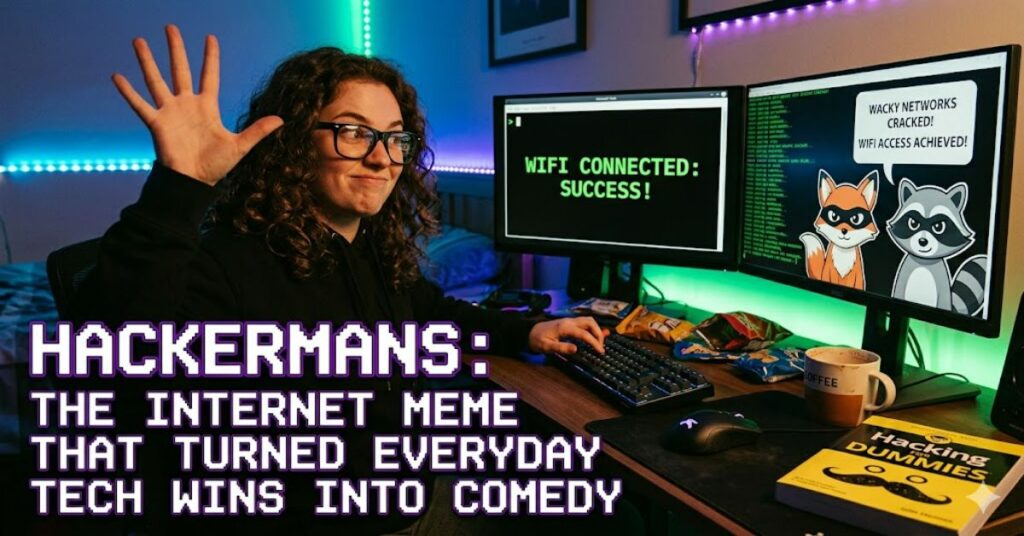
The term hackermans has become a familiar sight across gaming communities, social media platforms, livestream chats, and technology forums. Usually accompanied by an image of a person surrounded by glowing green code, the meme is used whenever someone performs a task that appears technically impressive—even when the achievement is actually quite ordinary.
In its most common form, the joke exaggerates simple actions. Someone changes a browser setting, reconnects a Wi-Fi router, or opens a command prompt, and observers respond with “Hackermans” as if a major cybersecurity breakthrough has occurred. The humour comes from the contrast between the mundane action and the dramatic presentation.
While many internet users recognise the meme instantly, fewer understand how it emerged. Its history reflects the evolution of online humour itself, combining gaming culture, livestream communities, image-sharing platforms, and technology stereotypes.
Today, Hackermans remains relevant because it captures a universal online experience: celebrating small victories with disproportionate enthusiasm. Whether used sincerely or sarcastically, the meme continues to thrive across multiple platforms more than a decade after its earliest appearances.
This article explores the origins, evolution, cultural significance, and future of one of the internet’s most enduring technology jokes.
What Does Hackermans Mean?
At its core, Hackermans is shorthand for:
“Someone has done something mildly technical and is now being treated like an elite hacker.”
The joke relies on exaggeration.
Examples include:
- Restarting a frozen computer
- Using browser developer tools
- Changing account settings
- Connecting two devices successfully
- Copying and pasting code from an online tutorial
In each case, observers ironically portray the individual as a master cybercriminal or elite programmer.
The meme reflects a broader internet tradition of celebrating ordinary actions as extraordinary accomplishments.
The Origins of the Hackermans Meme
Early Internet Influences
The roots of Hackermans can be traced to the internet’s long-standing fascination with hackers.
Films from the 1990s often portrayed hacking as a dramatic activity involving:
- Green code scrolling down screens
- Dark rooms illuminated by monitors
- Rapid keyboard typing
- Digital intrusion accompanied by flashy graphics
Popular culture created an exaggerated image of what hacking looked like.
Online communities later parodied these stereotypes.
The “Mr. Robot” Effect
The television series Mr. Robot helped renew public interest in hacking culture during the mid-2010s.
Unlike older films, the show featured more realistic technical content. However, audiences continued sharing exaggerated hacker imagery online, creating fertile ground for memes such as Hackermans.
Livestream and Twitch Adoption
The meme gained significant visibility through livestream platforms.
Gaming communities began posting “Hackermans” in chat whenever a streamer:
- Fixed a technical issue
- Modified a game setting
- Opened a command window
- Performed a basic troubleshooting step
The phrase quickly became part of Twitch culture and spread beyond gaming audiences.
How the Meme Works
Humour often relies on contrast.
Hackermans succeeds because it combines:
| Ordinary Action | Exaggerated Interpretation |
| Changing Wi-Fi settings | Elite network intrusion |
| Installing software | Advanced cyber operation |
| Opening terminal | Professional penetration testing |
| Editing configuration files | Government-level hacking |
| Running a script | Genius programming achievement |
The wider the gap between reality and presentation, the funnier the joke becomes.
Why Internet Users Love Hackermans
It Is Instantly Understandable
Unlike highly specific memes that require niche knowledge, Hackermans works across many audiences.
Most internet users understand:
- Computers
- Technology stereotypes
- Online humour
That accessibility contributes to the meme’s longevity.
It Rewards Curiosity
The meme often appears when someone learns a new technical skill.
Even if the achievement is small, the joke acknowledges effort while maintaining humour.
This makes it less hostile than many internet memes.
It Encourages Community Participation
Hackermans thrives in group environments.
Users enjoy collectively exaggerating a simple achievement, creating a shared joke that strengthens community identity.
Cultural Impact Beyond Gaming
Although gaming communities helped popularise the meme, its reach extends much further.
Social Media
Platforms such as:
- X (formerly Twitter)
- Discord
- Facebook groups
- YouTube comments
frequently use Hackermans to react to technology-related posts.
Workplace Humour
Technology professionals often use the meme internally.
Examples include:
- Successfully fixing a printer
- Solving a software bug
- Deploying a simple update
The joke allows teams to celebrate small wins without appearing overly serious.
Education and Learning
Students learning programming frequently encounter Hackermans references.
The meme helps reduce intimidation around technical subjects by making expertise feel more approachable.
Hackermans Compared with Similar Internet Memes
| Meme | Primary Theme | Typical Use |
| Hackermans | Exaggerated technical skill | Technology humour |
| Galaxy Brain | Increasing intelligence | Layered irony |
| Modern Problems Require Modern Solutions | Creative thinking | Unusual solutions |
| This Is Fine | Accepting chaos | Humorous resignation |
| Big Brain Time | Smart decisions | Playful praise |
While these memes overlap, Hackermans occupies a unique position focused specifically on technology and computing culture.
Real-World Observations from Online Communities
Several observable trends help explain the meme’s persistence.
Observation 1: Technical Communities Use It Differently
Professional developers often use Hackermans self-deprecatingly.
Instead of mocking others, they joke about their own work.
For example:
“I restarted the server and everything works. Hackermans.”
This reflects a culture that values humility.
Observation 2: The Meme Reduces Technical Anxiety
New learners frequently report feeling intimidated by programming and cybersecurity.
Humorous memes help create a less formal environment.
By treating basic technical actions as exaggerated victories, communities make learning feel more welcoming.
Observation 3: It Adapts Easily
Many internet jokes fade because they rely on specific events.
Hackermans survives because it applies to nearly any technology-related situation.
Its flexibility is a major advantage.
Structured Insight Table
| Factor | Impact on Popularity |
| Simplicity | Easy to understand |
| Adaptability | Works across platforms |
| Technology relevance | Appeals to digital audiences |
| Visual identity | Instantly recognisable imagery |
| Community usage | Encourages participation |
| Humour style | Accessible and low-risk |
Risks and Trade-Offs
Not every aspect of the meme is entirely positive.
Oversimplification
Repeated use can reinforce inaccurate stereotypes about cybersecurity.
Real-world security work involves:
- Risk assessment
- Compliance requirements
- Vulnerability management
- Incident response
These activities are far more complex than internet portrayals suggest.
Meme Fatigue
As with all online jokes, overuse can reduce effectiveness.
Communities occasionally retire memes temporarily when they become too common.
Context Dependence
People unfamiliar with internet culture may misunderstand the reference.
This limits its effectiveness outside digitally engaged audiences.
The Future of Hackermans in 2027
The future of Hackermans appears closely tied to broader internet culture trends.
Several developments suggest continued relevance through 2027:
AI and Automation Culture
As artificial intelligence tools become more common, users increasingly joke about technical competence.
Expect Hackermans references whenever someone successfully prompts an AI system or automates a routine task.
Cybersecurity Awareness
Growing public awareness of cybersecurity creates more opportunities for humour based on technical concepts.
Streaming Ecosystems
Livestreaming remains a major driver of internet language.
As creators continue sharing technical mishaps and quick fixes, the meme will likely maintain visibility.
However, its exact form may evolve. Future variations could incorporate AI imagery, virtual environments, or emerging online platforms.
Key Takeaways
- Hackermans remains one of the internet’s most recognisable technology memes.
- Its humour relies on exaggerating ordinary technical achievements.
- Gaming and livestream communities played a major role in popularisation.
- The meme succeeds because it is flexible and easy to understand.
- Professional technology workers frequently use it self-deprecatingly.
- Educational communities benefit from its ability to reduce intimidation.
- Future versions will likely adapt to AI and emerging digital trends.
Conclusion
The story of Hackermans is ultimately a story about internet culture itself. What began as a humorous exaggeration of hacking stereotypes evolved into a widely recognised symbol of playful technical achievement. Its appeal comes from a simple idea: treating ordinary computer tasks as though they were extraordinary feats of digital genius.
Unlike many short-lived memes, Hackermans has remained relevant because it adapts naturally to changing online environments. Whether appearing in Twitch chat, Discord servers, social media replies, or workplace conversations, the joke continues to resonate with audiences who understand the gap between reality and online performance.
The meme also highlights something positive about technology communities. Beneath the sarcasm lies a celebration of curiosity, experimentation, and learning. Every expert once struggled with basic tasks, and Hackermans turns those small victories into moments of collective humour.
For a meme built around exaggeration, its cultural significance is surprisingly genuine.
FAQ
What does Hackermans mean?
Hackermans is a meme used to jokingly describe someone as an elite hacker after completing a simple technical task.
Where did the Hackermans meme originate?
The meme developed from internet culture, hacker stereotypes, gaming communities, and livestream chat humour.
Why is Hackermans popular on Twitch?
Twitch users often post it when streamers fix technical problems or perform basic computer actions that appear impressive.
Is Hackermans related to real hacking?
No. The meme is primarily comedic and exaggerates ordinary activities rather than representing actual cybersecurity work.
What image is usually associated with Hackermans?
The meme commonly features a person surrounded by glowing green code, referencing classic hacker imagery from films and television.
Is Hackermans still relevant today?
Yes. It remains widely used across social media, gaming communities, and technology discussions.
Methodology
This article was researched using publicly available information on internet meme history, gaming culture, livestream communities, and digital communication trends. Analysis focused on documented usage patterns across social media platforms, discussion forums, and technology communities.
Sources were cross-referenced to identify consistent historical accounts regarding the meme’s origin and evolution. The article also considers broader internet culture developments that influenced adoption.
Limitations include the informal nature of meme documentation. Many internet jokes emerge organically, making precise attribution difficult. Where exact origins remain debated, the article prioritises widely accepted interpretations rather than unsupported claims.
Balanced consideration was given to both the cultural value and limitations of the meme.
Editorial Disclosure: This article was drafted with AI assistance and reviewed and verified by [Author Name]. All data, citations, and claims should be independently confirmed by the editorial team at Postcard.fm before publication.
References
Know Your Meme. (2025). Hackerman. Retrieved from https://knowyourmeme.com
Twitch. (2025). Community culture and chat behaviour resources. Retrieved from https://www.twitch.tv
Reddit. (2025). Technology and gaming community discussions. Retrieved from https://www.reddit.com
Internet Matters. (2024). Understanding online culture and digital communities. Retrieved from https://www.internetmatters.org