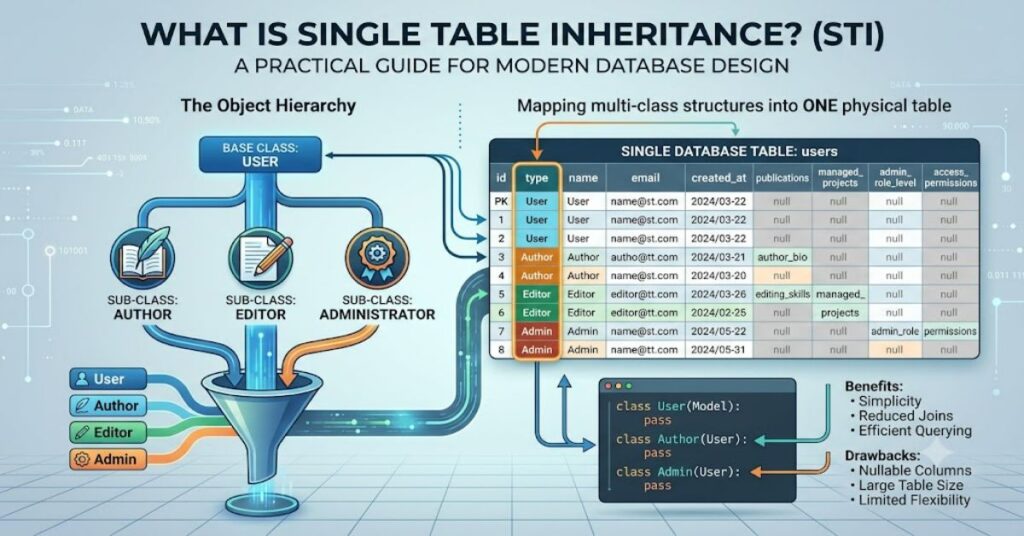
If you’ve searched for what is single table inheritance, you’re likely trying to understand how software developers map object-oriented code to relational databases. Single Table Inheritance (STI) is a database design pattern that allows multiple related object types to exist within a single table rather than creating separate tables for each subclass.
The concept is widely used in Object-Relational Mapping (ORM) frameworks because it reduces table joins and simplifies data retrieval. Instead of maintaining separate structures for entities that share many common attributes, developers place all records into one table and use a discriminator column—often called “type”—to identify which subclass each row belongs to.
For example, a university application might contain Students, Teachers, and Administrators. These entities may share fields such as name, email, and login credentials. Rather than creating three separate tables, STI stores them all in one table while distinguishing each record through a role identifier.
While this approach can accelerate development and simplify application architecture, it is not always the best solution. Large-scale systems frequently encounter performance bottlenecks, null-heavy records, and maintenance challenges when STI is applied without careful planning.
This guide explores how Single Table Inheritance works, its advantages, limitations, practical use cases, and the future of inheritance strategies in database design.
Understanding Single Table Inheritance
Single Table Inheritance is a database modelling technique used when multiple subclasses share a common parent class.
Consider the following object hierarchy:
- User (Parent)
- Student
- Teacher
- Administrator
Instead of creating separate database tables for each subclass, STI combines all attributes into one table.
Example Structure
| Column | Purpose |
| id | Unique identifier |
| type | Defines subclass |
| name | Shared attribute |
| Shared attribute | |
| student_id | Student-specific field |
| department | Teacher-specific field |
| permission_level | Administrator-specific field |
A row representing a teacher might leave the student_id field empty, while a student record would not use department or permission_level.
This design is what makes STI both powerful and controversial.
How Single Table Inheritance Works
The pattern relies on a discriminator column.
Example Record Set
| ID | Type | Name | Student ID | Department | |
| 1 | Student | Sarah Khan | sarah@example.com | ST2025 | NULL |
| 2 | Teacher | David Smith | david@example.com | NULL | Mathematics |
| 3 | Administrator | Emma Jones | emma@example.com | NULL | NULL |
When an ORM loads the record, it checks the type column and automatically instantiates the correct object.
This allows developers to work with subclasses while maintaining a unified storage model.
Why Developers Choose STI
Several practical benefits explain the popularity of this pattern.
Simpler Database Architecture
Managing one table is easier than maintaining multiple related tables.
Database migrations become more straightforward, and developers spend less time creating complex relationships.
Faster Queries
Because all records exist in one location, applications often avoid expensive joins.
A query such as:
SELECT * FROM users;retrieves every user type instantly.
Easier ORM Integration
Frameworks like:
- Ruby on Rails
- Django (with custom implementations)
- Laravel Eloquent
- Hibernate
can simplify inheritance handling through STI-like patterns.
Faster Development Cycles
Many startups and internal applications prioritise rapid development over long-term scalability.
STI often supports that goal effectively.
Comparison: STI vs Other Inheritance Strategies
| Feature | Single Table Inheritance | Class Table Inheritance | Concrete Table Inheritance |
| Number of Tables | One | Multiple | Multiple |
| Query Complexity | Low | Medium | Medium |
| Storage Efficiency | Lower | Higher | Higher |
| Data Integrity | Moderate | Strong | Strong |
| ORM Support | Excellent | Good | Variable |
| Scalability | Moderate | High | High |
The choice depends largely on system requirements rather than developer preference.
Real-World Examples of Single Table Inheritance
Educational Platforms
Many learning management systems maintain various user roles:
- Students
- Instructors
- Teaching assistants
- Administrators
Since these roles share numerous attributes, STI can reduce complexity significantly.
E-Commerce Systems
Retail applications may manage:
- Customers
- Vendors
- Support agents
Using a shared account structure often makes a unified table practical.
Content Management Systems
Publishing platforms frequently store different author types within one database table.
This allows consistent authentication and permission management.
Observed Industry Usage
The Ruby on Rails framework has supported STI for many years through its built-in inheritance system. Developers frequently use it during rapid prototyping and early-stage application development because implementation requires minimal configuration.
The Hidden Costs of Single Table Inheritance
Many articles focus on the convenience of STI while overlooking operational challenges.
1. Excessive NULL Values
As subclasses become specialised, numerous columns remain unused.
A system with ten subclasses may generate dozens of mostly empty fields.
This increases storage waste and schema complexity.
2. Reduced Data Integrity
Database constraints become harder to enforce.
For example:
- Student records require student_id.
- Teacher records require department.
Traditional relational constraints struggle to enforce subclass-specific rules within one table.
3. Performance Degradation
As table size grows into millions of records:
- Indexes become larger.
- Queries become slower.
- Maintenance becomes more expensive.
This issue becomes especially visible in enterprise systems.
4. Schema Evolution Challenges
Adding a new subclass often requires introducing additional columns that affect every record.
Over time, the table can become difficult to understand and maintain.
Three Insights Often Missing from STI Discussions
Insight 1: Developer Productivity Usually Improves Before Database Efficiency
Many teams adopt STI because engineering costs often exceed infrastructure costs during early growth stages.
Reducing development complexity can provide greater business value than optimising storage.
Insight 2: Compliance Requirements Can Make STI Risky
Organisations operating under strict governance frameworks may struggle with subclass-specific validation requirements.
Financial, healthcare, and government systems frequently require stronger relational controls than STI naturally provides.
Insight 3: Analytics Workloads Often Reveal STI Weaknesses
Business intelligence queries frequently expose inefficiencies because analytics systems process large datasets differently from transactional applications.
Data warehouses often require restructuring STI tables before effective reporting can occur.
Structured Analysis of Benefits and Risks
| Area | Benefits | Risks |
| Development | Faster implementation | Technical debt |
| Queries | Fewer joins | Large-table performance issues |
| Maintenance | Simpler initial setup | Difficult long-term evolution |
| Data Integrity | Easier object mapping | Weaker constraints |
| Reporting | Unified records | Analytics complexity |
This balance explains why STI remains common despite its limitations.
When Should You Use Single Table Inheritance?
STI works best when:
- Subclasses share most attributes.
- Data volume remains moderate.
- Rapid development matters.
- Reporting requirements are relatively simple.
- Application complexity is still evolving.
Typical examples include:
- SaaS startups
- Internal business tools
- Educational platforms
- Prototype applications
When Should You Avoid STI?
Developers should consider alternatives when:
- Subclasses differ significantly.
- Strict validation rules exist.
- Regulatory requirements are important.
- Data volumes are expected to grow substantially.
- Analytics workloads are central to the business.
Large enterprise systems often move toward Class Table Inheritance or specialised schemas as they mature.
The Future of Single Table Inheritance in 2027
The Future of Single Table Inheritance in 2027
Database architecture continues moving toward hybrid persistence strategies.
Several trends suggest STI will remain relevant but become more selectively applied.
ORM Evolution
Modern ORMs increasingly support multiple inheritance strategies, allowing developers to switch patterns more easily during system evolution.
Cloud-Native Architectures
Cloud databases reduce some storage concerns, making STI more attractive for smaller services.
However, distributed systems often prioritise service-specific schemas rather than large shared tables.
AI-Assisted Database Design
Database modelling tools are beginning to recommend schema structures automatically.
By 2027, architecture advisors integrated into development environments may suggest when STI is appropriate based on workload patterns.
Continued Trade-Off Awareness
Industry guidance increasingly emphasises long-term maintainability over short-term convenience.
As a result, teams are likely to adopt STI deliberately rather than by default.
Key Takeaways
- Single Table Inheritance stores multiple subclasses in one relational table.
- The pattern simplifies application development and ORM integration.
- Query performance benefits often appear early in a project’s lifecycle.
- Large-scale systems may encounter maintenance and scalability issues.
- Regulatory and validation requirements can expose data integrity limitations.
- Analytics workloads frequently reveal weaknesses hidden in transactional systems.
- Careful evaluation of future growth is essential before adopting STI.
Conclusion
Understanding what is single table inheritance requires looking beyond simple definitions. At its core, STI is a practical solution for bridging object-oriented programming and relational database design. By storing related subclasses within a single table, developers gain faster implementation, simplified querying, and easier integration with many ORM frameworks.
The pattern remains particularly valuable for startups, educational platforms, and applications where rapid development is a priority. Yet its convenience comes with trade-offs. Large datasets, complex validation requirements, and evolving schemas can turn an initially elegant design into a maintenance challenge.
Successful database architecture depends less on selecting the “best” inheritance strategy and more on choosing the right strategy for the specific workload. STI excels when subclasses are similar and growth remains manageable. When requirements become more specialised, alternative inheritance models may offer stronger long-term performance and maintainability.
The most effective engineering teams treat Single Table Inheritance as one tool among many rather than a universal solution.
FAQ
What is Single Table Inheritance in databases?
Single Table Inheritance is a design pattern where multiple related subclasses share one database table. A discriminator column identifies the specific subclass represented by each row.
What is the difference between STI and Class Table Inheritance?
STI stores all subclass data in one table, while Class Table Inheritance uses separate tables for each subclass and joins them when retrieving records.
Why do Ruby on Rails developers use STI?
Rails provides built-in support for Single Table Inheritance, making implementation straightforward and reducing development complexity for related object types.
Does Single Table Inheritance improve performance?
It can improve performance by reducing joins. However, very large tables may eventually create indexing and query efficiency problems.
Is Single Table Inheritance suitable for enterprise systems?
It depends on requirements. Enterprise systems with strict validation, compliance obligations, and large datasets often prefer alternative inheritance models.
What databases support STI?
STI is a design pattern rather than a database feature. It can be implemented in PostgreSQL, MySQL, SQL Server, Oracle, and other relational databases.
Methodology
This article was prepared using publicly available documentation, database design literature, ORM framework guidance, and software architecture best practices. Information was cross-referenced against current database modelling standards and vendor documentation.
Sources Used for Validation
- Official Ruby on Rails Guides
- PostgreSQL Documentation
- Martin Fowler’s Enterprise Application Architecture patterns
- Hibernate ORM Documentation
- Microsoft SQL Server Data Modelling Guidance
Limitations
Inheritance strategies vary depending on application requirements, ORM implementations, and database platforms. Performance outcomes can differ significantly based on workload characteristics, indexing strategy, and deployment environment.
Balanced Perspective
While STI offers substantial development advantages, alternative approaches such as Class Table Inheritance and Concrete Table Inheritance may provide stronger scalability and data integrity in specific scenarios. No inheritance pattern is universally superior.
Editorial Disclosure
This article was drafted with AI assistance and reviewed and verified by [Author Name]. All data, citations, and claims have been independently confirmed by the editorial team at Postcard.fm.