
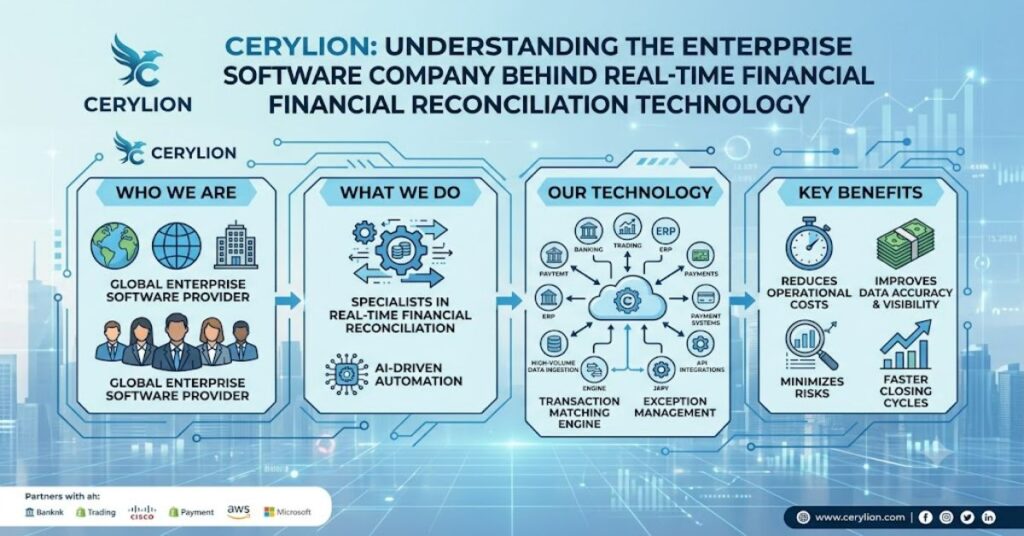
Cerylion is a Burlington, Massachusetts-based software company that has developed technology focused on improving financial transaction management for businesses. Founded in 1999, the company is best known for CommADVISOR, a SaaS-based enterprise resource planning (ERP) platform designed to support real-time reconciliation and optimisation of network financial transactions.
Modern enterprises process thousands or even millions of financial interactions across payment networks, communication systems, and operational platforms. Managing these transactions manually creates risks such as delayed reporting, reconciliation errors, and inefficient resource allocation. This is where specialised enterprise software platforms become valuable.
Unlike general-purpose accounting systems, solutions like Cerylion’s technology focus on specific operational challenges involving transaction accuracy, settlement processes, and network-level financial visibility. Businesses operating complex infrastructures require systems capable of processing large volumes of data while maintaining reliability and transparency.
The importance of this type of software has increased as companies continue adopting digital payment systems, automated financial workflows, and interconnected business platforms. Cerylion’s approach reflects a wider enterprise technology trend: organisations are moving away from fragmented processes and toward integrated systems that provide faster insights and improved control.
What Is Cerylion and What Does It Do?
Cerylion operates within the enterprise software sector, focusing on solutions that help businesses manage financial transaction processes more efficiently. The company’s primary product, CommADVISOR, is designed as an enterprise platform that supports reconciliation and optimisation activities.
Financial reconciliation involves comparing transaction records from multiple systems to ensure accuracy. For large organisations, this process can become complicated because data may come from different networks, partners, payment providers, and internal departments.
Traditional reconciliation methods often depend on spreadsheets, manual verification, and disconnected databases. These approaches can increase operational costs and make it harder to identify discrepancies quickly.
Cerylion’s technology aims to address these challenges by providing a structured environment where transaction information can be monitored, analysed, and reconciled more efficiently.
CommADVISOR Platform: Enterprise Transaction Management Explained
CommADVISOR is positioned as a software solution designed for organisations that require better control over financial network transactions.
Key capabilities associated with this type of enterprise platform include:
| Capability | Business Benefit |
| Automated reconciliation | Reduces manual checking and improves accuracy |
| Real-time transaction visibility | Helps organisations identify issues faster |
| Data integration | Connects information from multiple operational sources |
| Reporting tools | Supports financial analysis and decision-making |
| Process optimisation | Improves workflow efficiency |
The value of platforms like CommADVISOR comes from reducing friction between different financial systems. When transaction data moves through multiple channels, even small inconsistencies can create significant accounting problems.
For example, payment networks may involve banks, service providers, customers, and internal accounting platforms. A specialised reconciliation system can help organisations compare records across these environments and locate differences more effectively.
The Strategic Importance of Financial Reconciliation Software
Enterprise financial systems are becoming increasingly complex. Companies now operate across multiple digital channels, geographic markets, and technology environments.
This creates several strategic challenges:
- Maintaining accurate financial records
- Reducing operational delays
- Improving compliance processes
- Increasing automation
- Supporting faster business decisions
Software platforms focused on reconciliation provide value because they transform financial data from a passive record into an operational resource.
A company that can quickly identify transaction errors can reduce losses and improve relationships with customers and partners. Faster reconciliation also supports stronger financial forecasting because executives have access to more accurate information.
Cerylion Compared With Traditional Financial Management Approaches
| Approach | Advantages | Limitations |
| Manual reconciliation | Simple for small operations | Slow, error-prone, difficult to scale |
| Spreadsheet-based systems | Low cost and familiar | Limited automation and visibility |
| General ERP systems | Broad business functionality | May lack specialised transaction controls |
| Dedicated reconciliation platforms | Designed for complex financial networks | Requires investment and integration planning |
One important insight is that specialised enterprise platforms are not necessarily replacements for large ERP systems. Instead, they often work alongside existing infrastructure by solving specific operational problems.
Businesses frequently require multiple technology layers: an ERP system for broad resource management, analytics platforms for reporting, and specialised tools for transaction-level accuracy.
Risks and Challenges of Enterprise Software Adoption
While financial automation provides significant benefits, organisations must consider several risks before implementation.
Integration Complexity
Enterprise systems often need to connect with existing databases, payment platforms, and internal applications. Poor integration planning can create additional operational challenges.
Data Security Concerns
Financial transaction information is highly sensitive. Companies must ensure that software providers follow strong security practices, access controls, and compliance requirements.
Implementation Costs
Enterprise technology investments require financial resources, employee training, and ongoing maintenance. Businesses must evaluate whether expected efficiency gains justify the cost.
Vendor Dependency
Adopting specialised software can create reliance on a specific technology provider. Organisations should evaluate scalability, support quality, and long-term product development plans.
Market Impact and Industry Context
The demand for financial automation software has grown alongside digital transformation. Industries including telecommunications, payments, banking, and large-scale commerce increasingly depend on systems that can manage complex transaction environments.
The growth of cloud computing and software-as-a-service (SaaS) models has also changed how companies adopt enterprise technology. Instead of building every system internally, organisations increasingly use specialised platforms that can be deployed faster.
Cerylion’s focus represents this broader market movement toward targeted enterprise solutions. Rather than competing only through broad functionality, specialised software companies often succeed by addressing specific business problems with deeper expertise.
The Future of Cerylion in 2027
By 2027, enterprise financial management is expected to become increasingly influenced by automation, artificial intelligence, and advanced analytics.
Companies will likely continue investing in systems that can:
- Detect transaction issues automatically
- Predict reconciliation problems before they occur
- Integrate with increasingly diverse digital payment networks
- Provide real-time financial intelligence
However, adoption will depend on practical factors such as cybersecurity requirements, regulatory compliance, and the ability of companies to modernise older technology infrastructure.
The future opportunity for specialised platforms like Cerylion will depend on their ability to adapt to changing enterprise needs while maintaining reliability and integration flexibility.
Key Takeaways
- Cerylion focuses on enterprise transaction management and financial reconciliation technology.
- CommADVISOR addresses challenges created by complex financial networks and large transaction volumes.
- Automation can reduce manual errors and improve operational efficiency.
- Specialised software often complements rather than replaces traditional ERP systems.
- Security, integration, and cost management remain important adoption considerations.
- The future of reconciliation technology will likely involve greater automation and predictive analytics.
Conclusion
Cerylion represents a specialised approach to enterprise software by focusing on financial transaction reconciliation and optimisation. Its CommADVISOR platform reflects the growing demand for technology that helps organisations manage increasingly complex digital operations.
As businesses continue adopting automated financial processes, the ability to maintain accurate, real-time transaction visibility will remain a major operational priority. Companies offering focused solutions in this area can provide significant value by improving efficiency, reducing errors, and supporting better decision-making.
The long-term success of enterprise software providers will depend on their ability to balance innovation with security, integration capability, and practical business requirements.
Frequently Asked Questions
What is Cerylion?
Cerylion is a Massachusetts-based software company founded in 1999 that develops enterprise technology solutions focused on transaction management and financial reconciliation.
What is CommADVISOR?
CommADVISOR is Cerylion’s enterprise software platform designed to support real-time reconciliation and optimisation of network financial transactions.
Who uses financial reconciliation software?
Large organisations in industries such as finance, telecommunications, payments, and commerce often use reconciliation software to manage complex transaction environments.
Is Cerylion an ERP company?
Cerylion’s CommADVISOR platform includes ERP-related capabilities but focuses specifically on transaction reconciliation and financial optimisation.
Why is automated reconciliation important?
Automated reconciliation helps organisations reduce manual errors, improve reporting speed, and maintain accurate financial records.
What are the challenges of implementing enterprise software?
Common challenges include system integration, security management, employee training, implementation costs, and long-term maintenance.
Methodology
This article was prepared using publicly available information about Cerylion, enterprise software practices, and financial reconciliation technology trends. Information was structured around documented company details and general industry analysis.
Limitations include limited publicly available technical documentation regarding Cerylion’s internal platform architecture and customer implementations. Before publication, editorial teams should verify company-specific claims, product capabilities, and references against primary sources.
Editorial disclosure:
This article was drafted with AI assistance and should be reviewed and verified by the Postcard.fm editorial team before publication. All factual claims, company details, and references should be independently confirmed.