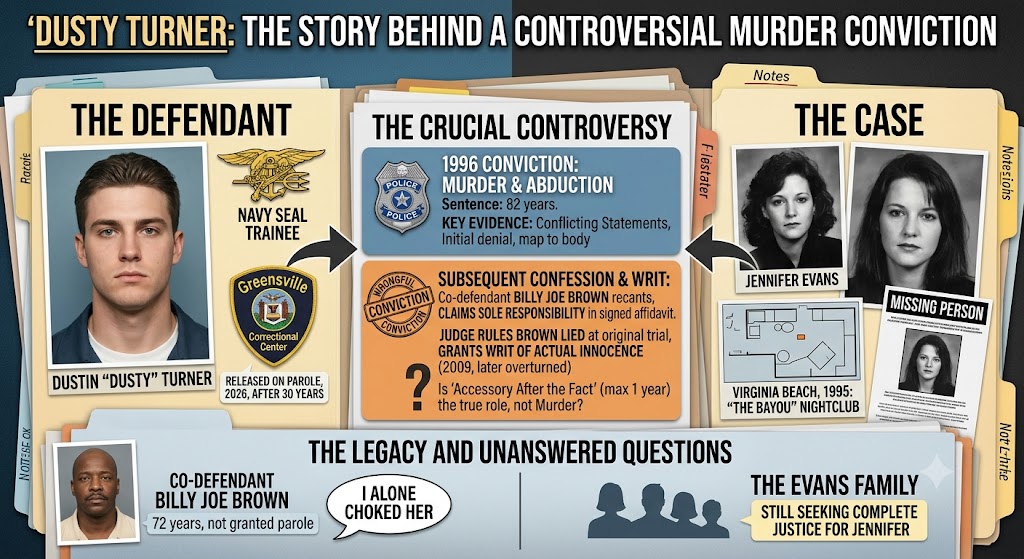
Dusty Turner became a well-known figure in the United States because of one of the country’s most controversial criminal cases. Before his arrest, Turner was a young U.S. Navy SEAL trainee with a promising future. His life changed dramatically after he was convicted in connection with the 1995 murder of Jennifer Evans.
The case attracted significant public attention because of its unusual circumstances, conflicting witness statements, and years of legal appeals. Supporters argued that Turner received an unfair sentence, while others believed the court’s decision reflected the seriousness of the crime. After spending more than thirty years behind bars, Turner was eventually released on parole, renewing public interest in his story and the wider debate about justice, accountability, and rehabilitation.
Early Life and Military Career
Dusty Turner grew up in Virginia and demonstrated an interest in military service from an early age. Determined to pursue a challenging career, he entered training to become a U.S. Navy SEAL.
SEAL training is recognized as one of the most demanding military programs in the world, requiring exceptional physical endurance, discipline, and mental resilience. Turner appeared to be on a path toward a successful military future before legal troubles interrupted his career.
The 1995 Murder Case
Turner’s name became nationally known after the death of Jennifer Evans in 1995. Prosecutors alleged that Turner was involved in the crime alongside another man.
The investigation relied heavily on witness testimony and statements presented during the trial. Prosecutors argued that Turner played a role in the events leading to the victim’s death, while the defense challenged several aspects of the evidence.
The case generated widespread media attention because many observers questioned whether the available evidence fully supported the conviction.
Trial and Conviction
During the trial, prosecutors presented evidence intended to establish Turner’s involvement in the crime. The court ultimately found him guilty, resulting in a lengthy prison sentence.
Legal experts and observers have continued to discuss the case because different interpretations of the evidence emerged over time. While the courts upheld the conviction through multiple appeals, supporters continued advocating for a review of the circumstances surrounding the case.
Life in Prison
Turner spent more than three decades incarcerated.
Throughout his imprisonment, reports indicated that he maintained a positive institutional record and participated in educational and rehabilitation programs. Long-term incarceration gave him time to reflect on his past while adapting to life inside the correctional system.
His supporters highlighted his behavior in prison as evidence of personal growth and rehabilitation.
Public Debate
The Dusty Turner case became part of broader discussions surrounding criminal justice in the United States.
Supporters argued that Turner deserved parole because of the amount of time served, his prison conduct, and questions surrounding portions of the evidence presented during the original trial.
Others maintained that the seriousness of the crime justified the punishment imposed by the court. These differing opinions helped keep the case in public discussion for many years.
| Issue | Discussion |
| Conviction | Based on evidence presented during trial |
| Appeals | Multiple legal efforts sought relief |
| Public Opinion | Divided over fairness of the sentence |
| Rehabilitation | Supporters cited positive prison record |
Release on Parole
After serving more than thirty years in prison, Turner was granted parole.
His release marked the beginning of a new chapter after decades of incarceration. It also renewed public conversations about rehabilitation, parole policies, and whether lengthy prison sentences achieve their intended goals.
Although parole does not erase a conviction, it allows individuals who meet legal requirements to re-enter society under supervision.
Why the Case Still Matters
The Dusty Turner case continues to attract attention because it touches on several important legal and social issues.
It raises questions about witness testimony, the reliability of evidence, sentencing practices, and opportunities for rehabilitation. Cases like Turner’s encourage discussions about balancing accountability with fairness while maintaining public confidence in the justice system.
For law students, criminal justice professionals, and those interested in legal history, the case remains an example of how complex criminal proceedings can influence public opinion for decades.
Lessons from the Case
Several broader lessons emerge from Turner’s story.
First, criminal investigations require careful examination of all available evidence. Second, legal proceedings can have lifelong consequences for everyone involved. Finally, rehabilitation remains an important topic within correctional systems, particularly for individuals serving lengthy prison sentences.
The case also demonstrates how public interest in criminal justice often continues long after court proceedings have ended.
Looking Ahead
As discussions about criminal justice reform continue across the United States, cases like Dusty Turner’s are frequently referenced in conversations about sentencing, parole, and rehabilitation.
While opinions remain divided regarding the original conviction, the case serves as a reminder of the importance of fair legal processes, thorough investigations, and ongoing review mechanisms within the justice system.
Conclusion
Dusty Turner’s journey—from Navy SEAL trainee to convicted prisoner and eventual parolee—is one of the more widely discussed criminal justice stories connected to the 1990s. His decades in prison, the legal debates surrounding his conviction, and his eventual release have made his case a subject of continued public interest.
Whether viewed through the lens of criminal law, rehabilitation, or legal reform, the story illustrates the lasting impact that major criminal cases can have on individuals, families, and society. It also highlights why discussions about fairness, accountability, and justice remain central to modern legal systems.
Frequently Asked Questions
Who is Dusty Turner?
Dusty Turner is a former U.S. Navy SEAL trainee who was convicted in connection with the 1995 murder of Jennifer Evans and later released on parole.
Why is Dusty Turner well known?
He is known because of the controversial murder case, his lengthy prison sentence, and ongoing public discussions surrounding his conviction.
How long was Dusty Turner in prison?
He spent more than thirty years in prison before being granted parole.
Was Dusty Turner released?
Yes. After serving decades in prison, he was released on parole under the applicable legal process.
Why does the case remain controversial?
The case continues to generate discussion because of differing interpretations of the evidence, legal appeals, and debates about criminal justice and rehabilitation.