
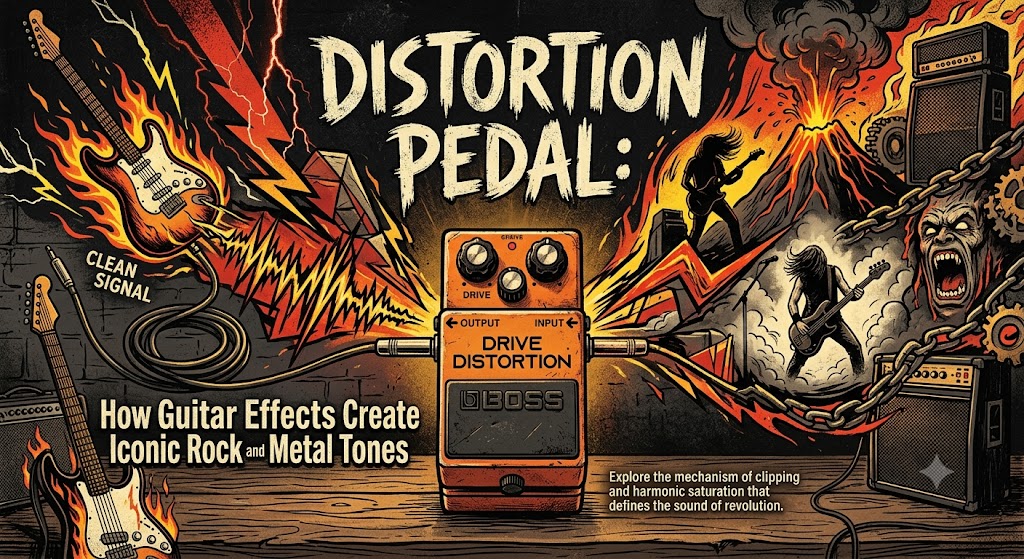
A distortion pedal is an effects unit for electric guitar or bass that alters the instrument’s tone by clipping the audio signal. This process creates a louder, more aggressive, and harmonically rich sound that has become central to rock, punk, blues, and metal music. From the raw crunch of 1970s guitar recordings to the heavier tones used in modern metal production, distortion remains one of the most recognizable sounds in popular music.
The basic purpose of a distortion pedal is simple: push the guitar signal beyond its clean limits to create controlled saturation. However, the design choices inside each pedal—including clipping methods, gain stages, EQ controls, and circuitry—produce very different tonal results.
Classic models such as the Boss DS-1 and ProCo Rat became industry standards because they offered reliable performance and distinctive sounds. Modern units, including high-gain designs like the Empress Effects Heavy, provide musicians with greater control over extreme tones while maintaining clarity and dynamic response.
Understanding how distortion works helps guitarists choose equipment more effectively. Instead of selecting pedals based only on popularity, players can evaluate how different circuits interact with their instruments, amplifiers, playing style, and musical goals.
How a Distortion Pedal Changes Guitar Sound
Electric guitars naturally produce relatively clean signals. When a player increases amplifier gain or uses an effects unit, the signal can become overloaded. A distortion circuit recreates this effect electronically by reshaping the waveform.
The process usually involves several stages:
| Component | Function |
| Gain stage | Increases the strength of the guitar signal |
| Clipping circuit | Creates controlled waveform distortion |
| Tone controls | Adjust frequencies such as bass, mids, and treble |
| Output stage | Adjusts final volume sent to the amplifier |
The result is a compressed sound with additional harmonics. Soft playing may produce mild grit, while aggressive picking can create a thicker and more powerful response.
This interaction between player dynamics and circuitry is one reason guitarists often develop strong preferences for specific pedals.
The Evolution of Distortion Effects
The history of distortion is closely connected with the development of electric guitar music. Early guitarists discovered that pushing tube amplifiers beyond their limits created a desirable rough tone. In the 1960s, artists began intentionally seeking this effect.
The introduction of dedicated pedals changed the way musicians accessed distortion. Instead of relying only on loud amplifiers, players could carry compact devices that delivered consistent tones on stage and in studios.
The Boss DS-1, released in 1978, became one of the most widely recognized distortion pedals worldwide. Its bright character and affordability helped introduce countless musicians to guitar effects.
The ProCo Rat, introduced in the late 1970s, gained popularity for blending distortion and fuzz-like characteristics. Its ability to move between subtle overdrive and heavier distortion made it valuable across multiple genres.
Comparing Popular Distortion Pedals
Different pedals serve different musical purposes. A high-gain metal player may need tighter low frequencies, while a blues guitarist may prefer a softer breakup.
| Model | Strength | Best For | Tone Character |
| Boss DS-1 | Affordable and reliable | Rock, beginners, live performance | Bright, classic distortion |
| ProCo Rat | Flexible gain range | Rock, alternative, punk | Thick and aggressive |
| Empress Effects Heavy | Advanced controls | Modern metal | Powerful high-gain sound |
The choice depends on the relationship between the pedal, amplifier, guitar pickups, and playing technique.
A common mistake is assuming expensive equipment automatically produces better tone. In practice, a well-matched affordable pedal can outperform a premium model when paired correctly with a guitarist’s setup.
Practical Considerations When Choosing a Distortion Pedal
Before buying a pedal, musicians should consider several factors.
Gain Requirements
Low-gain distortion provides a natural amplifier-like breakup, while high-gain designs create compressed tones suitable for heavier music.
Signal Chain Placement
Many guitarists place distortion before modulation effects such as delay or chorus. This allows the distorted signal to be shaped afterward.
Amplifier Compatibility
A pedal that sounds excellent through one amplifier may sound different through another. Tube amplifiers, solid-state amps, and digital modelling systems react differently.
Playing Style
Finger technique, pick attack, and guitar pickups influence how distortion responds. Humbucker pickups usually create stronger output than single-coil pickups.
Risks and Trade-Offs of Heavy Distortion
While distortion creates powerful sounds, excessive use can reduce musical clarity.
High gain can introduce:
- Increased background noise
- Reduced note separation
- Less dynamic expression
- Frequency conflicts in band mixes
Professional producers often balance distortion with careful EQ and compression rather than simply increasing gain.
A guitarist playing alongside bass, drums, and vocals must consider the entire arrangement. A tone that sounds impressive alone may disappear in a full mix.
Market Impact and Cultural Influence
Distortion pedals have influenced decades of music culture. Genres such as heavy metal, punk, grunge, and alternative rock developed around specific approaches to guitar tone.
The affordability of pedals also helped independent musicians create professional-sounding recordings without expensive studio equipment. Compact effects units remain popular because they provide creative control in small home studios and live environments.
Companies continue releasing new designs that combine traditional analogue circuits with digital features, including presets, software control, and impulse-response technology.
The Future of Distortion Pedals in 2027
By 2027, distortion technology is expected to continue moving toward hybrid systems that combine analogue warmth with digital convenience.
Modern musicians increasingly use modelling platforms and software-based effects, but physical pedals remain popular because many players value immediate control and tactile interaction.
Future developments may include:
- More advanced digital modelling of classic circuits
- Smartphone-based tone editing
- Better integration with recording software
- More environmentally efficient manufacturing
However, traditional analogue pedals are unlikely to disappear. Many musicians consider circuit imperfections and natural response part of the creative experience.
Key Takeaways
- Distortion pedals create aggressive guitar tones by clipping and reshaping audio signals.
- Classic models remain popular because they provide distinctive sounds and reliable performance.
- The best pedal depends on the guitar, amplifier, genre, and playing style.
- More gain does not always mean better tone.
- Modern designs increasingly combine analogue sound with digital flexibility.
- Distortion remains one of the most influential effects in guitar history.
Conclusion
Distortion pedals have transformed electric guitar music by making powerful, expressive tones accessible to musicians everywhere. From simple beginner models to advanced professional units, these devices continue shaping the sound of countless genres.
Choosing the right distortion effect requires understanding how circuits, equipment, and playing techniques interact. The most effective setup is not always the most expensive one; it is the one that supports the musician’s creative goals.
As technology advances, distortion pedals will continue evolving while preserving the character that made them essential tools for generations of guitarists.
FAQ
What does a distortion pedal do?
A distortion pedal increases and clips an electric guitar signal to create a saturated, aggressive tone. It can range from mild crunch to extreme high-gain sounds.
Is a distortion pedal necessary for metal guitar?
Many metal guitarists use distortion or high-gain effects because they provide the heavy, compressed sound associated with the genre. However, amplifier gain and pickups also influence tone.
What is the difference between distortion and overdrive?
Overdrive usually creates a softer, more natural breakup similar to a pushed tube amplifier. Distortion produces stronger clipping and a more aggressive sound.
Are expensive distortion pedals better?
Price does not always determine quality. A less expensive pedal may work better depending on the guitarist’s amplifier, instrument, and musical style.
Can beginners use distortion pedals?
Yes. Many beginner guitarists start with distortion pedals because they provide immediate access to recognizable rock and metal tones.
How should distortion pedals be placed in a signal chain?
Most players place distortion before modulation effects like delay and reverb, allowing those effects to process the distorted signal.
Methodology
This article was developed using information from manufacturer documentation, historical guitar equipment records, and established music technology references. Product descriptions were evaluated through publicly available specifications from manufacturers and industry sources.
Limitations include the subjective nature of guitar tone preferences. A distortion pedal’s performance depends heavily on equipment combinations, playing technique, and musical context.
References
Boss Corporation. (2024). Guitar effects product information and DS-1 specifications.
ProCo Sound. (2024). RAT distortion pedal history and product documentation.
Empress Effects. (2024). Heavy distortion pedal technical specifications.
Dregni, M. (2021). Gear Secrets of the Guitar Legends: How to Sound Like Your Favorite Players. Backbeat Books.