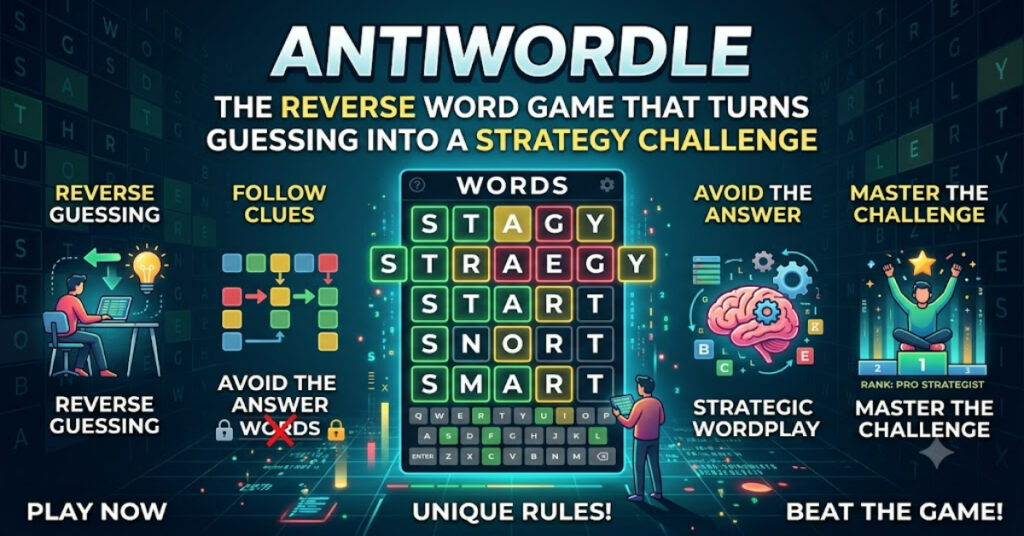
Antiwordle is a reverse-wordle game where the objective is not to discover the hidden five-letter word but to avoid guessing it for as long as possible. Unlike traditional word puzzles that reward speed and accuracy, this format creates a different type of challenge built around patience, deduction, and risk management.
The game gained attention after the popularity of Wordle in 2021, when developers and players began experimenting with alternative versions of the familiar format. Instead of celebrating a correct answer, Antiwordle makes that moment the end of the game.
This simple reversal changes the entire player mindset. Every guess becomes a calculation: which word provides useful information while keeping the player alive? The result is a puzzle experience that feels familiar but requires a completely different approach.
The appeal of Antiwordle comes from its ability to challenge assumptions. Most word games train players to search for solutions quickly. This version encourages players to think about uncertainty, probability, and controlled decision-making.
How Antiwordle Changes Traditional Word Puzzle Design
Traditional word puzzles are built around achievement. Players receive feedback after each attempt and use that information to move closer to the answer.
Antiwordle keeps many of these mechanics:
- Five-letter word selection
- Letter feedback systems
- Limited vocabulary choices
- Daily puzzle formats
However, the goal is completely reversed.
| Feature | Traditional Word Puzzle | Antiwordle |
| Main objective | Find the hidden word | Avoid finding the hidden word |
| Winning condition | Solve quickly | Survive as long as possible |
| Player mindset | Accuracy-focused | Risk-management focused |
| Feedback usage | Narrow possibilities | Maintain possibilities |
| Failure point | Too many attempts | Correct answer discovered |
This change creates a different psychological experience. Players are no longer hunters searching for information. They become defenders protecting uncertainty.
The Strategy Behind Avoiding the Answer
The core skill in Antiwordle is understanding how each guess affects future options.
In normal word games, players often choose words with common letters because they want confirmation. In Antiwordle, that approach can be dangerous. A highly informative guess may accidentally reveal the solution.
Strong strategies usually involve:
Maintaining a Large Possibility Pool
Players benefit from keeping many possible answers available. Eliminating too many words early can increase the chance of accidentally discovering the hidden solution.
Managing Letter Information
The colour-based feedback system remains important. However, the interpretation changes.
A player may intentionally avoid confirming certain letter combinations because those clues could lead directly to the answer.
Thinking About Risk Instead of Progress
The best move is not always the one that provides the most information. Sometimes the safest choice is the guess that creates the least immediate danger.
This makes Antiwordle closer to probability management than traditional vocabulary testing.
Why Reverse Games Are Becoming Popular
The growth of Antiwordle reflects a wider trend in gaming: players enjoy familiar systems with unexpected rules.
Many successful games are based on changing a single assumption:
- Competitive games reverse cooperation expectations.
- Puzzle games remove traditional scoring systems.
- Strategy games introduce unusual victory conditions.
Antiwordle benefits from this design principle. The rules are easy to understand because players already know the original concept, but the experience feels new because the objective has changed.
Practical Insights From Playing Antiwordle
Several lessons emerge from analysing the game format.
| Insight | Explanation | Practical Effect |
| Information is not always beneficial | More clues can create greater risk | Players must balance knowledge and survival |
| Failure can become the goal | The game rewards delayed success | Changes traditional achievement patterns |
| Familiar systems can support innovation | Small rule changes create new experiences | Developers can refresh simple formats |
One important limitation is that reverse puzzle games may have a shorter learning curve. Once players understand optimal strategies, the challenge can become predictable compared with games containing deeper progression systems.
Another challenge is accessibility. Players who enjoy solving problems may initially find it uncomfortable to intentionally avoid the correct answer.
The Cultural Impact of Antiwordle and Similar Games
The popularity of reverse-format games shows how internet communities interact with simple digital experiences.
Word games often succeed because they encourage sharing. Daily challenges create conversations among friends, online communities, and social media groups.
Antiwordle adds a humorous element because players celebrate failure. This contrasts with traditional gaming culture, where success is usually the main achievement.
The game also highlights a broader interest in “anti-goals” — experiences where users intentionally avoid normal outcomes. Similar ideas appear in creative challenges, speedrunning variations, and experimental game design.
The Future of Antiwordle in 2027
By 2027, reverse puzzle formats are likely to remain a niche but influential part of casual gaming.
The future growth of games like Antiwordle will depend on several factors:
- More personalised puzzle generation
- Adaptive difficulty systems
- Integration with mobile gaming platforms
- Community-created variations
Artificial intelligence may also influence puzzle design by creating personalised challenges based on player behaviour. However, the simplicity of Antiwordle remains its strongest feature. Adding too many complex systems could remove the elegant design that makes the concept attractive.
The larger lesson for game developers is that innovation does not always require complicated technology. Changing the relationship between players and objectives can create entirely new experiences.
Key Takeaways
- Antiwordle reverses traditional word puzzle goals by making avoidance the main objective.
- The game requires probability thinking rather than simple vocabulary knowledge.
- Reverse mechanics can create fresh experiences from familiar designs.
- Information management becomes more important than finding answers quickly.
- The popularity of Antiwordle reflects growing interest in experimental casual games.
Conclusion
Antiwordle demonstrates how a small change in game rules can completely transform player behaviour. By reversing the objective of traditional word puzzles, it creates a unique experience based on uncertainty, strategy, and controlled decision-making.
The game succeeds because it is easy to understand while offering a surprisingly different mental challenge. Players already know the foundation, but they must completely rethink their approach.
Its influence extends beyond a single puzzle format. Antiwordle represents a broader movement in gaming where developers experiment with alternative goals and unexpected mechanics. While it may remain a simple casual game, its design approach offers valuable lessons about creativity and innovation in interactive entertainment.
Frequently Asked Questions
What is Antiwordle?
Antiwordle is a reverse word puzzle where players try to avoid guessing the hidden five-letter word for as long as possible.
How is Antiwordle different from Wordle?
Wordle rewards players for finding the correct answer quickly, while Antiwordle challenges players to delay discovering the answer.
Is Antiwordle harder than traditional word games?
Many players find Antiwordle difficult because it requires avoiding normal problem-solving instincts and managing risk carefully.
Can strategy improve Antiwordle performance?
Yes. Players can improve by controlling information, avoiding risky guesses, and maintaining a larger range of possible answers.
Is Antiwordle available as a daily puzzle?
Yes, Antiwordle has been offered as a daily online puzzle format similar to other word games.
Methodology
This article was prepared using analysis of publicly available information about reverse word puzzle mechanics, online gaming trends, and documented discussions surrounding Wordle-style games. The analysis focuses on gameplay design principles rather than claiming original gameplay testing. Limitations include the changing availability of specific online puzzle versions and variations created by independent developers.
References
- New York Times. (2022). The acquisition and continued development of Wordle. The New York Times Company.
- Juul, J. (2011). Half-Real: Video Games between Real Rules and Fictional Worlds. MIT Press.
- Schell, J. (2020). The Art of Game Design: A Book of Lenses. CRC Press.