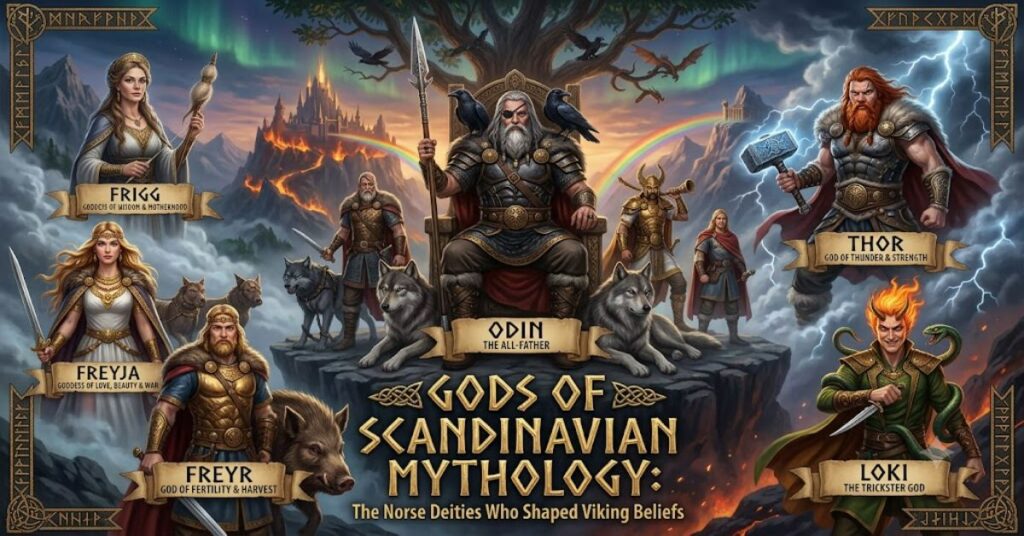
The gods of Scandinavian mythology are among the most influential figures in ancient European folklore. Originating from the beliefs of the Norse people during the Viking Age (roughly AD 793–1066), these deities governed everything from war and wisdom to fertility and the sea. The mythology centres on two main groups of gods—the Æsir and the Vanir—who eventually united after a legendary conflict. Led by powerful figures such as Odin, Thor, and Freyja, these gods lived primarily in Asgard while interacting regularly with humans and giants through a richly connected cosmology.
The stories preserved in medieval Icelandic texts continue to fascinate historians, archaeologists, and mythology enthusiasts because they offer valuable insights into Scandinavian society, religion, and worldview.
Understanding the Norse Pantheon
Unlike many ancient religions that focused on perfect, immortal gods, Norse mythology presents deities with strengths, weaknesses, ambitions, and inevitable destinies. Even the greatest gods cannot escape Ragnarök, the prophesied end of the world.
This perspective reflects the Viking understanding that bravery lies not in avoiding death but in facing it with honour.
The Two Divine Families
| Group | Primary Role | Notable Members |
| Æsir | War, leadership, wisdom | Odin, Thor, Tyr, Baldr |
| Vanir | Fertility, prosperity, nature | Freyja, Freyr, Njord |
Following a mythical war, members of both groups exchanged hostages and formed a united pantheon.
The Most Important Norse Gods
Odin – The Allfather
Odin ruled Asgard and served as the chief of the Æsir. Rather than relying solely on strength, he constantly sought knowledge.
His most famous sacrifices include:
- Giving one eye to drink from Mimir’s Well of Wisdom
- Hanging himself on Yggdrasil, the World Tree, for nine nights to discover the runes
- Consulting seers and spirits about the future
Odin was associated with kingship, poetry, magic, battle strategy, and wisdom.
Thor – Protector of Gods and Humanity
Thor remains the best-known Norse deity worldwide.
Armed with his magical hammer, Mjölnir, Thor defended Asgard and Midgard (Earth) from giants and other threats.
His characteristics included:
- Incredible physical strength
- Protection of ordinary people
- Control over thunder and lightning
- Sacred connection to oak trees and storms
Archaeological discoveries show that Thor’s hammer pendants were widely worn during the Viking Age, demonstrating his immense popularity.
Freyja – Goddess of Love and War
Freyja belonged to the Vanir but became one of the most respected gods after joining the Æsir.
She represented:
- Love
- Fertility
- Beauty
- Magic (Seiðr)
- Battle
According to Norse tradition, Freyja received half of all warriors who died in battle, while Odin welcomed the other half into Valhalla.
Loki – The Trickster
Although often portrayed as evil in modern adaptations, Loki occupies a much more complicated position in Norse mythology.
He alternates between helping and sabotaging the gods.
Some of his most famous actions include:
- Helping obtain magical treasures
- Causing Baldr’s death
- Fathering mythical creatures including Fenrir, Jörmungandr, and Hel
His betrayal eventually contributes to Ragnarök.
Other Significant Gods
Many additional gods played important roles within Norse religion.
| God | Domain |
| Baldr | Light, purity, beauty |
| Tyr | Justice and heroic courage |
| Heimdall | Guardian of Bifröst |
| Njord | Sea, wealth, commerce |
| Freyr | Harvests, prosperity, peace |
| Frigg | Marriage, motherhood, foresight |
Each deity fulfilled specific social and religious functions important to Viking communities.
The Nine Realms
The gods inhabited a universe connected by Yggdrasil, the immense World Tree.
Structured Overview
| Realm | Primary Inhabitants |
| Asgard | Æsir gods |
| Vanaheim | Vanir gods |
| Midgard | Humans |
| Jötunheim | Giants |
| Alfheim | Light Elves |
| Svartalfheim | Dwarfs |
| Niflheim | Ice and mist |
| Muspelheim | Fire giants |
| Helheim | Many of the dead |
This interconnected cosmology shaped how Scandinavians understood nature, destiny, and spiritual existence.
Cultural Importance During the Viking Age
The Norse gods influenced daily life far beyond religious ceremonies.
Historical evidence shows their presence in:
- Personal names
- Place names
- Jewellery
- Burial customs
- Political leadership
- Seasonal festivals
For example, Thursday derives from “Thor’s Day,” while Wednesday originates from “Woden’s Day,” referring to Odin in Old English.
These linguistic connections demonstrate the lasting influence of Norse belief across northern Europe.
Historical Evidence Behind the Myths
Knowledge of Norse mythology comes from several important historical sources.
The most influential include:
- The Poetic Edda
- The Prose Edda by Snorri Sturluson (13th century)
- Icelandic sagas
- Viking rune stones
- Archaeological excavations
- Temple remains discovered throughout Scandinavia
These sources combine mythology, oral tradition, and historical memory, requiring historians to compare literary evidence with archaeological findings.
Evidence-Based Insight
Modern excavations at sites such as Uppåkra in Sweden and Tissø in Denmark reveal ceremonial centres connected with Norse worship, supporting many aspects of medieval written accounts while also showing regional differences in religious practice.
Original Insights
Several aspects of the gods of Scandinavian mythology receive less attention than famous stories about Thor or Odin.
First, Norse religion had no single sacred scripture. Beliefs varied considerably between Iceland, Norway, Sweden, and Denmark, suggesting a flexible religious tradition rather than a rigid doctrine.
Second, the relationship between gods and humans was reciprocal. Vikings made offerings expecting practical benefits—safe voyages, successful harvests, or victory in battle—rather than unquestioning devotion.
Third, archaeological evidence indicates that local deities and regional traditions often existed alongside the famous gods, highlighting the diversity of pre-Christian Scandinavian religion.
The Future of Scandinavian Mythology in 2027
Interest in Norse mythology continues to grow through museums, academic research, historical tourism, and digital media. By 2027, ongoing archaeological projects and advances in digital reconstruction are expected to provide more detailed visualisations of Viking ceremonial sites and artefacts.
At the same time, scholars continue to emphasise separating historical evidence from fictional adaptations. While popular entertainment has increased public awareness, academic institutions increasingly encourage evidence-based interpretations grounded in archaeology, linguistics, and medieval manuscripts.
Key Takeaways
- The Æsir and Vanir formed the two principal families of Norse gods.
- Odin represented wisdom, while Thor symbolised protection and strength.
- Freyja combined fertility, magic, and warrior traditions.
- Viking religious practice varied across different Scandinavian regions.
- Archaeology continues to refine our understanding of ancient Norse beliefs.
- Modern popular culture often simplifies complex mythological traditions.
Conclusion
The gods of Scandinavian mythology remain some of history’s most compelling religious figures because they embody deeply human qualities alongside extraordinary powers. Their stories reveal how Viking societies understood courage, honour, leadership, nature, and destiny. Rather than portraying flawless beings, Norse mythology presents gods who struggle, learn, sacrifice, and ultimately face unavoidable fate.
Centuries after Christianity replaced the old Norse religion, these myths continue to inspire literature, archaeology, television, films, and historical scholarship. As new discoveries emerge from Scandinavian archaeological sites, our understanding of these remarkable traditions becomes increasingly nuanced. Studying Norse mythology is therefore not simply an exploration of ancient legends but also an opportunity to understand the beliefs, values, and cultural legacy of the people who shaped medieval northern Europe.
Methodology
This article gods of Scandinavian mythology synthesises information from established historical scholarship, archaeological findings, and primary medieval texts. The analysis relies on recognised academic sources, including translations of the Poetic Edda and Prose Edda, alongside recent research from museums and university publications. Limitations include the fragmentary nature of surviving pre-Christian sources and the fact that many written records were compiled centuries after the Viking Age. Interpretations presented here aim to balance literary tradition with archaeological evidence.
Editorial Disclosure: This article was drafted with AI assistance and should be reviewed and verified by the editorial team before publication.
FAQ
Who are the main gods of Scandinavian mythology?
The principal gods include Odin, Thor, Freyja, Loki, Tyr, Freyr, Frigg, Heimdall, Baldr, and Njord. Odin serves as the chief deity, while Thor is the protector of gods and humanity.
What is the difference between the Æsir and Vanir?
The Æsir are mainly associated with war, leadership, and governance, whereas the Vanir are connected with fertility, prosperity, and nature. After a mythical war, the two groups united.
Did Vikings actually worship Thor?
Yes. Archaeological discoveries, including Mjölnir hammer pendants and temple remains, indicate that Thor was one of the most widely worshipped Norse gods during the Viking Age.
Where did the Norse gods live?
The gods primarily resided in Asgard, one of the Nine Realms connected by Yggdrasil, the World Tree.
Is Loki considered a god or a giant?
Loki has giant ancestry but lived among the gods and participated in many of their adventures, making him a complex figure rather than fitting neatly into one category.
References (APA)
Byock, J. L. (2022). The Viking Age: A Reader (Updated ed.). Penguin Books.
HistoryExtra. (2024). Who were the Norse gods? https://www.historyextra.com/
Larrington, C. (Trans.). (2023). The Poetic Edda. Oxford University Press.
National Museum of Denmark. (2023). The Viking Age and Norse Religion.
Sturluson, S. (Trans. A. Faulkes). (2022 ed.). The Prose Edda. Everyman.