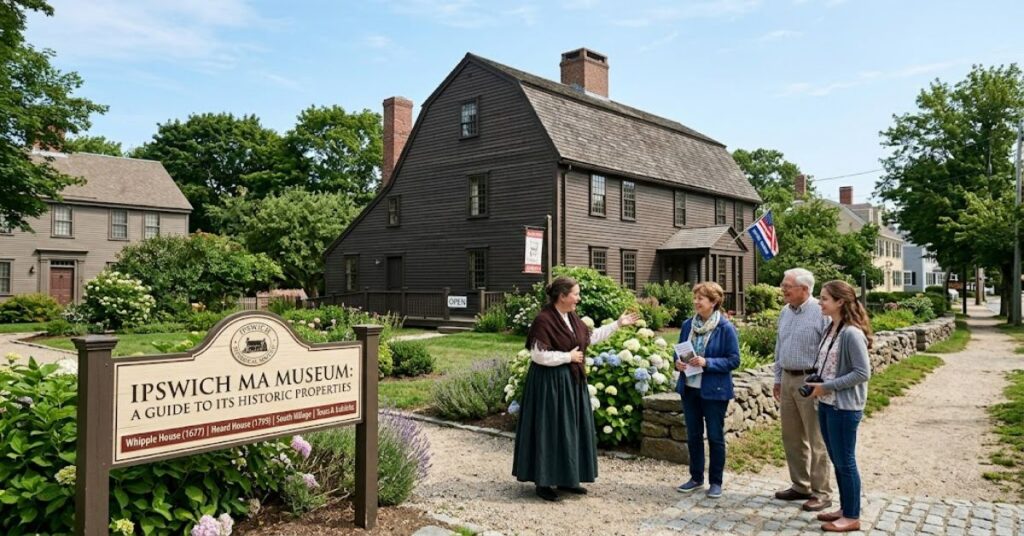
For anyone searching for an Ipswich MA museum, the town offers a distinctive historical experience centred on preserved properties rather than a single conventional museum building. The Ipswich Museum oversees several important historic homes, including the Whipple House, built in 1677, the Heard House, dating from 1795–1800, and the Alexander Knight House. These properties are made available to visitors through seasonal guided tours.
This approach gives visitors an opportunity to experience history in the places where it physically unfolded. Instead of viewing every object behind glass, visitors can explore buildings that reflect different periods of Ipswich’s development. Architecture, interior spaces and surviving historical details can all help explain how the town changed over generations.
Ipswich itself has a deep connection with early Massachusetts history, making its historic properties especially valuable to people interested in colonial architecture, local culture and community development. A visit can appeal to residents, families, students and travellers who want to move beyond the usual tourist experience.
The strongest reason to visit is not simply the age of the buildings. Historic properties create context. They show how construction methods changed, how wealth and domestic life were expressed and how each generation adapted existing spaces to new needs. For visitors who enjoy history, that makes the Ipswich experience both educational and memorable.
The Whipple House and Colonial Ipswich
The Whipple House is one of the most significant properties associated with the museum. Built in 1677, it represents a remarkably early period of New England domestic architecture.
A building from the seventeenth century can reveal details that are difficult to understand through photographs alone. The scale of rooms, timber construction and relationship between different spaces help visitors imagine the practical realities of colonial life.
The Whipple House also represents an important challenge in historic preservation. Buildings do not remain unchanged simply because they survive. They are repaired, adapted and interpreted over time. Understanding a historic property therefore means looking not only at its original construction but also at the decisions that helped preserve it.
The Heard House and a Changing America
The Heard House dates from approximately 1795 to 1800, placing it in a very different historical context from the Whipple House. By this period, the United States had emerged from the Revolutionary era and communities were developing new social and economic identities.
Comparing the Heard House with an earlier colonial property can help visitors see how architectural priorities changed over more than a century.
| Historic Property | Approximate Date | Historical Perspective |
| Whipple House | 1677 | Colonial New England |
| Heard House | 1795–1800 | Early American period |
| Alexander Knight House | Historic property | Local community history |
The contrast between these properties is one of the most useful parts of an Ipswich MA museum visit. Rather than presenting history as a single frozen moment, the collection of homes reflects continuity and change.
Why Historic Homes Matter
Historic houses are sometimes viewed as simple collections of old furniture and decorative objects. In reality, they can function as records of social history.
A doorway, fireplace, staircase or building extension may reveal something about technology, family life or economic circumstances. Even the layout of a property can show how ideas about privacy and domestic work changed.
This makes preservation important for more than tourism. Historic sites can support education and give local communities a tangible connection to earlier generations.
A useful insight for visitors is that preservation also involves interpretation. Every guided tour makes choices about which stories to highlight. The strongest museum experiences acknowledge that history is complex and that buildings can contain multiple layers of meaning.
What to Expect from Seasonal Guided Tours
The museum offers guided tours on a seasonal basis, so visitors should plan ahead when arranging a trip.
Guided interpretation can be particularly valuable in historic homes because architectural details are not always self-explanatory. A guide can provide context about construction, former residents and the broader period represented by the property.
| Visitor Interest | What Historic Properties Can Offer |
| Architecture | Examples of changing building styles and methods |
| Local history | Connections to Ipswich and its development |
| Education | A physical setting for understanding historical periods |
| Family visits | Guided storytelling and visual exploration |
| Cultural tourism | A destination beyond conventional museum galleries |
Visitors should also remember that historic buildings may have practical limitations. Accessibility, tour duration and seasonal availability can vary. Checking current arrangements before travelling is sensible.
The Cultural Value of the Ipswich MA Museum Experience
The value of an Ipswich MA museum visit lies partly in its sense of place. These buildings were not created as modern exhibition spaces. They were homes with practical purposes, personal histories and connections to the community around them.
That creates a different relationship between visitors and history. Instead of standing outside the story, visitors enter spaces that have survived for generations.
Historic tourism can also benefit local communities when it encourages visitors to explore wider cultural attractions, local businesses and the architectural character of the town. Preservation, education and tourism can therefore support one another, although careful management is needed to protect fragile sites.
Risks and Trade-Offs in Historic Preservation
Preserving a centuries-old property is never simple. Organisations must balance historical authenticity with visitor safety, structural maintenance and public access.
Too much modern intervention can affect a building’s historic character. Too little maintenance can place the structure at risk. This creates a constant trade-off between preservation and practical use.
Another challenge is interpretation. A museum must make history understandable without oversimplifying it. Visitors benefit when guides and exhibitions provide context while also recognising that historical understanding can evolve as new research becomes available.
The Future of Ipswich MA Museum in 2027
By 2027, historic museums and cultural organisations are likely to place even greater emphasis on digital interpretation, accessibility and audience engagement. However, technology should support the physical experience rather than replace it.
Digital archives, audio guides and interactive historical resources may help visitors prepare for a tour or continue learning afterwards. At the same time, the strongest feature of historic properties will remain their authenticity.
Standing inside a building that has survived for centuries creates an experience that a screen cannot fully reproduce. The future challenge will be finding ways to attract new audiences while protecting the character of the sites themselves.
Key Takeaways
- The Ipswich MA museum experience includes several important historic properties.
- The Whipple House, built in 1677, offers a connection to colonial New England.
- The Heard House represents a later phase of early American history.
- Historic homes can reveal changes in architecture, domestic life and community development.
- Seasonal guided tours provide useful historical context for visitors.
- Preservation requires a careful balance between authenticity, maintenance and public access.
Conclusion
An Ipswich MA museum visit offers a different way to experience history. Through preserved homes such as the Whipple House, Heard House and Alexander Knight House, visitors can explore the physical spaces that connect Ipswich’s past with its present.
The importance of these properties goes beyond their age. They provide evidence of changing architectural styles, social conditions and local traditions. They also demonstrate why preservation requires ongoing care, research and thoughtful interpretation.
For visitors interested in colonial history, early American architecture or the cultural story of Massachusetts communities, Ipswich’s historic properties offer a focused and meaningful experience. Seasonal guided tours can add the context needed to understand the buildings more fully and appreciate the generations of history they represent.
FAQ
What is the Ipswich MA museum known for?
The museum experience is associated with historic properties, including the Whipple House, Heard House and Alexander Knight House, which preserve different periods of Ipswich history.
How old is the Whipple House?
The Whipple House dates to 1677, making it an important example of early colonial-era architecture.
What historic homes does the Ipswich Museum oversee?
The museum oversees the Whipple House, Heard House and Alexander Knight House.
Are guided tours available?
Yes. Guided tours of the historic properties are offered on a seasonal basis. Availability may vary, so visitors should confirm arrangements before planning a visit.
Is the Ipswich MA museum suitable for history lovers?
Yes. The historic properties are particularly relevant for visitors interested in colonial history, early American life, architecture and local heritage.
Methodology
This article was developed from the supplied Postcard.fm editorial brief and its keyword detail, which identifies the Ipswich Museum’s three historic properties and notes that guided tours are offered seasonally. The analysis focuses on the historical and educational significance of preserved properties without inventing visitor experiences, interviews or unverified statistics.