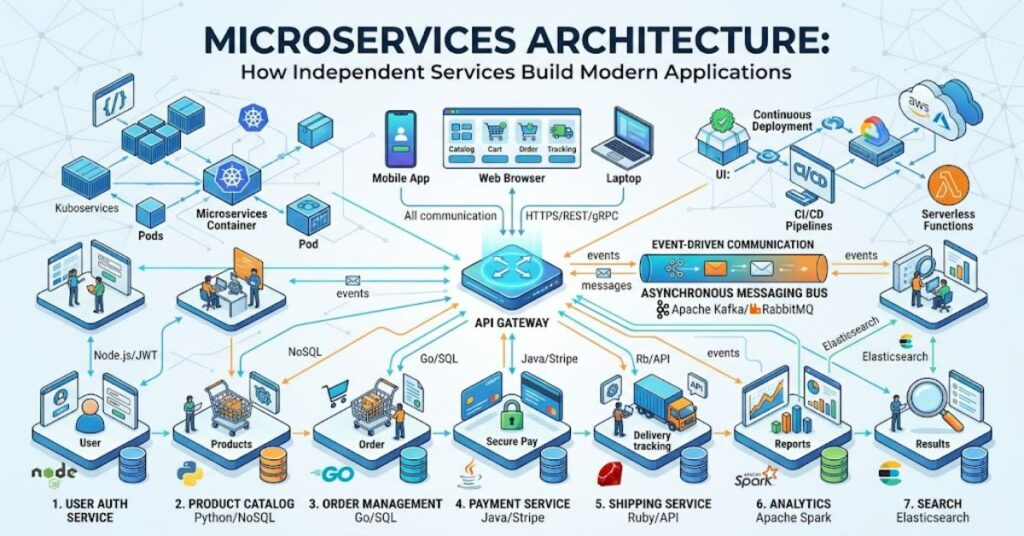
Microservices architecture builds a single application as a collection of small, independent services, with each service responsible for a specific business capability. These services communicate through lightweight, well-defined APIs rather than existing as one tightly connected codebase.
The approach became prominent as development teams looked for alternatives to large monolithic applications. In a traditional monolith, many functions may share the same deployment process and database. A change to one area can therefore require rebuilding and deploying the entire application. Microservices separate these functions so individual services can be developed, tested and deployed independently.
That independence is useful, but it is not free. A system with dozens of services has more network calls, deployment units, logs, failure points and operational dependencies than a simple application. Microsoft describes service discovery, data consistency, communication, testing and distributed management as important challenges.
For that reason, microservices architecture should be treated as an architectural choice rather than a default upgrade from monolithic software.
How Microservices Architecture Works
A typical system divides business functions into services such as customer accounts, payments, orders, inventory and notifications. Each service owns a defined responsibility and exposes an interface that other components can use.
An API gateway is often placed between clients and backend services. It can provide routing, authentication, load balancing and other cross-cutting functions. Internal communication may use synchronous APIs or asynchronous messaging, depending on the workflow.
Data ownership is another important principle. Instead of allowing every service to use a shared database schema, each service should generally control its own data. This reduces direct dependencies and allows individual services to evolve independently.
Microservices vs Monolithic Architecture
| Area | Microservices | Monolithic |
| Deployment | Individual services | Usually whole application |
| Scaling | Service by service | Usually application-wide |
| Data | Often service-owned | Commonly centralised |
| Communication | Network APIs or messaging | Mostly in-process |
| Operations | More distributed | Simpler initially |
| Technology | Can vary between services | Usually more unified |
| Failure handling | Requires distributed resilience | Fewer network boundaries |
The practical distinction is not simply that one model is “small” and the other is “large”. The deeper difference is how responsibilities, dependencies and deployment boundaries are organised.
Benefits and Trade-Offs
The strongest advantage is independent change. A team can update one service without necessarily redeploying the complete application. Services can also be scaled according to demand, meaning a heavily used function does not automatically require every part of the system to receive additional resources.
Microservices can also support organisational independence. Small teams can take ownership of particular business capabilities, reducing coordination requirements between teams.
However, splitting software creates new technical problems. A request may travel through several services, increasing latency and creating more places where failure can occur. Distributed data also makes transactions and consistency more complicated. Microsoft specifically warns that long chains of service dependencies and overly chatty APIs can create performance and coupling problems.
| Architectural concern | Practical implication |
| Service boundaries | Poor boundaries create unnecessary dependencies |
| Network latency | More service calls can slow critical workflows |
| Data consistency | Distributed ownership complicates transactions |
| Observability | Logs and traces must be correlated across services |
| Deployment | Automation becomes increasingly important |
| Security | Every service boundary adds communication and access concerns |
One useful insight follows from these trade-offs: microservices reduce some forms of coupling while potentially increasing others. A shared codebase may become less tightly connected, but network contracts, APIs, schemas and event formats become important dependencies.
Designing Effective Services
The most important design decision is where to draw service boundaries. Microsoft recommends modelling services around business capabilities rather than technical layers such as generic data-access or messaging components. A service should have a clear purpose and high functional cohesion.
A service that is too large can become a miniature monolith. A service that is too small can create excessive communication overhead. The objective is therefore not to create the maximum possible number of services. It is to create boundaries that reflect meaningful business responsibilities.
Automation is equally important. Independent deployment becomes difficult when releases still require extensive manual coordination. Continuous integration and continuous delivery pipelines can automate testing, deployment and health checks across services. Observability should cover centralised logging, metrics and distributed tracing so teams can follow a request across service boundaries.
The Future of Microservices Architecture in 2027
By 2027, microservices are likely to remain an important pattern for complex cloud applications, but architectural practice is expected to focus increasingly on operational discipline rather than simply decomposing applications.
Container orchestration, managed application platforms, asynchronous messaging and distributed observability are already established parts of modern microservices environments. Microsoft’s current guidance identifies platforms such as Kubernetes-based services and managed container environments as options for independent deployment and scaling.
The more significant shift may be towards choosing the simplest architecture that meets a system’s actual requirements. A modular monolith can remain appropriate for smaller teams or less complex domains. Microservices become more compelling when independent scaling, frequent releases, organisational autonomy or complex business boundaries justify their operational cost.
Key Insights
- Service boundaries should follow business capabilities rather than arbitrary technical layers.
- Independent deployment does not eliminate dependencies; it changes where those dependencies exist.
- Data ownership is central to maintaining service autonomy.
- Observability is a core architectural requirement, not an optional monitoring feature.
- Excessive service granularity can increase latency and operational overhead.
- Mature CI/CD practices make independent deployment considerably more practical.
- A monolith can be an appropriate choice when distributed complexity offers little measurable benefit.
Conclusion
Microservices architecture provides a structured way to build applications from independent services rather than one tightly coupled deployment unit. Its value comes from meaningful autonomy: teams can develop, deploy and scale services around distinct business capabilities. That model can improve flexibility for complex systems, particularly where different functions have different scaling or release requirements.
Yet independence introduces a different class of problems. Network communication, distributed transactions, service discovery, observability and failure recovery all require deliberate engineering. A poorly designed microservices system can become more difficult to operate than the monolith it replaced.
The central lesson is therefore architectural rather than technological. Microservices work best when service boundaries are clear, data ownership is respected, communication is deliberately designed and operational automation is mature. The goal should not be to maximise the number of services, but to create useful boundaries that make the overall system easier to change and operate.
FAQ
What is microservices architecture?
It is an architectural style in which an application consists of small, independently deployable services, with each service responsible for a defined business capability.
How do microservices communicate?
They commonly communicate through well-defined APIs. Some workflows use synchronous requests, while event-driven systems can use asynchronous messaging.
Are microservices better than monolithic applications?
Neither approach is universally better. Microservices can provide independent deployment and scaling but introduce distributed-system complexity. The appropriate choice depends on the application’s requirements.
Does every microservice need its own database?
Service-owned data is a common microservices principle because it reduces shared-state coupling. The exact implementation depends on the system and its consistency requirements.
Is Kubernetes required for microservices?
No. Kubernetes is one orchestration option. Microservices can also run on other container platforms, managed application services or infrastructure environments.
What is the biggest challenge with microservices?
The major challenge is managing distributed complexity. Communication, consistency, monitoring, deployment and failure handling become more difficult as the number of services increases.
Methodology
This article uses established architectural guidance from Microsoft Azure Architecture Center, AWS and Martin Fowler and James Lewis’s foundational 2014 description of microservices. No claim of firsthand testing or personal implementation experience is made. The analysis focuses on documented architectural characteristics, benefits and trade-offs. Because implementations vary considerably, specific technology choices should be validated against an application’s workload, team capability, security requirements and operational environment.
References
AWS. (2026). What is microservices architecture? AWS.
Fowler, M., & Lewis, J. (2014). Microservices: A definition of this new architectural term. Martin Fowler.
Microsoft. (2026). Microservices architecture style. Microsoft Azure Architecture Center.
Microsoft. (2026). Design a microservices architecture. Microsoft Azure Architecture Center.
Microsoft. (2026). Use domain analysis to model microservices. Microsoft Azure Architecture Center.