
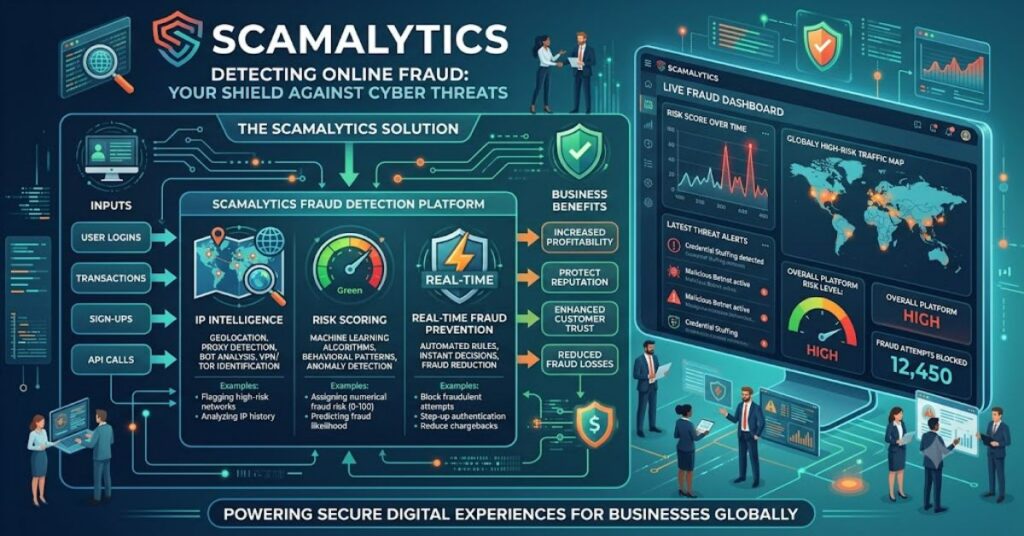
Online fraud continues to grow as businesses expand their digital services. From fake account registrations to payment fraud and identity theft, organizations face increasingly sophisticated threats that traditional security systems may not detect. Scamalytics is a fraud prevention platform designed to help businesses identify risky users before fraudulent activity causes financial or reputational damage.
Rather than relying on a single indicator, Scamalytics analyzes multiple data points to calculate a fraud risk score. This allows businesses to make better-informed decisions about customer registrations, transactions, and account activity. Whether protecting an online marketplace, subscription service, or financial platform, effective fraud detection can reduce losses while maintaining a positive customer experience.
What Is Scamalytics?
Scamalytics is a cybersecurity and fraud detection company that develops products to help organizations identify and prevent online fraud. Its services focus on analyzing customer activity using multiple intelligence sources rather than simple rule-based screening.
Businesses integrate the platform into websites, applications, and payment systems to evaluate risk before approving registrations or transactions.
Its solutions are commonly used by:
- Online marketplaces
- Financial technology companies
- Dating platforms
- E-commerce businesses
- Digital subscription services
How Scamalytics Works
The platform evaluates incoming activity using a combination of fraud indicators. Instead of blocking every unfamiliar visitor, it assigns a risk score based on available information.
Typical evaluation factors include:
- IP address reputation
- Device characteristics
- Geographic location
- Proxy or VPN detection
- Behavioral patterns
- Historical fraud intelligence
When the calculated risk exceeds a predefined threshold, businesses can choose to block, review, or request additional verification from the user.
Core Features
| Feature | Purpose |
| IP reputation analysis | Identifies suspicious network activity |
| Risk scoring | Assigns fraud probability to users |
| API integration | Connects with websites and applications |
| Device intelligence | Detects unusual devices and behavior |
| Real-time screening | Evaluates activity instantly |
Benefits for Businesses
Fraud prevention offers advantages beyond reducing financial losses.
Lower Fraud Costs
Detecting suspicious activity before transactions are completed minimizes chargebacks, refund disputes, and operational expenses.
Improved Customer Trust
Customers feel more confident using platforms that actively protect their accounts and payment information.
Faster Decision-Making
Automated risk scoring enables businesses to approve legitimate users quickly while directing high-risk cases for manual review.
Scalable Security
As businesses grow, automated fraud detection handles larger transaction volumes without requiring proportional increases in manual review staff.
Industries That Benefit
Several industries regularly use fraud detection platforms.
| Industry | Common Fraud Risks |
| E-commerce | Payment fraud, account takeover |
| Financial services | Identity fraud, money laundering attempts |
| Online dating | Fake profiles and romance scams |
| Digital marketplaces | Seller fraud and fake listings |
| Subscription services | Promotional abuse and fake accounts |
Each industry faces different challenges, making configurable fraud detection especially valuable.
Potential Limitations
No fraud detection system is perfect.
Businesses should understand several practical considerations:
- False positives may occasionally affect legitimate customers.
- Fraud tactics evolve continuously, requiring ongoing updates.
- Risk scores support decision-making but should not replace human judgment in high-value cases.
- Successful implementation depends on proper integration and configuration.
Organizations often combine automated screening with manual review for the highest-risk transactions.
Best Practices for Implementation
Businesses achieve stronger results when fraud detection is part of a broader security strategy.
Recommended practices include:
- Enable multi-factor authentication.
- Monitor unusual login behavior.
- Review fraud reports regularly.
- Update internal security policies.
- Train employees to recognize emerging fraud trends.
- Combine fraud detection with identity verification where appropriate.
These measures help create multiple layers of protection instead of relying on a single defense.
Practical Insights
One overlooked aspect of fraud prevention is balancing security with customer experience. Extremely strict screening rules may reduce fraud but also increase the number of legitimate users who are incorrectly flagged. Businesses should regularly review approval rates and false-positive trends to fine-tune their fraud thresholds.
Another valuable practice is monitoring fraud patterns by region or product category. Fraudsters often target specific campaigns or promotions, and adjusting risk models accordingly can improve detection without disrupting genuine customers.
Finally, fraud prevention is most effective when integrated early in the customer journey, such as during account creation, rather than waiting until payment processing.
The Future of Scamalytics in 2027
By 2027, fraud detection platforms are expected to rely even more heavily on artificial intelligence and behavioral analytics. Instead of evaluating only static information such as IP addresses, future systems will analyze user interactions, typing patterns, device behavior, and real-time activity to improve detection accuracy.
At the same time, privacy regulations worldwide are becoming stricter. Fraud prevention providers will need to balance security with compliance by ensuring data collection and processing align with evolving legal requirements while maintaining transparency for businesses and customers.
Key Takeaways
- Fraud detection reduces financial losses and protects customer trust.
- Risk scoring combines multiple signals instead of relying on one indicator.
- Real-time analysis helps stop suspicious activity before damage occurs.
- Automated systems work best alongside human review.
- Regular monitoring improves long-term fraud detection accuracy.
- Strong cybersecurity requires multiple layers of protection.
Conclusion
Online fraud is becoming increasingly sophisticated, making proactive security essential for organizations of every size. Scamalytics provides businesses with technology that evaluates customer risk using multiple data points, helping identify suspicious activity before it results in financial loss or compromised accounts.
While no platform can eliminate fraud entirely, combining intelligent risk analysis with sound security practices allows businesses to respond more effectively to evolving threats. Organizations that continuously monitor fraud patterns, refine detection rules, and balance security with customer experience are better positioned to protect both their operations and their users.
Frequently Asked Questions
What is Scamalytics used for?
Scamalytics helps businesses detect and reduce online fraud by analyzing customer activity and assigning risk scores before transactions or registrations are completed.
Does Scamalytics prevent every type of fraud?
No. It reduces fraud risk but should be used alongside other security measures such as identity verification and multi-factor authentication.
Which industries commonly use Scamalytics?
E-commerce, fintech, online marketplaces, subscription services, and dating platforms are among the industries that benefit from fraud detection technology.
Can small businesses use Scamalytics?
Yes. Businesses of different sizes can integrate fraud detection tools to strengthen online security and reduce fraudulent activity.
How does Scamalytics determine risk?
The platform evaluates factors such as IP reputation, device information, geographic location, behavioral signals, and historical fraud intelligence to calculate a risk score.
Methodology
This article was prepared using publicly available information about Scamalytics, general cybersecurity best practices, fraud prevention frameworks, and industry guidance on online risk management. It is intended for informational purposes and does not represent an independent product review or security audit.