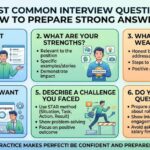
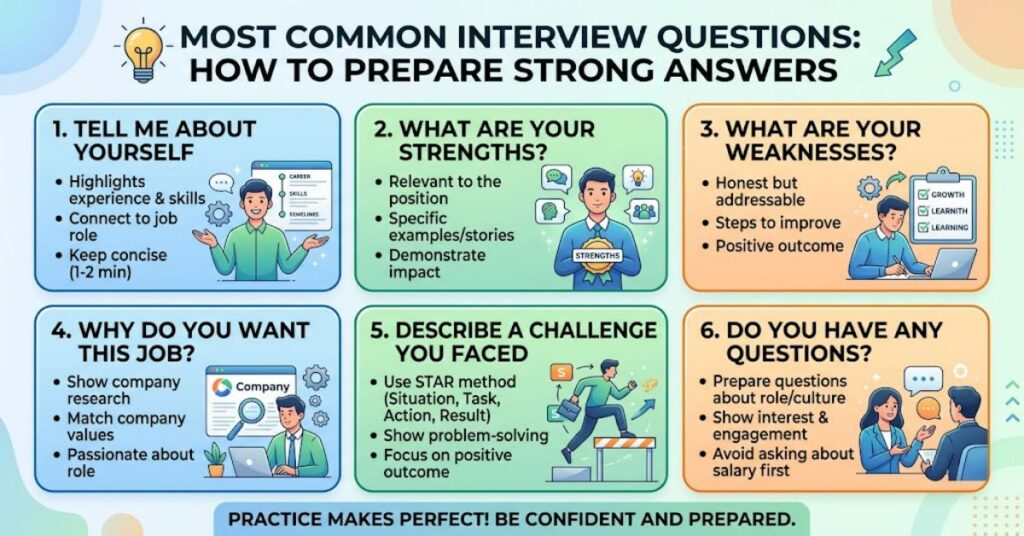
The most common interview questions focus on your background, suitability for a position, strengths, weaknesses and ability to solve problems. Employers use them to understand what you have done, how you approach challenges and why you want to join their organisation. Preparing clear, relevant answers can help you communicate your value without sounding rehearsed.
Questions such as “Tell me about yourself”, “Why should we hire you?” and “What is your greatest weakness?” appear across many industries. However, interviewers rarely want a memorised speech. They want evidence that you understand the role and can explain how your skills relate to its responsibilities.
Career resources from The Muse and Indeed offer guidance on common interview questions and answer preparation. The most useful approach is to combine that general advice with research into the employer, the job description and the experience you can genuinely demonstrate.
Preparation also involves more than deciding what to say. You should practise keeping answers focused, prepare examples of achievements, consider difficult questions and develop thoughtful questions for the interviewer. For behavioural interviews, a structured method such as STAR—Situation, Task, Action and Result—can make your examples easier to follow.
Whether you are applying for your first job, changing careers or pursuing a management position, the goal is the same: show that you understand the employer’s needs and can contribute to the team. The following guide explains common questions, provides answer frameworks and highlights mistakes that can weaken an otherwise strong interview.
1. Tell Me About Yourself
This question often opens an interview. It gives you an opportunity to present a brief professional introduction and establish why your background is relevant.
Avoid describing your entire life story. Focus on your experience, important skills and interest in the position.
Example answer:
“I have experience in customer service, where I developed strong communication and problem-solving skills. In my previous role, I handled customer enquiries, resolved complaints and worked with colleagues to improve the customer experience. I am now looking for a position where I can use those skills, take on new responsibilities and contribute to a growing team.”
Adapt this example to your real experience. If you are a recent graduate, discuss your education, projects, internships or relevant volunteering.
A useful structure is present, past and future: explain what you do now, highlight relevant experience and finish by connecting your background to the role.
2. Why Do You Want to Work Here?
Interviewers want to know whether you understand the organisation and have a genuine reason for applying.
Research the employer’s products, services, customers and recent developments. Then connect one or two specific points to your professional interests.
Example answer:
“I am interested in this position because it combines analytical work with collaboration. I was particularly interested in the organisation’s focus on improving its customer service. My experience resolving customer issues has taught me how important efficient processes are, and I would like to contribute those skills while continuing to develop professionally.”
Avoid relying entirely on salary, convenience or general praise. These factors may matter to you, but they do not demonstrate why you are suitable for the position.
3. What Are Your Greatest Strengths?
Choose strengths that relate directly to the advertised responsibilities. Communication, organisation, adaptability, teamwork and analytical thinking are useful examples, but the strongest answer includes evidence.
Example answer:
“One of my main strengths is organisation. In my previous role, I managed several competing deadlines by prioritising tasks, maintaining a shared schedule and communicating early when priorities changed. This helped me complete work on time and keep colleagues informed.”
Do not list every positive quality you can think of. Two relevant strengths supported by examples are more convincing than a long list without evidence.
4. What Is Your Greatest Weakness?
This question tests self-awareness and your willingness to improve. Choose a genuine but manageable development area, then explain the steps you are taking to address it.
Example answer:
“I used to spend too much time refining written work before sharing a draft. I have been improving by setting time limits for initial reviews and asking colleagues for feedback earlier. This helps me maintain quality while working more efficiently.”
Avoid claiming that you have no weaknesses or presenting a disguised compliment, such as saying you care too much about being perfect. Interviewers are more likely to value honest reflection and practical improvement.
5. Why Should We Hire You?
This question asks you to connect your qualifications to the employer’s needs.
Review the job description and identify two or three important requirements. Explain how your experience, skills or approach would help you meet them.
Example answer:
“You should consider me because I bring relevant experience, a strong commitment to reliable work and the ability to communicate effectively with colleagues and customers. I am comfortable learning new systems, managing priorities and taking responsibility for resolving problems. These strengths align with the role’s focus on customer support and efficient service.”
Keep your answer specific. The objective is not to claim that you are better than every other candidate, but to explain why you are a credible match.
6. Where Do You See Yourself in Five Years?
Employers ask this question to understand your ambitions and whether the position fits your longer-term plans.
You do not need to predict your career precisely. Explain the skills you want to develop and how the opportunity could support your growth.
Example answer:
“In five years, I hope to have developed stronger expertise in my field and taken on greater responsibility. I would like to become someone my team can rely on for complex projects while continuing to learn from experienced colleagues.”
Keep your answer realistic and relevant to the role.
7. Tell Me About a Challenge You Overcame
Behavioural questions explore how you respond to real workplace situations. Use the STAR method to organise your response.
| STAR element | What to explain |
| Situation | The context or problem |
| Task | Your responsibility |
| Action | The steps you personally took |
| Result | The outcome and what you learned |
Example answer:
“Our team faced a tight deadline after an unexpected delay affected a project. I reviewed the remaining tasks, identified the most urgent items and helped redistribute the workload. We completed the essential deliverables on schedule and improved how we tracked deadlines for later projects.”
Use an example from your own experience. If you have not held a formal job, an academic project, internship or volunteering activity can demonstrate similar skills.
8. How Do You Handle Stress and Pressure?
Interviewers want to understand how you prioritise work, communicate under pressure and maintain quality.
Example answer:
“I manage pressure by identifying urgent tasks, breaking larger assignments into smaller steps and communicating early if a deadline is at risk. This helps me focus on the most important work without overlooking details.”
Support your answer with a genuine example whenever possible.
9. Why Are You Leaving Your Current Job?
Keep the answer professional. Explain what you hope to gain from the new opportunity rather than criticising a previous manager or employer.
Example answer:
“I have learned a great deal in my current position, and I am grateful for that experience. I am now looking for an opportunity to develop additional skills, take on new challenges and contribute in a role that better matches my long-term goals.”
If you were made redundant or your contract ended, explain the circumstances honestly and briefly.
10. Do You Have Any Questions for Us?
Always prepare a few thoughtful questions. They demonstrate interest and help you decide whether the role is right for you.
Consider asking:
- What would success look like in the first three months?
- What are the team’s main priorities at the moment?
- How is performance evaluated in this position?
- What training or development opportunities are available?
- What are the next steps in the recruitment process?
Avoid asking questions that are already clearly answered in the job advertisement. Salary, working hours and benefits are legitimate topics, but choose an appropriate moment to discuss them.
Comparison of Common Interview Questions
| Question type | What it assesses | Best preparation |
| Background | Relevant experience | Prepare a concise introduction |
| Motivation | Interest in the role | Research the organisation |
| Strengths | Job-related abilities | Match skills to requirements |
| Weaknesses | Self-awareness | Explain genuine improvement |
| Behavioural | Past actions and judgement | Prepare STAR examples |
| Situational | Decision-making | Explain your reasoning |
| Career goals | Motivation and direction | Identify realistic development goals |
The Future of Interview Preparation in 2027
By 2027, artificial intelligence and online recruitment tools are likely to remain important parts of the hiring process. Candidates may use AI to practise answers, review job descriptions and identify relevant examples. Employers may also use automated tools during parts of recruitment.
These tools can support preparation, but they cannot guarantee that an answer will impress an interviewer. Over-reliance on generated scripts can make responses sound generic, while inaccurate claims about experience can undermine trust.
Video interviews and remote assessments also make communication, preparation and technical reliability important. Candidates should test their equipment, choose a quiet environment and practise speaking naturally to a camera.
The most useful preparation will combine technology with genuine self-reflection. Candidates who can explain their decisions, demonstrate relevant skills and respond thoughtfully to follow-up questions will be better prepared for interviews across different formats.
Key Takeaways
- Prepare evidence: Match every major skill to a genuine example.
- Practise aloud: Clear spoken answers often need a different rhythm from written responses.
- Use structure: STAR helps make behavioural examples specific and easy to follow.
- Research the employer: Connect your experience to the organisation’s actual needs.
- Be honest: Never invent achievements, qualifications or responsibilities.
- Ask useful questions: Interviews also help you evaluate the employer.
- Adapt naturally: Use preparation notes as guidance, not a script to recite word for word.
Frequently Asked Questions
What are the most common interview questions for beginners?
Beginners should prepare for questions about their background, interest in the role, strengths, weaknesses, teamwork and future goals. Examples from education, volunteering and personal projects can demonstrate relevant abilities.
How should I answer interview questions confidently?
Prepare key points, practise aloud and support claims with genuine examples. Pause briefly before answering if necessary, and ask for clarification when a question is unclear.
What are the most common behavioural interview questions?
These often ask about teamwork, conflict, deadlines, mistakes, leadership and problem-solving. Use the STAR method to explain the context, your responsibility, your actions and the outcome.
What should I avoid saying in an interview?
Avoid exaggerating your experience, criticising former employers unnecessarily or giving vague answers without examples. Do not claim expertise you cannot demonstrate.
How long should an interview answer be?
Most straightforward answers can take around 30–90 seconds. More detailed behavioural examples may take longer, provided they remain relevant and focused.
Can I use AI to prepare for a job interview?
Yes. AI can help generate practice questions, organise examples and conduct mock interviews. Verify any suggestions, protect personal information and ensure your final answers reflect your genuine experience.
Conclusion
Preparing for an interview is not about memorising perfect answers. It is about understanding the position, identifying relevant experience and communicating your value clearly. Questions about your background, strengths, weaknesses and career goals give employers a starting point for assessing your suitability.
The strongest candidates support their answers with specific examples and explain what they learned from their experiences. Structured methods such as STAR can make those examples easier to understand, while thoughtful questions help candidates assess whether an organisation meets their own expectations.
Preparation should also leave room for flexibility. An interviewer may ask an unexpected question or explore an example in greater detail. Staying honest, listening carefully and explaining your reasoning are more useful than trying to deliver a flawless script.
Ultimately, a successful interview is a two-way conversation. Your aim is to demonstrate that you can contribute to the role while gaining a realistic understanding of the workplace, its expectations and its opportunities for professional growth.
References
The Muse. (n.d.). Common job interview questions and how to answer them. The Muse.
Indeed Editorial Team. (n.d.). Common interview questions and sample answers. Indeed Career Guide.
U.S. Department of Labor. (n.d.). Interviewing. CareerOneStop.
Methodology
This guide draws on established career-advice resources from The Muse, Indeed and the U.S. Department of Labor’s CareerOneStop service. The examples are illustrative templates, not claims of firsthand interviews or tested hiring outcomes. Candidates should adapt them to their actual experience and the requirements of each position.
The advice is general rather than tailored to a particular employer, profession or country’s recruitment laws. The references should be checked against their original publisher pages before publication, and a human editor should confirm their exact titles and publication details.
Editorial disclosure: This article was drafted with AI assistance and should be reviewed and verified by a human editor before publication.