
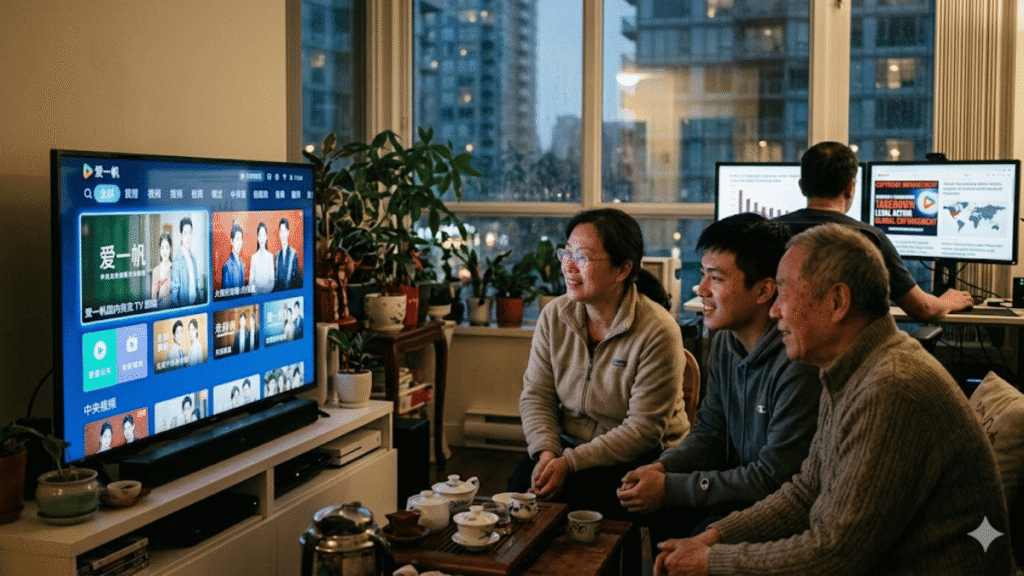
In the quiet hours of a suburban Tuesday in Melbourne, or perhaps during a crowded commute on the London Underground, a familiar interface glows on thousands of smartphone screens. It is not Netflix, nor is it the polished international export of Disney+. Instead, it is Aiyifan—a platform that has quietly become the most vital, and most controversial, cultural conduit for the Chinese diaspora. For millions living outside the borders of the People’s Republic, Aiyifan represents a digital bridge to home, providing instant access to the latest mainland dramas, variety shows, and cinema that are often otherwise locked behind regional geo-fences or fragmented across a dozen expensive, localized subscriptions.
Aiyifan (爱壹帆), formerly known to many as IYF TV, is a comprehensive streaming aggregator that specializes in Chinese-language content. It operates primarily as a web portal and an Android-based APK, offering high-definition streams of content originally produced by Chinese giants like iQIYI, Tencent Video, and Youku. While it bills itself as a “smart streaming platform” powered by sophisticated recommendation algorithms, its existence is defined by a persistent tension: it provides a user experience that many argue surpasses the “official” alternatives, yet it operates in a legal gray zone that has recently culminated in high-stakes litigation in United States federal courts. As the diaspora grows more mobile and tech-savvy, Aiyifan’s rise highlights a broader crisis in the global media landscape—the failure of traditional licensing to keep pace with the demands of a borderless audience.
For the user, the appeal is crystalline. The platform’s library is an exhaustive repository of cultural currency. Whether it is the latest historical “wuxia” epic or a trending reality competition like Sisters Who Make Waves, Aiyifan typically hosts the content within hours of its domestic release. This speed is critical. In the age of social media, where spoilers and memes travel at the speed of a fiber-optic pulse, being two days behind a broadcast in Beijing is an eternity. For a young professional in Toronto or a student in Berlin, Aiyifan is not just about “piracy” in the traditional sense; it is about participation in a global conversation that their physical location would otherwise exclude them from.
The technical architecture of Aiyifan is surprisingly robust for a platform often labeled as “underground.” It utilizes adaptive bitrate streaming, which adjusts video quality in real-time based on the user’s bandwidth—a feature once reserved for premium services like Netflix. This reliability, coupled with an interface that mirrors the sleek, “infinite scroll” aesthetics of modern social media, has allowed it to shed the cluttered, ad-choked reputation of earlier pirate sites. However, this polish has also made it a more visible target. As of early 2025, the platform is at the center of a major copyright infringement lawsuit filed by iQIYI in the Southern District of Florida, marking a new chapter in the struggle between creators and the digital aggregators who distribute their work without a license.
The Architecture of the Diaspora’s Choice
To understand why Aiyifan has succeeded where official platforms struggle, one must look at the fragmentation of the Chinese streaming market. In mainland China, the “Big Three”—iQIYI, Tencent (WeTV), and Youku—dominate. While each has launched international versions of their apps, their overseas libraries are often curated, censored, or restricted due to complex third-party licensing agreements. A user in New York might find that their favorite show is available on iQIYI in Beijing, but restricted on the iQIYI International app in the U.S. because the North American rights were sold to a different, niche distributor.
Aiyifan effectively “disrupts” this friction by ignoring it. By aggregating content from every major source into a single, unified interface, it offers a “one-stop-shop” experience that the official market is structurally incapable of providing. As media analyst Dr. Elena Rossi notes, “Aiyifan isn’t just competing on price—it’s competing on convenience. For the consumer, a single portal that works everywhere is infinitely more valuable than five separate subscriptions that each offer only 20% of what they want to see.” This sentiment is echoed by many in the diaspora who view the platform as a necessary tool for cultural preservation.
| Feature | Aiyifan (Aggregator) | Official Apps (iQIYI/WeTV) |
| Content Origin | All major CN networks | Network-specific originals |
| Geo-Restrictions | Virtually none | Highly regionalized |
| Cost | Free (Ad-supported) / Low-cost VIP | Subscription-based ($6-$15/mo) |
| Video Quality | Up to 4K Adaptive | 1080p / 4K (VIP only) |
| Accessibility | Web, APK, Smart TV | Official App Stores |
| Legal Status | Contested / Unlicensed | Fully Licensed |
The platform’s technical persistence is also a point of fascination. Over the years, Aiyifan has migrated through a dizzying array of domains—iyf.tv, yfsp.tv, aiyifan.tv—to stay ahead of takedown notices and ISP blocking. This “hydra-headed” strategy is common among pirate sites, but Aiyifan pairs it with a level of customer support and app stability that is rare in the world of unauthorized streaming. Its Android APK is updated frequently, often including “stealth” updates that bypass security patches intended to block sideloaded applications.
The High Stakes of Intellectual Property
The legal walls began closing in more significantly in April 2025. In the case of Beijing iQIYI Science & Technology Co., Ltd. v. Aiyifan TV, the plaintiffs alleged that the platform was not merely a passive host but a sophisticated commercial enterprise profiting from the massive, unauthorized distribution of copyrighted works. The lawsuit, filed in Florida, seeks to seize the platform’s domains and freeze assets linked to its operators. This represents a more aggressive stance from Chinese production companies, who are increasingly looking to Western courts to protect their intellectual property as they attempt to monetize their content globally.
“The issue with Aiyifan isn’t just that it’s free,” says Marcus Thorne, a copyright attorney specializing in international media law. “It’s that it creates a parallel ecosystem where the original creators see zero return on their investment. When a show costs $50 million to produce, and the primary audience in the West is watching it on a platform like Aiyifan, the economic model for exporting Chinese culture begins to collapse.” Thorne’s perspective highlights the existential threat such platforms pose to the burgeoning “C-drama” industry, which seeks to replicate the global success of Korean “K-dramas.”
The platform’s defense—often articulated in community forums rather than courtrooms—is built on the concept of “fair access.” Proponents argue that if the official platforms provided a global, unified subscription with consistent subtitles and no regional blackouts, Aiyifan would disappear overnight. They point to the “Netflix effect” in the early 2010s, which significantly reduced music and film piracy by offering a superior legal alternative. However, the complexity of international media rights makes such a “global iQIYI” a legal and logistical impossibility for the time being.
Evolution of a Digital Lifeline
Aiyifan did not appear in a vacuum. It is the latest evolution in a long history of “gray market” media consumption that has defined the immigrant experience for decades. In the 1990s, it was pirated VCDs and DVDs sold in the backrooms of Chinatown groceries. In the 2000s, it was P2P file-sharing and sites like Tudou and early Bilibili. Aiyifan represents the “SaaS-ification” of this trend—a polished, cloud-based service that feels like a legitimate product but lacks the underlying legal foundation.
| Milestone | Event Description | Year |
| Founding | Initial launch as IYF TV, targeting overseas Chinese students. | 2016 |
| Technical Pivot | Introduction of adaptive 4K streaming and dedicated Android APK. | 2019 |
| Brand Transition | Rebranding to Aiyifan to evade increasing legal pressure on the IYF name. | 2021 |
| Global Expansion | Significant traffic growth in Malaysia, Australia, and North America. | 2023 |
| Legal Crisis | iQIYI files federal lawsuit in Florida seeking domain seizure. | 2025 |
The platform’s impact on the diaspora’s social fabric cannot be overstated. In many overseas households, Aiyifan is the primary source of entertainment for the elderly, who may not be fluent in the local language and rely on Chinese-language television for connection to their heritage. “For my parents, Aiyifan isn’t a ‘tech platform,'” says Li Wei, a software engineer living in San Francisco. “It’s the television. It’s how they keep up with the news, the comedy shows they grew up with, and the cultural touchstones that keep them feeling connected to their roots. If it went away, their world would become much smaller.”
This emotional tether creates a complex moral landscape. While the legal arguments against Aiyifan are grounded in clear violations of property rights, the social arguments for its existence are grounded in the fundamental human need for cultural continuity. This friction is where the “New York Times” style of reporting finds its most fertile ground: the intersection of rigid law and messy, human reality.
The Future of “Borderless” Content
As AI technology continues to advance, Aiyifan has begun to integrate “smart” features that further blur the lines between a pirate site and a legitimate tech startup. Its recommendation engine, which users claim is more intuitive than iQIYI’s, uses machine learning to analyze viewing habits and suggest content across different production houses. It is a level of personalization that traditional networks, hampered by their own silos, struggle to match.
The question remains: Can Aiyifan survive the onslaught of international litigation? Previous “giants” of the gray market, such as the legendary pirate site Renren Yingshi, eventually succumbed to pressure from Chinese authorities. However, Aiyifan’s decentralized nature and its focus on the overseas market make it a harder target. By hosting servers in jurisdictions with lax copyright enforcement and using encrypted payment methods for its “VIP” tiers, it has built a resilient, if precarious, empire.
“We are entering an era of ‘content balkanization,'” says media critic Sarah Jenkins. “As every network launches its own streaming service, the user experience is getting worse, not better. Platforms like Aiyifan are a symptom of a broken system. They provide a glimpse of what a truly global, unified media platform could look like—even if the way they achieve it is illegal.”
Key Takeaways
- Aggregator Dominance: Aiyifan has captured the overseas Chinese market by aggregating content from multiple competing domestic networks into a single, high-quality interface.
- Legal Vulnerability: The platform is currently facing major federal litigation in the U.S., with iQIYI leading the charge to dismantle its infrastructure.
- Technical Superiority: Unlike previous generations of pirate sites, Aiyifan offers 4K adaptive streaming and a sophisticated recommendation engine that rivals official platforms.
- Cultural Necessity: For many in the diaspora, the platform serves as a vital tool for cultural preservation and connection to their home country.
- The Licensing Gap: The platform’s success highlights the failure of official streaming services to provide a seamless, global experience for international audiences.
- Domain Resilience: Aiyifan uses a multi-domain strategy to stay ahead of ISP blocks and legal takedowns, maintaining a consistent presence despite constant pressure.
Reflections on the Digital Horizon
The story of Aiyifan is ultimately a story of the modern world’s inability to reconcile the physical boundaries of law with the digital reality of human connection. We live in a time where a person can move halfway across the globe but remain culturally anchored to their birthplace through a five-inch screen. The legal systems we use to govern property were designed for a world of physical borders and slow-moving ships; they are ill-equipped for a world where a data packet can traverse the Pacific in milliseconds.
As we look toward the future, the resolution of the Aiyifan conflict will likely serve as a bellwether for the broader media industry. If the official platforms can find a way to offer the same level of convenience and breadth that Aiyifan provides, the “pirate” alternative will naturally wither. But if the industry remains fragmented, protective of its silos at the expense of the user, platforms like Aiyifan will continue to thrive in the shadows, fueled by the inexhaustible hunger of a global community that simply wants to watch the stories that remind them of home. The battle for the screens of the diaspora is just beginning, and the stakes are nothing less than the future of global culture in a digital age.
FAQs
What is Aiyifan and why is it popular?
Aiyifan is a streaming aggregator that provides Chinese-language content, such as dramas and movies, to audiences outside of China. It is popular because it combines shows from various competing Chinese networks (like iQIYI and Tencent) into one platform, often with higher speeds and fewer regional restrictions than official international versions of those apps.
Is Aiyifan legal to use in the United States or Europe?
The legality of Aiyifan is highly contested. While users are rarely prosecuted for viewing content, the platform itself is considered an unauthorized distributor of copyrighted material. Major Chinese production companies have filed lawsuits against it for copyright infringement, and it operates without official licenses from content creators.
What happened to IYF TV?
IYF TV was the predecessor to Aiyifan. Due to increasing legal pressure and domain blocks, the platform rebranded to Aiyifan (爱壹帆) to continue operations. It frequently changes its web domain (e.g., from .tv to .lv) to evade takedowns, but the underlying service and content library remain largely the same.
Does Aiyifan offer subtitles in languages other than Chinese?
While Aiyifan primarily targets Chinese speakers, it has increasingly integrated AI-driven subtitle support for English and other languages. However, the quality of these subtitles can vary significantly compared to the professionally translated subtitles found on official platforms like Viki or iQIYI International.
Is the Aiyifan APK safe to download on Android devices?
Sideloading any APK from an unofficial source carries security risks, including the potential for malware. While many users in the community report the “official” Aiyifan APK as safe, it is not verified by Google Play Protect, and users are encouraged to use a VPN and maintain updated security software if they choose to use it.