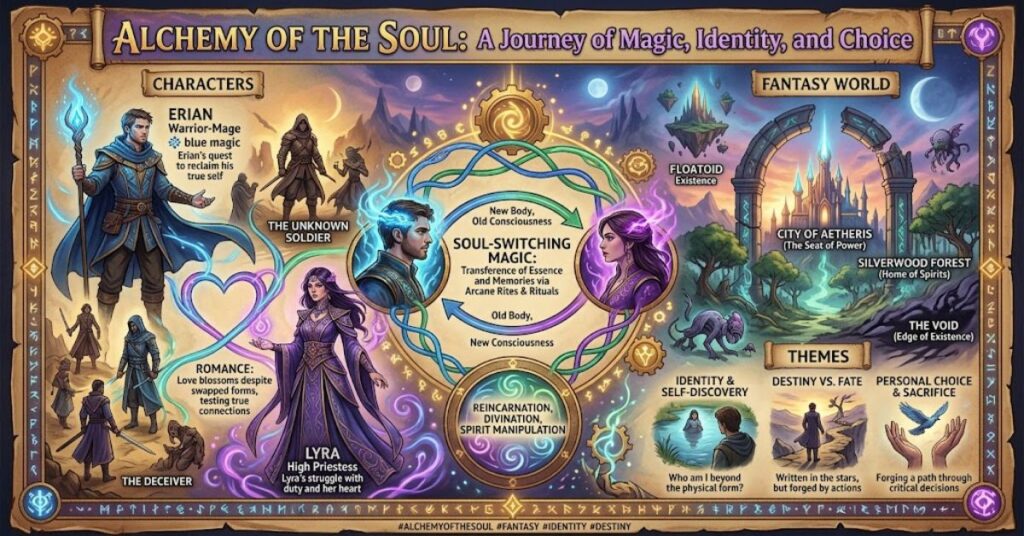
Alchemy the Soul is a South Korean fantasy romance television series that originally aired on tvN in 2022. The series is set in the fictional country of Daeho, where powerful mages use spells and magical techniques that can alter the course of people’s lives. At the centre of the story is a forbidden technique that allows a person’s soul to move into another body.
Netflix describes the series as the story of a powerful sorceress whose soul becomes trapped in the body of a physically weaker woman, bringing her into contact with a man from a prestigious family who wants to change his own destiny.
The drama premiered on 18 June 2022 and its first part concluded on 28 August 2022. The first part contained 20 episodes, while a second part, titled Alchemy of Souls: Light and Shadow, followed later in 2022.
What makes the series distinctive is its combination of genres. It is simultaneously a fantasy adventure, romantic drama, martial-arts story and character-driven tale about identity.
The Story and the Soul-Switching Magic
The central magical concept is known as soul shifting. In the fictional world of Daeho, certain mages possess extraordinary abilities, but magic also carries serious consequences.
Mu-deok is actually the powerful assassin Naksu, whose soul becomes trapped inside Mu-deok’s body. This creates the central contradiction of the story: a highly skilled warrior is physically restricted by a body that cannot initially match her abilities.
Jang Uk, meanwhile, is the young heir of the Jang family. Although he comes from a powerful lineage, his development as a mage has been deliberately restricted because of secrets surrounding his birth. His meeting with Mu-deok changes the direction of both characters.
AsianWiki identifies Jang Uk as a member of the noble Jang family and describes Mu-deok as an elite warrior whose soul is trapped in a physically weak body.
Their relationship develops through training, deception and mutual dependence. Mu-deok becomes Jang Uk’s servant while secretly teaching him martial and magical skills. This arrangement gives the series much of its humour and tension, while the larger political story gradually raises the stakes.
Jang Uk and Mu-deok
The relationship between Jang Uk and Mu-deok is more complicated than a conventional fantasy romance.
Jang Uk begins as a frustrated young man who wants access to the magical training that has been denied to him. Mu-deok enters his life with a completely different objective. She wants to regain her power and continue surviving in a world where her identity is dangerous.
Their relationship therefore begins as an arrangement based on mutual advantage.
Over time, however, training becomes trust. Trust develops into emotional dependence, and both characters are forced to reconsider their assumptions about power and identity.
This is one of the series’ most effective narrative devices. The body-switching premise is not merely a supernatural gimmick. It repeatedly forces characters to distinguish between a person’s appearance, social identity and actual self.
A World Built Around Mages and Power
Daeho provides the fictional political and magical framework for the story. Several influential families possess knowledge, status and connections that affect the balance of power.
Magic is therefore not presented simply as entertainment. It is tied to social hierarchy.
Characters who possess exceptional magical abilities can influence political decisions, family succession and military power. That makes magical knowledge a form of institutional power.
The series also uses different forms of magical training to show character development. Progress is not simply about becoming stronger. It involves discipline, control and understanding the consequences of using supernatural abilities.
This creates a useful distinction between power and maturity. A character may possess extraordinary potential while lacking the experience needed to use it responsibly.
Identity, Destiny and Personal Choice
The most important theme in Alchemy the Soul is identity.
Soul shifting makes identity unstable. A person’s body may no longer correspond to their original self, while other characters may know them by a different name or social position.
That premise allows the series to explore a familiar question through fantasy: how much of identity comes from the body, and how much comes from memory, personality and relationships?
Destiny is equally important.
Jang Uk is burdened by circumstances surrounding his birth, while Mu-deok is pursued by the consequences of her past. Other characters are similarly affected by family expectations and political responsibilities.
The series repeatedly asks whether people must accept the roles assigned to them or whether they can construct different futures.
Why the Series Connected With Viewers
The show’s popularity can be measured partly through its Korean television ratings. Its 18 June 2022 premiere recorded a nationwide average rating of 5.2 per cent, according to Nielsen Korea figures reported by Soompi. By 21 August, the series had reached 9.3 per cent, its highest rating at that point.
The first-part finale on 28 August recorded a nationwide average of 9.2 per cent and ranked first in its time slot across cable channels.
| Element | Role in the series |
| Soul shifting | Drives the identity and fantasy conflict |
| Jang Uk | Young mage seeking control over his destiny |
| Mu-deok/Naksu | Powerful warrior dealing with a transformed identity |
| Daeho | Fictional setting for political and magical conflict |
| Romance | Connects personal relationships to the wider story |
| Magic | Functions as both power and a source of danger |
| Family politics | Shapes status, responsibility and conflict |
These figures do not explain the entire appeal of the drama, but they show that its audience grew substantially during its first run.
Risks, Sacrifice and the Cost of Magic
The magical system also introduces one of the show’s darker ideas: power always has consequences.
Soul shifting can provide an escape from physical limitations, but it can also produce instability, fear and loss of control. Characters who pursue magical power without considering its consequences put themselves and others at risk.
This makes the fantasy system relevant to the emotional story. The supernatural rules create external problems, but the consequences are ultimately personal.
The series also uses sacrifice to challenge romantic expectations. Love does not remove danger. Instead, relationships become more meaningful because characters must make difficult choices about loyalty, identity and survival.
The Future of Alchemy the Soul in 2027
Although the main story concluded with its second part in 2022, Alchemy the Soul remains relevant to the international Korean drama audience because streaming platforms continue to make Korean fantasy and romance series accessible worldwide.
Netflix currently categorises the programme as a Korean fantasy and romantic television drama and lists Lee Jae-wook, Go Youn-jung, Hwang Min-hyun and Jung So-min among its cast.
Its longer-term appeal is likely to depend less on new episodes and more on continued streaming discovery, fan discussion and interest in Korean fantasy dramas.
For new viewers, the series also demonstrates how Korean television can combine large-scale fantasy mythology with intimate character relationships rather than treating spectacle and emotional storytelling as separate elements.
Key Takeaways
- Fantasy and romance are interconnected: The supernatural plot directly shapes the central relationship.
- Identity drives the story: Soul shifting creates questions about bodies, memory and personal identity.
- Destiny is repeatedly challenged: Characters struggle against family expectations and predetermined roles.
- Magic has consequences: Power creates opportunities but also danger and responsibility.
- The fictional setting matters: Daeho’s families, institutions and magical hierarchy provide the political framework.
- The series gained strong domestic ratings: Its first-part finale reached 9.2 per cent nationwide according to reported Nielsen Korea figures.
- Its themes extend beyond fantasy: Identity, autonomy, sacrifice and social expectations remain central throughout the narrative.
Conclusion
Alchemy the Soul works because its fantasy premise serves a deeper character story. Soul shifting creates the spectacle, but questions about identity, love, family and destiny give the series its emotional foundation.
Jang Uk and Mu-deok are compelling partly because neither character begins with complete control over their circumstances. Their development comes from learning how to respond to those circumstances rather than simply accepting them.
The series also uses its fictional magical society to examine familiar forms of power. Family status, inherited expectations and access to knowledge influence people’s choices just as strongly as supernatural abilities.
Released in 2022, the drama combined fantasy, romance, martial arts and political intrigue into a distinctive Korean television format. Its continuing availability through streaming gives new audiences an opportunity to explore a story in which changing one’s fate requires more than changing one’s body.
Frequently Asked Questions
What is Alchemy the Soul about?
Alchemy the Soul follows characters in the fictional country of Daeho whose lives become entangled through forbidden magic, soul shifting, family politics and romance.
Is Alchemy the Soul a Korean drama?
Yes. It is a South Korean television drama that originally aired on tvN in 2022.
Who are the main characters in Alchemy the Soul?
The central characters include Jang Uk, Mu-deok/Naksu, Seo Yul and Go Won, alongside several powerful families and mages in Daeho.
What is soul shifting in Alchemy the Soul?
Soul shifting is a magical technique that allows a person’s soul to move into another person’s body. It is one of the central mechanisms driving the story.
Is Alchemy the Soul a romance series?
Yes. Romance is one of its major genres, although the series also combines fantasy, comedy, action, martial arts and political drama.
When was Alchemy the Soul released?
The first part premiered on 18 June 2022 and concluded on 28 August 2022. A second part followed in December 2022.
Methodology
This article was prepared using publicly available information from Netflix, AsianWiki and contemporary reporting on Nielsen Korea ratings. Plot and character descriptions were cross-checked against published series information, while ratings were attributed to contemporary reports rather than presented as independently calculated figures.
The analysis focuses on the series’ narrative structure, characters, themes and documented reception. Audience preferences are subjective, so the discussion does not treat ratings as a measurement of artistic quality. The article also distinguishes between the fictional rules of Daeho and real-world historical Korean culture.
Editorial disclosure: This article was drafted with AI assistance. Named statistics, institutional claims and references should be independently checked by a human editor against the original sources before publication.
References
Netflix. (2022). Alchemy of Souls. Netflix.
AsianWiki. (2022). Alchemy of Souls. AsianWiki.
Soompi. (2022, 19 June). Alchemy of Souls premieres to No. 1 ratings as Doctor Lawyer hits new all-time high. Soompi.
Soompi. (2022, 21 August). Alchemy of Souls and It’s Beautiful Now soar to their highest ratings yet. Soompi.
Soompi. (2022, 29 August). Alchemy of Souls Part 1 finale achieves No. 1 ratings. Soompi.