
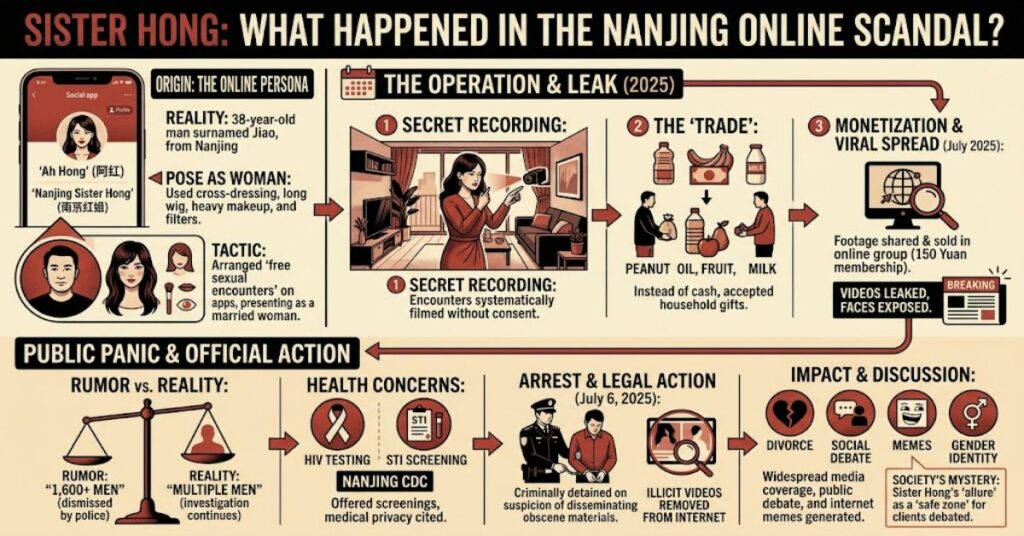
The Sister Hong incident refers to a 2025 online scandal in Nanjing, Jiangsu, China, involving a 38-year-old man surnamed Jiao who allegedly used a female persona known online as “Sister Hong” or “Red Sister”. Reports said he arranged intimate encounters with men, secretly recorded some of them and distributed the recordings online.
Chinese and international coverage quickly became dominated by sensational claims. One widely repeated figure suggested that more than 1,600 men had been involved. However, reporting later made clear that this number was disputed and that online accounts had mixed verified information with speculation. What’s on Weibo specifically documented how early viral versions of the story contained major inaccuracies.
The case therefore needs to be understood on two levels. First, there was the underlying police investigation into alleged recording and distribution of sexual material. Second, there was a much larger digital phenomenon in which rumours, leaked material, memes and attempts to identify people involved spread across social platforms.
Timeline of the Nanjing Case
| Date | Development |
| 5–6 July 2025 | Chinese media reported the detention of a 38-year-old man surnamed Jiao in Nanjing |
| Early July | Videos and rumours began spreading rapidly across Chinese social platforms |
| 8 July | The related topic became a major trending discussion on Weibo |
| Mid-July | International media increasingly reported on the case and its misinformation problems |
| Late July | Conflicting claims about the number of participants and health consequences continued circulating |
The precise chronology differs slightly between international reports because early social-media accounts appeared before authoritative details were available. Reports from The Standard and other outlets placed the detention in early July and described allegations involving secret recordings and online distribution.
Why the Story Became So Viral
The story contained several elements that are particularly powerful in social-media environments: an unusual identity, unexpected allegations, leaked material, a large number of supposed participants and easily reproduced visual memes.
That combination encouraged users to move quickly from reporting the event to participating in it. Images were reposted, alleged participants were discussed and parody content appeared. The original allegation became surrounded by secondary stories that were much harder to verify.
This is an important distinction. Virality does not automatically increase factual reliability. In this case, some of the most repeated details were among the least securely established.
Verified Facts Versus Viral Claims
| Topic | Better-supported information | Caution |
| Location | Nanjing, Jiangsu, China | Widely reported |
| Person arrested | 38-year-old man surnamed Jiao | Reported by multiple outlets |
| Online identity | “Sister Hong” / “Red Sister” | Nicknames varied by platform |
| Arrest/detention | Early July 2025 | Reports differ on exact date |
| Number of participants | Not definitively established publicly | Viral figures varied substantially |
| Health claims | Became a major online rumour | Several claims were disputed or unverified |
| Legal issue | Alleged dissemination of obscene material | Police investigation formed the central documented case |
This distinction is essential because several viral accounts presented disputed numbers as established facts. What’s on Weibo reported that the dramatic claim involving 1,691 men was inaccurate, while Chinese-language reporting also documented official rejection of some widely circulated figures.
The Privacy Problem Behind the Scandal
The most significant issue is not the unusual online persona. It is the alleged recording and distribution of private sexual encounters without the participants’ consent.
China’s Civil Code protects privacy and specifically identifies private activities and private information as protected interests. Article 1033 also addresses unauthorised photographing, eavesdropping and disclosure of private activities.
China’s Personal Information Protection Law adds another layer. It defines personal information broadly and places stronger requirements around sensitive personal information, including health-related information. Separate consent is generally required for processing sensitive personal information under Article 29.
The case therefore illustrates a broader digital principle: once intimate material is copied and redistributed, the original recording is no longer the only privacy problem. Screenshots, names, faces, usernames and identifying details can create additional exposure.
The Legal Dimension
Chinese criminal law contains specific provisions concerning the production, sale and dissemination of pornographic materials. Article 363 addresses production and distribution for profit, while Article 364 covers serious dissemination of pornographic material.
Reports on the Nanjing investigation said the man was detained on suspicion related to dissemination of obscene material. That is a documented legal description of the investigation and should not be confused with a final court judgment.
The case also demonstrates why reporting must distinguish an allegation, an arrest and a conviction. An arrest or detention does not itself establish every allegation made online.
Three Information Lessons From the Case
1. A viral number is not necessarily a verified statistic.
The enormous participant figures attached to the story became part of its mythology. Later reporting showed that several figures were disputed. This is a useful example of why journalists and readers should trace numerical claims back to police statements or primary reporting.
2. Secondary exposure can become a separate harm.
People allegedly appearing in private recordings faced the possibility of identification by strangers. Reposting, naming or attempting to identify them can compound the original privacy violation.
3. Memes can erase context.
Once an event becomes meme material, audiences may encounter jokes and parody before they encounter reliable reporting. The cultural afterlife of the story therefore became partially detached from the underlying investigation.
The Future of Sister Hong in 2027
By 2027, the lasting significance of the Sister Hong case is likely to be less about the identity itself and more about digital privacy and misinformation.
China already has a legal framework addressing privacy and personal information, including the Personal Information Protection Law and Civil Code provisions. The technical challenge is enforcement across rapidly copied content, encrypted groups, overseas platforms and synthetic media.
Generative AI could make this problem more difficult. Once real images, names or video fragments are available, manipulated versions can be produced quickly. That makes provenance, takedown systems and careful verification increasingly important.
The 2025 case also provides a warning for publishers: reporting on a viral scandal can unintentionally amplify false claims if sensational figures are repeated before they are independently established.
Key Insights
- The case shows how quickly an alleged criminal investigation can become a global digital spectacle.
- Disputed statistics can become embedded in public memory even after they are challenged.
- Privacy risks continue after original content is removed because copies can circulate across multiple platforms.
- Legal responsibility and online gossip are not the same thing.
- Sexual scandals are particularly vulnerable to sensational reporting and identity-based harassment.
- Strong source verification is essential when original evidence is difficult to access.
- The case demonstrates the growing importance of digital provenance in viral news.
Conclusion
The Sister Hong scandal became one of the most widely discussed Chinese internet stories of July 2025, but its significance extends beyond the sensational details. At its centre was an alleged pattern of secret recording and online distribution, followed by a much larger wave of reposting, speculation and public identification.
The conflicting claims surrounding the number of people involved demonstrate the dangers of treating viral posts as primary evidence. Meanwhile, China’s existing privacy and personal-information laws provide an important legal context for understanding why unauthorised recording and disclosure can create serious consequences.
The case ultimately illustrates a modern information problem: once private material becomes viral, correcting false claims becomes much harder than spreading them. Responsible coverage therefore requires separating documented facts from allegations, rumours and internet folklore.
Frequently Asked Questions
What is Sister Hong?
Sister Hong was an online nickname associated with a 38-year-old man surnamed Jiao in Nanjing who became the subject of a major scandal in July 2025.
Why did Sister Hong become famous online?
The story spread because of allegations involving secret recordings, online distribution and a rapidly growing collection of rumours and memes.
How many people were involved in the Nanjing Sister Hong case?
There is no reliable public basis for treating the widely circulated figure of 1,600-plus participants as an established fact. Multiple reports described the number as disputed.
Was the alleged intimate material recorded without consent?
Reporting on the case stated that some encounters were secretly recorded and subsequently distributed. The allegations formed part of the police investigation.
What happened to the people appearing in the recordings?
Some individuals reportedly faced unwanted public exposure after material circulated online. Their privacy was further threatened when users attempted to identify them.
Did the online health claims about the case prove true?
Several dramatic health claims circulated online, but reporting and fact-checking showed that some were unverified or false. They should not be repeated as established facts.
Methodology
This article was prepared by cross-checking contemporary reporting from July 2025 with Chinese legal sources and specialist analysis of the online information environment. Key factual points were compared across reporting from The Standard, What’s on Weibo, Euronews and Chinese-language sources. China’s Personal Information Protection Law, Civil Code and Criminal Law were checked against published legal texts.
A key limitation is that many original social-media posts and alleged recordings were inaccessible, removed or unreliable. Consequently, disputed participant numbers and health claims have not been presented as established facts.
Editorial disclosure: This article was drafted with AI assistance and requires human editorial verification before publication. All names, dates, legal claims and citations should be checked against the original sources before going live.
References
AFP. (2025–2026). Fact-checking reports on misinformation and viral claims relating to China. Agence France-Presse.
Euronews. (2025, July 19). Sister Hong scandal: Man disguised himself as a woman and secretly recorded encounters in China.
Koetse, M. (2025, July 17). Hidden cameras and taboo topics: The many layers of the “Nanjing Sister Hong” scandal. What’s on Weibo.
People’s Republic of China. (2021). Personal Information Protection Law of the People’s Republic of China.
People’s Republic of China. (2020). Criminal Law of the People’s Republic of China.
People’s Republic of China. (2020). Civil Code of the People’s Republic of China.
The Standard. (2025, July 15). Red Sister client pleads to public as life spirals into chaos.