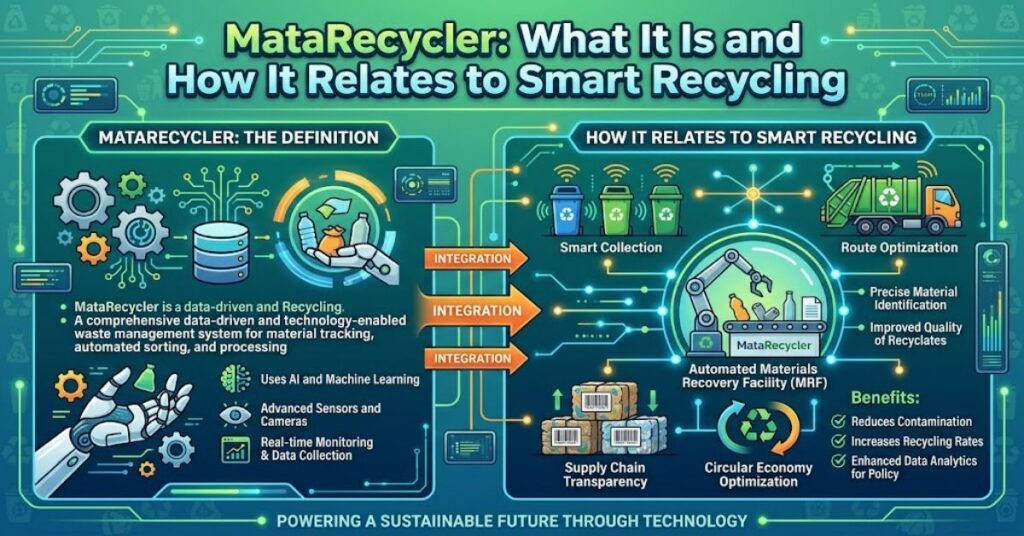
MataRecycler is associated with recycling, sustainability and smarter approaches to waste management, but its precise identity requires some clarification. Its own website describes MataRecycler as a platform providing recycling information, guides, environmental insights and educational resources rather than documenting a specific AI-powered sorting machine.
That distinction matters because online descriptions can easily turn a broad sustainability concept into a description of a specific technology. In reality, artificial intelligence is already being used in waste sorting, particularly through computer vision systems that identify materials as they move along conveyor belts. UK examples include AI-powered optical sorting installations capable of recognising beverage cartons and separating them mechanically from mixed waste streams.
MataRecycler therefore sits within an interesting information gap. The name suggests smart recycling, and its website discusses optimisation, technology and sustainable resource use, but publicly available evidence does not establish a clearly documented product specification, manufacturer, deployment record or independently tested performance benchmark for a single MataRecycler AI model.
The distinction between a recycling information platform and an automated material recovery system is important for anyone researching the term. It prevents assumptions about capabilities that have not been demonstrated while still allowing the broader technological idea behind smart recycling to be examined.
What Is MataRecycler?
MataRecycler’s stated purpose is educational. Its About Us page says the platform focuses on responsible recycling, sustainable practices and environmental awareness. It provides articles, recycling guides, sustainability information and educational resources for individuals and organisations.
| Attribute | Evidence currently available |
| Primary identity | Recycling and sustainability platform |
| Main content | Guides, articles and environmental information |
| Stated audience | Individuals, businesses and communities |
| AI sorting machine publicly documented? | Not sufficiently verified |
| Independent performance benchmark | Not identified |
| Manufacturer/product specification | Not clearly documented |
This creates the first useful distinction: describing the platform as an established AI sorting machine would go beyond the evidence currently available.
The site’s homepage does discuss artificial intelligence, predictive analytics, smart monitoring and resource optimisation as part of the wider future of sustainable systems. However, those references do not amount to a technical specification for a proprietary sorting device.
How AI Recycling Technology Actually Works
The technology associated with the supplied description of MataRecycler is real, even if its connection to this particular platform cannot currently be verified.
AI recycling systems commonly combine cameras, computer vision, machine-learning models and mechanical equipment. A camera captures objects moving through a waste stream. Software analyses characteristics such as shape, colour, material appearance and object category. The system can then trigger mechanical separation, including pneumatic ejection.
A strong UK example is Recycleye’s QuantiSort system. Tetra Pak reported in July 2025 that the technology had been installed at Cumbria Waste Management’s materials recycling facility in Carlisle to identify food and beverage cartons. The system uses AI and cameras to detect cartons, after which pneumatic valves eject them for separate recycling. Tetra Pak reported carton-output purity above 98% at that installation.
This provides a useful real-world comparison because it demonstrates what a documented AI sorting deployment looks like: named technology, named facility, identified technology partners, a defined material stream and a reported performance measure.
MataRecycler Compared With Documented AI Sorting
| Feature | MataRecycler evidence | Documented AI sorting systems |
| Recycling focus | Yes | Yes |
| Educational information | Yes | Usually secondary |
| Computer vision system | Not verified as a specific product | Documented in deployed systems |
| Automated physical separation | Not verified | Common in industrial applications |
| Named commercial installation | Not established | Available for several systems |
| Published performance data | Not identified | Available for some deployments |
The comparison highlights an important information-quality issue. Smart recycling is not one technology. It is an ecosystem involving sensing, classification, robotics, mechanical separation, data analysis and waste logistics.
Why AI Sorting Matters
England’s recycling system is also becoming more structured. From 31 March 2026, Simpler Recycling rules require local authorities to collect specified recyclable materials separately from households, including paper and card, glass, metal and plastic. The policy is designed to reduce confusion and increase recycling.
Better sorting technology can support that objective, but it cannot solve every problem.
The Royal Institution of Chartered Surveyors has highlighted a key limitation of machine vision: systems only see and classify the material they are designed and trained to recognise. They do not automatically provide visibility across the entire waste chain after material leaves a sorting facility.
That is a significant practical insight. Better recognition at one point in the process does not guarantee better circularity at every subsequent stage.
Three Important Limits of Smart Recycling
1. Identification is not the same as recovery
An AI model may identify an object correctly, but that does not guarantee the material can be economically or technically recycled. Contamination, composite materials and downstream processing capacity can still prevent recovery.
2. Training data affects performance
Computer vision models depend on representative training data. Research published in 2025 on mixed construction and demolition waste identified a continuing research gap around model performance in genuinely mixed and contaminated material streams.
3. The waste journey continues after sorting
AI may improve classification at a materials recovery facility, but collection, transport, processing and end-market demand remain separate stages. RICS makes this wider systems limitation explicit in its assessment of AI in waste management.
These constraints do not undermine AI sorting. They show why it should be evaluated as one component of a waste-management system rather than a complete solution.
Real-World Evidence From AI Waste Sorting
There are already several documented examples of computer vision moving beyond laboratory research.
In September 2025, Tetra Pak reported another UK installation at Levenseat Resource Management in Scotland using AI-powered optical sorting to identify beverage cartons.
Academic research is advancing at the same time. A 2025 Waste Management study tested deep-learning and regression techniques for analysing waste electrical and electronic equipment. Its combined approach achieved a mean relative error of 4.94% on a validation dataset for material-flow estimation.
Another 2025 study investigated AI-based recognition of electro-construction waste and found that a Swin Transformer architecture outperformed the compared convolutional neural-network approaches in its experimental evaluation.
These cases are stronger evidence for the general technology than unsupported claims about an individual product.
The Future of MataRecycler in 2027
By 2027, the most important development around smart recycling is likely to be greater integration between classification, tracking and operational decision-making.
UK waste policy is already moving towards more consistent collection systems. The government has also been developing digital waste tracking, with a public beta updated in September 2026 to prepare organisations for mandatory reporting changes.
For a platform such as MataRecycler, this creates an opportunity to provide clearer educational guidance around AI sorting, recycling rules and resource management. But a future claim that it operates a proprietary AI sorting model would require technical documentation, named deployments and independently verifiable results.
The practical direction is therefore clear even where the specific product identity is not: recycling is becoming increasingly data-driven, while AI is becoming one tool within a larger materials-management system.
Key Insights
- MataRecycler’s own description supports its identity as a recycling information platform.
- The supplied description of it as a specific AI-powered sorting model cannot currently be independently established.
- AI sorting itself is commercially real and already deployed in UK facilities.
- Computer vision performance depends heavily on training data and material conditions.
- Correct identification does not guarantee successful downstream recycling.
- UK recycling policy is increasing the importance of consistent material separation.
- Digital tracking could eventually connect sorting data with wider waste-chain reporting.
Conclusion
MataRecycler is best understood, based on the currently available primary evidence, as a recycling and sustainability information platform rather than a verified standalone AI waste-sorting machine. Its stated mission centres on education, responsible recycling and environmental awareness.
The wider technology described in the keyword context is genuine. AI-powered computer vision is being deployed to identify materials in recycling facilities, while academic research continues to improve recognition of complex waste streams. UK installations reported by Tetra Pak demonstrate that this technology has moved beyond theory into operational environments.
The key issue is therefore evidence, not technological possibility. A credible claim about an AI recycling system needs identifiable hardware or software, a responsible organisation, documented deployment conditions and measurable results.
Until those details are publicly established for MataRecycler itself, separating verified information from broader smart-recycling concepts provides the more reliable interpretation.
FAQ
What is MataRecycler?
MataRecycler currently presents itself as an online platform focused on recycling, sustainability, waste-management information and environmental education. Its own description does not establish it as a specific commercial AI sorting machine.
Is MataRecycler an AI recycling machine?
There is insufficient independent evidence to confirm that MataRecycler is a particular AI-powered recycling machine. AI sorting technology itself is well documented through other named systems and research projects.
How does AI sort recyclable waste?
AI sorting generally uses cameras and computer-vision models to identify materials or objects. The system can then control mechanical equipment, such as pneumatic valves or robotic mechanisms, to separate selected items.
Can AI eliminate recycling contamination?
No. AI can improve identification and separation, but contamination can arise from mixed materials, incorrect disposal, damaged items and limitations in downstream processing.
Why is AI important for recycling?
AI can process large volumes of material consistently and generate detailed information about waste composition. This can help operators understand material flows and improve sorting decisions.
What should be checked before trusting claims about smart recycling technology?
Look for a named manufacturer or organisation, technical documentation, identifiable deployments, independent testing and clearly defined performance measurements. General claims about AI should not be treated as proof of a particular product’s capabilities.
Methodology
This article was researched using MataRecycler’s own published About Us and homepage material, alongside UK government sources, RICS commentary, documented industry deployments and recent peer-reviewed research on AI-based waste recognition.
The central limitation is important: the available primary material does not provide enough technical evidence to verify MataRecycler as a specific AI-powered waste-sorting model. Accordingly, claims about such a machine have not been presented as established facts.
The documented examples from Tetra Pak and academic research are used as evidence for the wider AI recycling sector, not as evidence that MataRecycler owns, developed or operates those systems.
AI Disclosure: This article was drafted with AI assistance and should be independently reviewed by the RubbleMagazine.co.uk editorial team before publication. All named claims, statistics and references should be checked against their original sources during editorial review.
References
Department for Environment, Food & Rural Affairs. (2026, 31 March). Simpler household recycling rules come into force across England. GOV.UK.
Department for Environment, Food & Rural Affairs & Environment Agency. (2026, 18 September). Digital waste tracking service. GOV.UK.
Langley, A., Lonergan, M., Huang, T., & Rahimi Azghadi, M. (2025). Analyzing mixed construction and demolition waste in material recovery facilities: Evolution, challenges, and applications of computer vision and deep learning. Resources, Conservation and Recycling, 217, 108218.
MataRecycler. (2026). About Us. MataRecycler.
MataRecycler. (2026). Transforming Sustainable Recycling into Smart. MataRecycler.
Senanayake, A., & Arashpour, M. (2025). Automated electro-construction waste sorting: Computer vision for part-level segmentation. Waste Management, 203, 114883.
Tetra Pak. (2025, 3 July). Tetra Pak announces second AI investment site to enhance sorting of food and beverage cartons. Tetra Pak United Kingdom.
Tetra Pak. (2025, 24 September). Tetra Pak announces third AI investment to enhance sorting of food and beverage cartons. Tetra Pak United Kingdom.
Vogelgesang, M., Kaczmarek, V., Lopes, A. do C. P., Li, C., Ionescu, E., & Schebek, L. (2025). Automated material flow characterization of WEEE in sorting plants using deep learning and regression models on RGB data. Waste Management, 204, 114904.