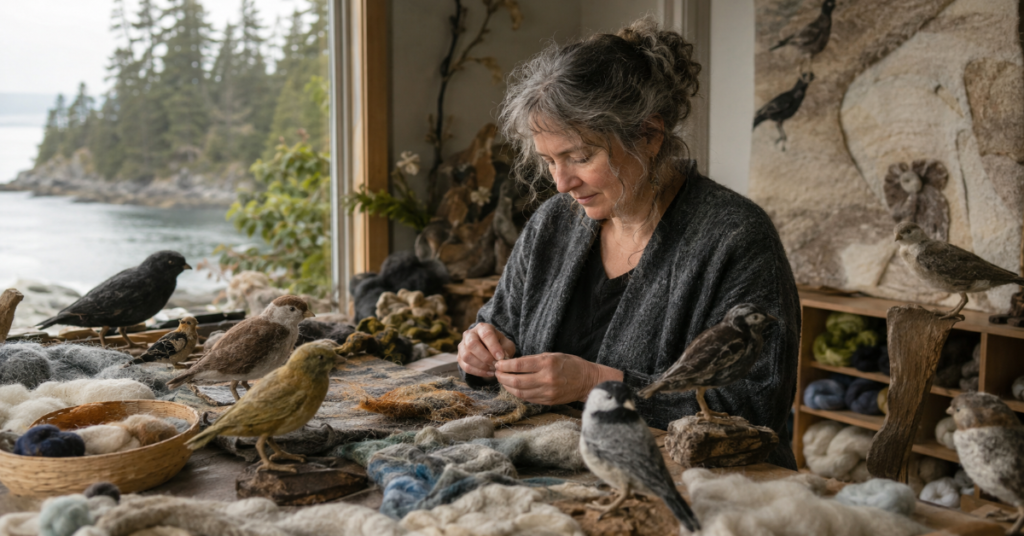
Anne Steves is a Welsh-Canadian multidisciplinary artist living in Cumberland on Vancouver Island, British Columbia. Her work is rooted in textiles, especially tufted wool rugs, but it does not sit neatly inside decorative craft. It uses softness, repetition and domestic materials to ask harder questions about death, belonging, ecology and how people relate to the non-human world. The uploaded production brief correctly frames the article around the artist Anne Steves and warns that search results can confuse her with Anne Steves, the former wife of travel writer Rick Steves.
That distinction matters. Public search intent around the name is split. One version leads to contemporary Canadian art, residencies and exhibitions. The other leads to a private biographical profile connected to Rick Steves’ divorce, which Britannica notes ended in 2010 after 25 years of marriage. This article focuses on the artist because that is where the verifiable current public record is strongest.
Steves’ artistic biography is unusually coherent: Wales, Vancouver Island, craft memory, ecological attention and the emotional charge of handmade objects. KIAC describes her as holding an undergraduate degree in Visual Arts from Emily Carr University of Art and Design and a Master of Fine Art in Studio Practices from the University of Victoria. It also identifies her participation in residencies including the Canadian Craft Biennial residency, MAWA residency, Kent Harrison Ranger Station residency and a Swansea-based residency with Gower College and Mission Gallery.
Anne Steves at a Glance
| Detail | Verified Information |
| Full name used professionally | Anne J. Steves / Anne Steves |
| National and cultural background | Welsh-Canadian |
| Base | Cumberland, Vancouver Island, British Columbia |
| Primary media | Tufted wool rugs, textiles, photography, written reflection |
| Education | BFA in Visual Arts, Emily Carr University of Art and Design; MFA in Studio Practices, University of Victoria |
| Key themes | Life, loss, connection, place, childhood craft, ecological grief |
| Notable recent exhibition | Flight [Cage], ODD Gallery, Dawson City, Yukon, 2024 |
| Search clarification | Not the same search subject as Rick Steves’ former wife |
Artistic Background and Education
Steves’ formal training sits between two important West Coast art institutions. Emily Carr University of Art and Design gave her a foundation in visual art while the University of Victoria MFA placed her work in a research-led studio context. The University of Victoria’s 2012 MFA coverage listed Anne J. Steves among the graduating Master of Fine Arts artists in Visual Arts, confirming her place in that cohort.
Her practice is not only academic. It carries a strong thread of childhood craft. MAWA’s profile of Anne J. Steves notes that embroidery, knitting, string games, storytelling and handwriting from her childhood as an immigrant from Wales continue to influence her work. The key idea is repetition: small actions repeated until they become memory, method and place-making.
That background helps explain why rugs matter in her work. A rug is not just an image. It is stepped on, touched, warmed, cleaned, lived with and inherited. When Steves uses a rug format to present dead birds or ecological fragments, she brings grief into the scale of the body and the home.
The Work: Why Tufted Wool Rugs Matter
Steves’ recent work has centered on tufted wool rugs, particularly large textile pieces based on bird imagery. KIAC’s description of Flight [Cage] says the exhibition featured tufted wool rugs, photographs and written reflections, transforming images of lifeless birds into large, human-scale artworks.
That phrase, “human-scale,” is crucial. A small dead bird on a sidewalk can be overlooked. A bird enlarged into a wool rug demands a different response. The viewer is not simply looking at an image. The viewer is facing something tactile, soft and bodily. The work pushes against the childhood instruction not to touch dead animals, asking whether distance is always ethical or whether care sometimes requires proximity.
Steves’ materials sharpen that question. Wool carries associations of warmth, protection, domestic labor and animal life. Tufting is also repetitive and physical. Each loop or punch becomes a gesture of attention. In that sense, the making process mirrors mourning itself: repeated, slow and never fully finished.
Key Exhibitions, Residencies and Public Context
| Year | Project or Institution | Why It Matters |
| 2012 | University of Victoria MFA Thesis Exhibition | Confirms graduate-level studio training and early professional development |
| 2019 | MAWA residency, Winnipeg | Shows continued development of craft, place and belonging themes |
| 2019 | CraftED: A-Luring Objects | Demonstrates engagement with craft objects, play and material culture |
| 2021 | Comox Valley Art Gallery OFFSITE_ONSITE | Connects Steves’ practice to Vancouver Island place-based research |
| 2024 | Flight [Cage], ODD Gallery, Dawson City | Major recent exhibition focused on birds, loss and tactile memorial forms |
Steves’ 2019 CraftED project, A-Luring Objects, was presented through the Manitoba Craft Council’s C2 Centre for Craft. The listing identifies her as a Welsh/Canadian interdisciplinary artist working on Vancouver Island and confirms her BFA and MFA credentials.
Her Vancouver Island grounding is also visible in Comox Valley Art Gallery’s OFFSITE_ONSITE project, which described her as a first-generation Welsh/Canadian interdisciplinary artist working in Cumberland. That listing connects her to residencies, exhibitions across Canada and the UK and a practice informed by place.
The Kent Harrison Arts Council profile adds another important detail: Steves works through textiles, drawing and thread-based media, examining narratives of place through common craft materials. That is a useful summary of the larger arc of her work. She is not simply making rugs as objects. She is using craft materials to ask how places become legible through memory, touch and story.
Flight [Cage]: The 2024 Exhibition That Clarified Her Current Direction
Flight [Cage] opened at ODD Gallery in Dawson City, Yukon in October 2024. KIAC’s calendar listed the opening reception, artist talk and rug tufting demonstration for October 24, 2024. The ODD Gallery archive lists the exhibition from October 24 to December 6, 2024.
The exhibition’s core subject was direct but emotionally complex: dead birds. Steves used images of lifeless birds, including her own photographs and images sourced from friends or online contributors, then transformed them into large textile works.
Three original insights stand out from this public record.
First, Steves’ use of dead bird imagery is not shock-based. It is relational. The works ask viewers to slow down around something usually avoided, making the exhibition less about spectacle and more about ethical attention.
Second, the rug format complicates the boundary between art object and domestic object. A rug is expected to support bodies. A dead bird image asks for reverence. That tension gives the work its force.
Third, her practice offers a quiet critique of digital grief. The source images may circulate through friends and online networks, but the final textile form is slow, manual and materially heavy. In an image-saturated culture, Steves turns a passing photograph into a sustained encounter.
Anne Steves and the Search Confusion Around Rick Steves
A responsible article about Anne Steves should address the search confusion directly without exploiting it.
There is a separate public figure-adjacent search result for Anne Steves as the former wife of American travel writer Rick Steves. Britannica states that Rick Steves’ marriage to Anne ended in divorce in 2010 after 25 years. That fact belongs to Rick Steves’ public biography, but it does not provide meaningful context for the artist Anne Steves unless a source establishes they are the same person. The available art sources identify the artist through Wales, Cumberland, Vancouver Island, Emily Carr University, the University of Victoria and contemporary textile practice.
For readers, the practical takeaway is simple: when searching the name, check context. If the result discusses textile art, tufted rugs, Vancouver Island, Wales, ODD Gallery or MAWA, it is about the artist. If it discusses Rick Steves, divorce or celebrity biography, it is a different search context and should not be merged without evidence.
Cultural and Market Relevance
Steves’ practice fits into several larger art-world movements: the renewed critical attention to craft, the rise of textile-based contemporary art and the increasing visibility of ecological grief as an artistic subject.
The art market has long separated “fine art” from “craft,” often undervaluing textiles because of their associations with domestic labor, women’s work and utility. Artists such as Steves challenge that hierarchy by using textile methods for conceptually serious work. Her rugs do not reject craft. They depend on it. The technical softness of the medium becomes part of the argument.
Her work also reflects a cultural shift in how people process environmental loss. Bird mortality is not abstract. It appears in neighborhoods, window strikes, roadsides and shorelines. By enlarging bird bodies through wool, Steves makes ecological loss visible without turning it into statistics alone.
Risks, Trade-Offs and Editorial Limits
The biggest risk in writing about Anne Steves is overclaiming. Her public profile is meaningful but not celebrity-scale. A strong article should not invent personal details, estimate net worth, fabricate family history or pretend to have interviewed her without doing so.
Another trade-off is source availability. Gallery pages and residency listings are reliable for exhibitions, education and artist statements, but they do not answer every biographical question. That limitation should be respected.
There is also a visual risk in describing the work too gently. The subject matter includes lifeless birds and grief. Yet the work is not bleak in a simplistic way. It uses softness to hold discomfort. That balance is what makes it artistically interesting.
The Future of Anne Steves in 2027
By 2027, Anne Steves’ work is likely to be read within the broader growth of contemporary textile art, ecological craft practice and site-responsive installation. That is an informed projection, not a guaranteed market forecast.
The public record suggests three plausible directions. First, her tufted bird works may continue moving through public galleries because they combine strong visual identity with accessible emotional themes. Second, her residency-based practice may remain central because past sources repeatedly connect her work to place, travel and community exchange. Third, her use of digital image sourcing could become more important as artists continue to examine how online networks shape memory and mourning.
The uncertainty is institutional. Textile artists often need large production time, storage capacity and installation support. Human-scale rugs are labor-intensive objects. Their future visibility depends not only on artistic quality but on gallery budgets, shipping logistics and curatorial appetite for craft-based installation.
Practical Takeaways
• Anne Steves’ strongest public identity is as a Welsh-Canadian multidisciplinary artist based on Vancouver Island.
• Her education and residencies show a serious, sustained studio practice rather than a casual craft business.
• Tufted wool rugs are central because they bring image, touch, labor and domestic memory together.
• Bird imagery in her work functions as ecological mourning, not decorative motif.
• Search confusion with Rick Steves’ former wife should be handled carefully and not collapsed into the artist’s biography.
• Flight [Cage] is the key recent exhibition for understanding her current direction.
• The most reliable sources for her profile are gallery, residency and institutional art pages.
Conclusion
Anne Steves’ work stands out because it treats craft as a serious language for grief, ecology and connection. Her tufted rugs are visually immediate, but their force comes from the tension between softness and death, domestic comfort and environmental unease. The public record shows an artist shaped by Wales, Vancouver Island, formal art education and a sustained interest in how ordinary materials carry memory.
The name “Anne Steves” may lead some readers toward celebrity-adjacent search results, but the artist’s story deserves its own frame. Her practice is not about borrowed fame. It is about the slow work of looking closely at what people are taught to avoid: dead birds, fragile bonds and the uneasy intimacy between human life and the natural world.
FAQ
Who is Anne Steves?
Anne Steves is a Welsh-Canadian multidisciplinary artist based in Cumberland on Vancouver Island, British Columbia. She works with textiles, tufted wool rugs, photography and written reflection. Her practice explores life, loss, place, ecological connection and the emotional power of handmade objects.
Is Anne Steves the same person as Rick Steves’ ex-wife?
Search results can confuse readers, but the artist Anne Steves should not be merged with Rick Steves’ former wife unless a reliable source proves that connection. Current art sources identify the artist through Vancouver Island, Wales, Emily Carr University, the University of Victoria and contemporary textile practice.
What kind of art does Anne Steves make?
Anne Steves works primarily with textile-based media, including tufted wool rugs. Her recent work also incorporates photography and writing. She is especially associated with bird imagery, natural elements and tactile works that examine grief, memory and connection.
Where is Anne Steves based?
Anne Steves is based in Cumberland, a village on Vancouver Island in British Columbia, Canada. Multiple gallery and residency sources identify Cumberland and Vancouver Island as central to her professional profile.
What was Flight [Cage]?
Flight [Cage] was Anne Steves’ 2024 exhibition at ODD Gallery in Dawson City, Yukon. It featured tufted wool rugs, photographs and written reflections based on images of lifeless birds, presented as large human-scale artworks.
What is Anne Steves’ educational background?
Public art listings state that Anne Steves holds a BFA in Visual Arts from Emily Carr University of Art and Design and an MFA in Studio Practices from the University of Victoria.
Why does Anne Steves use birds in her work?
Birds allow Steves to explore vulnerability, mortality, ecology and care. In Flight [Cage], dead bird imagery becomes a way to examine how people respond to loss and whether touch, attention and handmade labor can become forms of respect.
Methodology
This article was prepared from the uploaded Postcard.fm production brief, gallery listings, institutional art pages, residency records and publicly available biographical sources. The strongest sources were KIAC/ODD Gallery, MAWA, Comox Valley Art Gallery, the University of Victoria and the Manitoba Craft Council/C2 Centre for Craft. The article avoids unsupported personal claims and treats the Rick Steves search overlap as a disambiguation issue only. Known limitation: no direct interview with Anne Steves was conducted for this draft. A human editor should verify all references, image permissions, internal links and any final APA formatting before publication.
References
Britannica. (2026). Rick Steves biography.
Comox Valley Art Gallery. (2021). OFFSITE_ONSITE / Ongoing Installation Projects.
Kent Harrison Arts Council. (n.d.). Past residents.
Klondike Institute of Art & Culture. (2024). In the ODD Gallery: Anne Steves.
Klondike Institute of Art & Culture. (2024). Anne Steves | Flight [Cage] opening reception, artist talk and rug tufting demonstration.
Klondike Institute of Art & Culture. (2024). ODD Gallery exhibition archive.
MAWA. (2019). Anne J. Steves, Cumberland, BC.
Manitoba Craft Council / C2 Centre for Craft. (2019). CraftED: A-Luring Objects with Anne Steves.
University of Victoria. (2012). MFA Thesis Exhibition on now.