
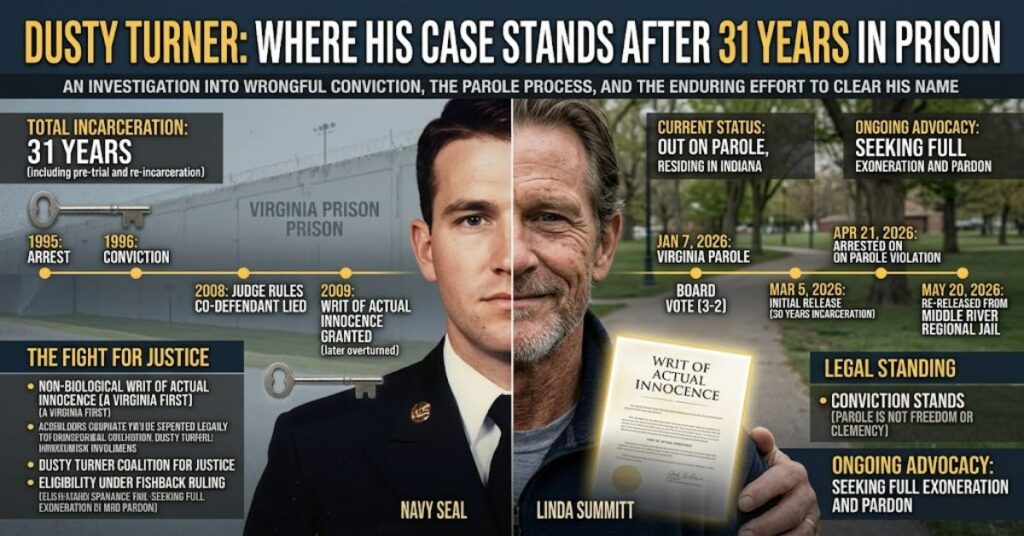
Dusty Turner is now home in Bloomington, Indiana, after spending more than three decades in a Virginia prison. His release is a major development in a case that has continued through several stages of litigation, parole proceedings and renewed challenges to his convictions. For Turner, however, leaving prison does not represent the end of the story. His legal status remains complicated because parole is not the same as exoneration.
Turner was convicted in 1996 in connection with the 1995 killing of Jennifer Lea Evans, a 21-year-old pre-med student in Virginia Beach. He maintained that he was not responsible for the killing. His co-defendant, Billy Joe Brown, later recanted his original account and testified that he alone killed Evans. A Virginia judge subsequently found Brown’s confession credible, but Turner’s efforts to overturn his convictions did not result in complete legal exoneration.
The case entered a new phase in January 2026, when the Virginia Parole Board voted 3–2 to release Turner. He walked out of prison on March 5. After a short period of freedom, however, he was arrested in April over an alleged parole violation. He was released again in May and eventually returned to Indiana.
His circumstances now illustrate an important distinction in criminal justice: being released from prison does not necessarily mean that a conviction has been erased.
Who Is Dusty Turner?
Dustin “Dusty” Turner is a Bloomington native and former Navy SEAL trainee whose life changed dramatically after the events surrounding Evans’ death in 1995.
According to reporting from Indiana Public Media, Turner left Bloomington in 1992 to pursue his goal of becoming a Navy SEAL. He was later convicted in Virginia and sentenced to 82 years.
Turner’s case became particularly controversial because his co-defendant eventually claimed sole responsibility for the killing. That later confession became central to Turner’s long-running effort to challenge his convictions.
The case demonstrates how difficult it can be to reverse a criminal conviction even when significant evidence changes after trial.
The 1995 Killing and Turner’s Conviction
Jennifer Lea Evans was killed in Virginia Beach in 1995. Turner and Brown were subsequently prosecuted in connection with the case.
Turner was convicted in 1996 of first-degree murder and abduction with intent to defile. Brown was also convicted, along with an attempted rape charge.
Turner’s legal position was that he did not murder Evans. His defence maintained that his involvement was limited to helping Brown dispose of the body after the killing.
The distinction became increasingly significant when Brown later changed his account.
The Confession That Changed the Case
One of the most important developments came in 2003, when Brown signed an affidavit recanting his trial testimony.
According to reporting on the case, Brown later testified under oath that he alone strangled Evans during a drunken rage and that Turner had attempted to stop him. A judge found Brown’s confession credible and ruled that Turner had not participated in Evans’ murder or restraint.
That finding became a central part of Turner’s subsequent legal battle.
Yet the legal consequences were not as straightforward as the factual dispute might suggest. Higher courts later rejected Turner’s effort to obtain a writ of actual innocence on legal grounds connected to the prosecution’s theory of the case.
This is one of the most important distinctions when discussing Turner’s situation: a judicial finding concerning evidence is not automatically the same thing as a final legal exoneration.
Why Parole Became Possible
Turner’s path toward parole changed after a 2020 Virginia Supreme Court decision involving parole eligibility.
In Fishback v. Commonwealth, the court addressed parole eligibility for certain prisoners whose juries had not been informed that Virginia had abolished parole when they were convicted. Turner’s case subsequently became eligible for parole consideration.
He was considered for parole more than once before the board ultimately voted in his favour.
On January 7, 2026, the Virginia Parole Board approved his release by a 3–2 vote. Turner had spent roughly 30 years in prison at that point.
March 5, 2026: Turner Walks Free
Turner was released on March 5, 2026.
The moment marked the end of more than three decades of incarceration. Family members were present when he left the prison grounds, and his release allowed him to begin rebuilding a life outside prison.
His return also represented a major adjustment. Turner entered prison in the 1990s and emerged into a world that had changed dramatically during his incarceration.
That transition is one reason his story extends beyond the courtroom.
The April Parole Violation
Turner’s first period of freedom lasted only several weeks.
On April 21, Virginia State Police arrested him after his parole officer alleged that Turner had failed to disclose his criminal history and sex-offender registration status to women with whom he had intimate relationships. His attorney disputed aspects of the allegation.
The incident resulted in another period of incarceration while the alleged violation was reviewed.
The situation highlights a difficult reality of parole: release does not mean unrestricted freedom. A person remains subject to specific supervision conditions, and an alleged violation can result in a return to custody.
May Release and Return to Indiana
The Virginia Parole Board subsequently approved Turner’s release again.
On May 20, 2026, Turner walked out of Middle River Regional Jail. His parole was transferred to Indiana, allowing him to return home.
The second release was particularly significant for his family. His mother, Linda Summitt, had spent decades advocating for her son and preparing for the possibility that he would eventually return home.
By July, reporting showed Turner living at his childhood home in Bloomington and adapting to ordinary life outside prison.
What Life Looks Like for Turner Now
Turner’s return to Bloomington has involved more than simply changing his address.
A July 2026 report described him exercising, swimming, playing pickleball, gardening and spending time around Lake Monroe. He also continued some environmental habits developed during his imprisonment, including collecting compost and paying attention to waste.
These details provide an unusual window into the practical side of re-entry.
After 31 years away, ordinary activities can become markers of freedom. Swimming, driving around familiar streets and returning to a childhood bedroom carry a different meaning for someone who spent decades incarcerated.
Turner also remains under parole supervision and wears a GPS monitor, according to the July report.
Parole Is Not Exoneration
This distinction is central to understanding Turner’s current position.
Parole means that Turner has been released from prison under supervision. It does not erase the convictions on his record.
His supporters continue to describe his ultimate objective as clearing his name. Turner’s own legal fight therefore continues even though he is no longer incarcerated.
| Development | Date | Significance |
| Parole approved | January 7, 2026 | Virginia board votes 3–2 for release |
| First release | March 5, 2026 | Turner leaves prison after more than 30 years |
| Arrest over alleged violation | April 21, 2026 | Turner returns to custody |
| Second release | May 20, 2026 | Parole release approved again |
| Parole transferred | May 2026 | Supervision moves to Indiana |
| Return-home reporting | July 2026 | Turner documented rebuilding daily life in Bloomington |
The legal and personal outcomes should therefore be described separately. His imprisonment has ended, but the underlying convictions remain an unresolved part of his legal history.
The Human Cost of a Long Incarceration
The case also illustrates the effects of prolonged incarceration on families.
Turner’s mother, Linda Summitt, spent decades advocating for him. Indiana Public Media reported that Turner described his mother’s experience as resembling incarceration alongside him because of the length and emotional burden of the case.
His return to Bloomington therefore represents a family event as much as a legal development.
It also creates a difficult adjustment period. Turner must rebuild relationships, adapt to technology and social changes, and establish a routine while still living under parole conditions.
What Happens Next?
The precise legal route toward overturning Turner’s convictions remains a matter for his attorneys and the relevant courts.
What is established is that parole has changed his immediate circumstances. He is no longer serving his sentence inside a Virginia prison, and his supervision has moved to Indiana. At the same time, his convictions have not simply disappeared.
His case therefore remains legally active in a broader sense, even as his day-to-day life has shifted toward rebuilding.
The Future of Dusty Turner in 2027
Turner’s story is likely to remain connected to the wider debate over wrongful convictions, parole and post-conviction remedies in 2027.
The most important development to watch is whether his legal team succeeds in securing a further review capable of changing the status of his convictions. That outcome cannot be predicted from the current record.
His transition back into society is also significant. The July 2026 reporting shows that Turner has begun developing routines in Bloomington while remaining under supervision.
The next stage will therefore involve two parallel questions: how Turner rebuilds his life after 31 years away, and whether the legal system ultimately provides the complete clearing of his name that he continues to seek.
Key Takeaways
- Turner spent more than three decades incarcerated in Virginia.
- His co-defendant later claimed sole responsibility for Jennifer Evans’ killing.
- A Virginia judge found the later confession credible, but Turner was not fully exonerated.
- The Virginia Parole Board approved his release in January 2026.
- His first release occurred on March 5 before an alleged parole violation led to his temporary return to jail.
- He was released again in May and transferred to Indiana parole supervision.
- As of July 2026, he was living in Bloomington and continuing his effort to clear his convictions.
Conclusion
Dusty Turner’s journey in 2026 represents a significant transition rather than a simple ending. After more than 30 years in prison, he has returned to Bloomington and begun rebuilding the ordinary routines that incarceration took away. His first release in March was followed by another period behind bars, demonstrating how restrictive parole can remain even after a person leaves prison.
The legal questions surrounding his convictions are more complicated. Brown’s later confession and the judicial findings surrounding it became important elements of Turner’s innocence claims, yet those developments did not automatically erase the convictions.
For Turner, freedom and exoneration remain separate goals. His return home is therefore both an achievement and the beginning of another chapter. The continuing legal effort to clear his name will determine whether his story ultimately ends with parole alone or with a formal resolution of the convictions that have shaped more than three decades of his life.
Frequently Asked Questions
Who is Dusty Turner?
Dusty Turner is a Bloomington, Indiana native who spent more than 30 years imprisoned in Virginia following convictions connected to the 1995 killing of Jennifer Lea Evans.
When was Dusty Turner released?
Turner was first released on March 5, 2026, after the Virginia Parole Board approved his release in January. He was released again on May 20 after a parole violation case.
Is Dusty Turner fully exonerated?
No. Turner has been released on parole, but his convictions have not been completely cleared. His legal fight to change that status continues.
Where is Dusty Turner now?
As of July 2026 reporting, Turner was living at his childhood home in Bloomington, Indiana, under parole supervision.
Why did Dusty Turner go back to jail in 2026?
He was arrested in April after his parole officer alleged that he had violated a supervision condition concerning disclosure of his convictions and sex-offender registration status to intimate partners. His attorney disputed the allegations.
What happened to the other man convicted in the case?
Billy Joe Brown, Turner’s co-defendant, later said that he alone killed Evans. He remains incarcerated in Virginia.
Methodology
This article was prepared from the supplied keyword brief, which identifies the target keyword as “dusty turner” and frames the article around Turner’s return to his childhood home in Bloomington following his 2026 parole and subsequent reincarceration.
Current factual details were cross-checked against Indiana Public Media, WBIW, WAVY reporting reproduced through secondary outlets, and July 2026 reporting from FPI News. Particular care was taken to distinguish allegations from established facts and parole from exoneration.
The article does not claim firsthand testing, interviews or personal observation by the author. The supplied editorial rules specifically prohibit inventing firsthand authority signals, so documented reporting and named case developments are used instead.
No suitable relevant Postcard.fm internal articles were located through the available site search, so no unrelated internal links have been inserted merely to satisfy a numerical link target. The supplied brief itself states that link quality should take priority over quantity when fewer than three relevant articles exist.
References
Baumgarth, C. (2026, March 6). After 30 years in jail, wrongfully convicted Bloomington native is released. Indiana Public Media.
Fitzgibbons, N. (2026, January 16). Bloomington native granted parole after decades in prison. Indiana Public Media.
Fitzgibbons, N. (2026, April 22). Bloomington native back in jail. Indiana Public Media.
Fitzgibbons, N. (2026, May 18). Bloomington native re-release on parole approved. Indiana Public Media.
Lane, L. (2026, July 14). After 31 years in prison, Bloomington man is home and fighting to clear his name. FPI News.
Lejano, J. (2026, May 22). Dustin Turner released from jail, heads to Indiana for parole. WAVY.