
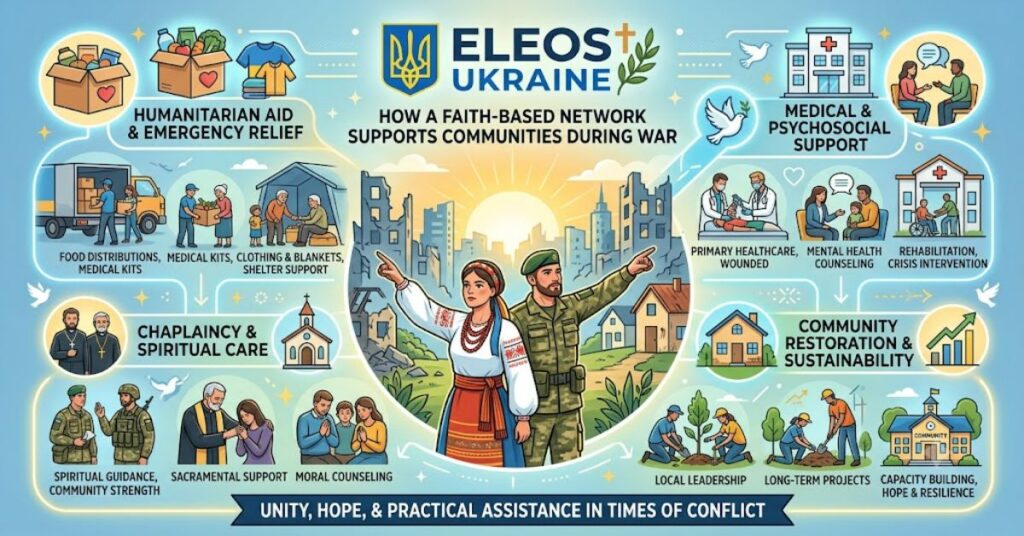
Eleos-Ukraine is a prominent faith-based non-governmental organisation that serves as the social service and charity network of the Orthodox Church of Ukraine (OCU). Established in 2014, the organisation developed in response to growing social needs following political instability, displacement, and later the full-scale Russian invasion of Ukraine in February 2022.
The name “Eleos” comes from the Greek word meaning mercy or compassion, reflecting the organisation’s focus on supporting people experiencing hardship. Through a network of regional branches, Eleos-Ukraine delivers humanitarian aid, evacuation assistance, medical support, and psychological rehabilitation programmes.
Unlike traditional charity models that operate from a central headquarters, the organisation relies heavily on local networks. This structure allows volunteers and social workers to respond quickly to changing conditions in different parts of Ukraine.
The work of Eleos Ukraine demonstrates the wider role religious institutions can play during humanitarian crises. Beyond spiritual activities, faith-based organisations often provide practical assistance where public services are limited or overwhelmed.
The Origins and Mission of Eleos-Ukraine
Eleos-Ukraine was founded in 2014 during a period of significant social disruption in Ukraine. The organisation initially focused on helping vulnerable communities affected by conflict and displacement.
Its mission developed around several key areas:
| Area of Support | Main Activities |
| Humanitarian Aid | Food packages, clothing, emergency supplies |
| Social Services | Assistance for vulnerable families and individuals |
| Medical Support | Healthcare assistance and rehabilitation services |
| Psychological Care | Trauma support and recovery programmes |
| Evacuation Assistance | Help relocating people from dangerous areas |
The organisation’s connection with the Orthodox Church of Ukraine provides access to local communities, volunteers, and parish networks. This relationship allows humanitarian work to reach people who may otherwise struggle to access assistance.
How the Organisation Responds During Wartime
The escalation of the war in 2022 significantly increased humanitarian needs across Ukraine. Millions of people were displaced internally, while many communities experienced damage to homes, infrastructure, and healthcare facilities.
Eleos-Ukraine adapted its activities to address emergency requirements. Its regional branches became important points for distributing aid and supporting affected residents.
A decentralised structure creates several advantages:
- Local teams understand community needs more accurately.
- Assistance can be delivered faster during emergencies.
- Volunteers often have existing relationships with residents.
- Regional branches can adapt programmes according to local conditions.
However, decentralisation also creates challenges. Maintaining consistent reporting standards, coordinating resources, and ensuring transparent distribution require strong organisational systems.
The Role of Faith-Based Humanitarian Networks
Faith-based organisations have historically played a significant role in humanitarian assistance. Their strength often comes from established community relationships and volunteer networks.
Eleos Ukraine represents a model where religious identity and humanitarian action operate together. The organisation’s activities are focused on practical support rather than only religious engagement.
| Organisation Feature | Practical Impact |
| Church-based network | Wider community access |
| Local volunteers | Faster emergency response |
| Regional branches | Better understanding of local needs |
| Humanitarian programmes | Direct assistance to vulnerable groups |
This model can be especially valuable during prolonged conflicts, where humanitarian needs continue beyond immediate emergency periods.
Challenges and Operational Risks
Operating during wartime creates complex challenges for humanitarian organisations.
Eleos-Ukraine must manage several risks:
Security risks:
Staff and volunteers may operate in areas affected by military activity, infrastructure damage, and unpredictable conditions.
Resource limitations:
Humanitarian organisations depend heavily on donations, partnerships, and international support. Funding uncertainty can affect long-term planning.
Coordination challenges:
Large-scale emergencies require cooperation between government agencies, international organisations, and local groups.
A key operational challenge is balancing immediate relief with sustainable recovery. Providing food and emergency supplies is essential, but communities also require psychological support, healthcare access, and long-term social rebuilding.
The Human Impact of Eleos Ukraine’s Work
The organisation’s impact extends beyond material assistance. War affects communities through displacement, trauma, family separation, and uncertainty about the future.
Psychological rehabilitation has become increasingly important as civilians experience prolonged stress. Support programmes can help individuals process trauma and rebuild social connections.
Internally displaced persons (IDPs) represent one of the largest groups requiring assistance. Many displaced families need temporary accommodation support, employment assistance, medical care, and integration into new communities.
The Future of Eleos-Ukraine in 2027
By 2027, humanitarian organisations in Ukraine are likely to face a transition from emergency response toward long-term recovery efforts.
Future priorities may include:
- Supporting displaced people returning home
- Expanding mental health programmes
- Strengthening local community services
- Developing partnerships with international humanitarian organisations
The organisation’s future effectiveness will depend on maintaining transparency, improving coordination systems, and adapting programmes to changing social needs.
Ukraine’s recovery will require cooperation between government institutions, civil society groups, religious organisations, and international partners. Faith-based networks such as Eleos-Ukraine may continue to play an important role because of their community-level presence.
Key Takeaways
- Eleos-Ukraine was established in 2014 to provide social and humanitarian support.
- The organisation operates through regional branches connected with local communities.
- Its activities expanded significantly after Russia’s full-scale invasion of Ukraine in 2022.
- Faith-based networks can provide important humanitarian support during crises.
- Long-term recovery requires psychological, medical, and social assistance alongside emergency aid.
- Future challenges include funding stability, coordination, and sustainable rebuilding.
Frequently Asked Questions
What is Eleos-Ukraine?
Eleos-Ukraine is a humanitarian and social service organisation connected with the Orthodox Church of Ukraine, providing assistance to vulnerable communities.
When was Eleos Ukraine founded?
The organisation was founded in 2014 during a period of major social and political challenges in Ukraine.
What services does Eleos-Ukraine provide?
It provides humanitarian aid, evacuation assistance, medical support, social services, and psychological rehabilitation.
How does Eleos-Ukraine support displaced people?
The organisation assists internally displaced persons through humanitarian supplies, social support programmes, and community-based services.
Is Eleos-Ukraine only a religious organisation?
Although connected with the Orthodox Church of Ukraine, its humanitarian activities focus on assisting people affected by hardship regardless of background.
Methodology
This article was prepared using publicly available information about Eleos-Ukraine, humanitarian response structures, and faith-based organisations operating in Ukraine. Sources were reviewed for organisational background, humanitarian context, and conflict-related developments.
Limitations include the availability of detailed internal operational data, financial information, and complete impact measurements, as many humanitarian organisations do not publicly release all operational records.
This article was drafted with AI assistance and reviewed for factual accuracy. All claims should be independently verified by editors before publication.
References
Orthodox Church of Ukraine. (2024). Social and humanitarian initiatives of the Orthodox Church of Ukraine.
United Nations High Commissioner for Refugees. (2024). Ukraine emergency: Humanitarian situation update.
United Nations Office for the Coordination of Humanitarian Affairs. (2024). Ukraine humanitarian response.
World Health Organization. (2024). Ukraine emergency response and health situation reports.