
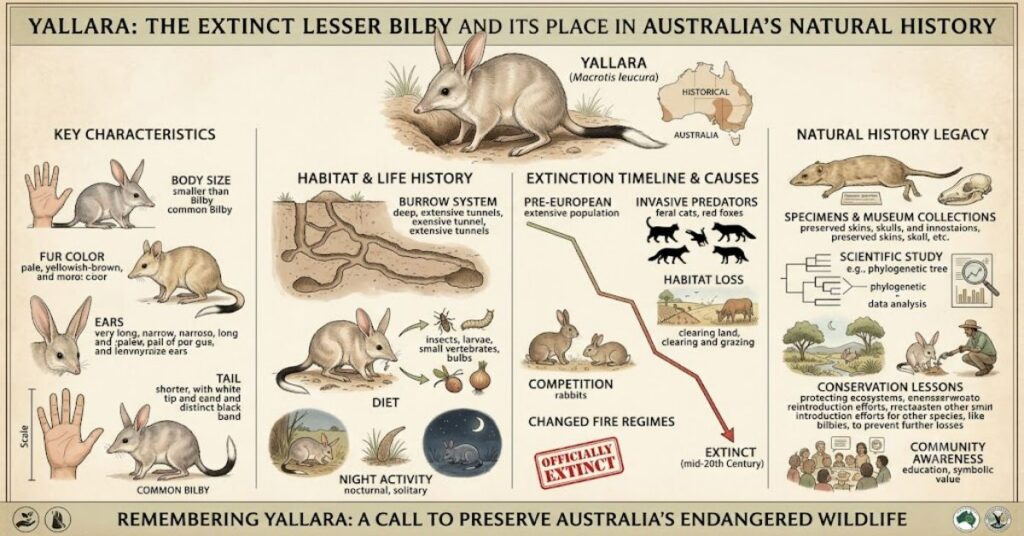
The yallara was a small, rabbit-like marsupial that once lived in Australia’s arid and semi-arid regions. Also known as the lesser bilby, lesser rabbit-eared bandicoot, or white-tailed rabbit-eared bandicoot, this extinct species represents one of Australia’s many lost native mammals.
The species was scientifically described by British zoologist Oldfield Thomas in 1887 as Peragale leucura (later placed under Macrotis relatives) after researchers examined a single specimen held in the mammal collection of the British Museum.
Unlike the surviving greater bilby, the lesser bilby disappeared during the 20th century. Scientists believe its extinction resulted from a combination of environmental changes, introduced predators such as feral cats and foxes, competition from introduced animals, and changes to Australia’s landscapes.
The history of this marsupial provides important lessons for modern conservation. Understanding why the yallara vanished helps researchers identify risks facing other vulnerable species and improve protection strategies for Australia’s remaining native wildlife.
The Origins and Classification of the Yallara
The yallara belonged to the bandicoot and bilby group of Australian marsupials. These animals are recognised for their long ears, strong digging abilities, and adaptations to dry environments.
The species was first documented scientifically in 1887 when Oldfield Thomas studied a specimen collected in Australia. Because researchers had limited information about its behaviour and distribution, much of what is known today comes from museum records and comparisons with related species.
| Feature | Description |
| Common Names | Yallara, lesser bilby, lesser rabbit-eared bandicoot |
| Scientific Name | Macrotis leucura |
| Classification | Marsupial |
| Discovery Description | Oldfield Thomas, 1887 |
| Status | Extinct |
The limited number of historical specimens makes the species difficult to study compared with living mammals. Researchers have had to rely on physical evidence, historical records, and ecological comparisons.
How the Yallara Differed From the Greater Bilby
The yallara was closely related to the greater bilby, which still survives in protected areas and conservation programmes. However, there were important differences between the two species.
| Characteristic | Yallara | Greater Bilby |
| Status | Extinct | Endangered |
| Body Size | Smaller | Larger |
| Distribution | Arid Australian regions | Central and western Australia |
| Scientific Records | Limited | Extensive research available |
| Conservation Efforts | None possible after extinction | Active recovery programmes |
The loss of the yallara demonstrates why protecting species before populations become critically low is essential. Once a species disappears, conservation efforts can only preserve knowledge rather than restore living populations.
Causes Behind the Extinction of the Lesser Bilby
The exact timeline of the yallara’s extinction remains uncertain, but researchers generally associate its disappearance with several overlapping pressures.
Introduced Predators
European settlement introduced predators such as red foxes and feral cats. These animals placed significant pressure on native mammals that evolved without similar threats.
Small ground-dwelling marsupials were especially vulnerable because they often nested and searched for food on the desert floor.
Habitat Changes
Changes in land management, grazing patterns, and vegetation structure altered many Australian ecosystems. Species adapted to specific environments often struggled when those conditions changed.
Competition From Introduced Species
Introduced rabbits created additional ecological pressure by competing for vegetation and modifying habitats through grazing and burrowing.
What the Yallara Teaches Modern Conservation
The extinction of this marsupial provides several important lessons for wildlife management.
First, rare species require early intervention. Waiting until populations become extremely small can leave conservationists with limited options.
Second, protecting ecosystems is often more effective than focusing only on individual species. Habitat protection benefits entire communities of plants and animals.
Third, historical records such as museum collections remain valuable. Although they cannot replace living populations, specimens provide genetic and biological information that supports modern research.
The Cultural and Scientific Importance of the Yallara
Australia has lost many native mammals since European colonisation. The yallara is part of a broader pattern of biodiversity decline that has affected unique Australian species.
Museum collections preserve evidence of these lost animals. They allow scientists to study anatomy, evolution, and ecological relationships long after extinction.
The species also represents the importance of Indigenous and scientific knowledge working together. Traditional ecological knowledge and modern conservation research can provide deeper understanding of Australia’s changing environments.
The Future of Yallara in 2027
The yallara cannot be brought back through traditional conservation methods, but research into extinct species continues to influence wildlife protection.
By 2027, conservation priorities are expected to focus on preventing further extinctions through:
- Predator control programmes
- Habitat restoration
- Native species monitoring
- Genetic research
- Protected ecosystem management
Advances in biodiversity science may provide additional information from historical specimens, but current conservation efforts remain focused on protecting living species such as the greater bilby.
The story of the yallara is therefore not only about extinction. It is also about improving conservation decisions before other vulnerable animals face the same outcome.
Key Takeaways
- The yallara was an extinct Australian marsupial related to the greater bilby.
- Oldfield Thomas formally described the species in 1887 from a museum specimen.
- Predator introduction and environmental changes likely contributed to its disappearance.
- Museum collections provide essential evidence about extinct wildlife.
- Protecting habitats is one of the strongest tools for preventing future extinctions.
- The yallara remains an important example of Australia’s biodiversity losses.
Frequently Asked Questions
What was the yallara?
The yallara was the lesser bilby, an extinct rabbit-like marsupial native to Australia.
When was the yallara discovered?
The species was scientifically described in 1887 by zoologist Oldfield Thomas.
Why did the lesser bilby become extinct?
Its extinction is linked to introduced predators, habitat changes, and ecological pressures following European settlement.
Is the yallara the same as the greater bilby?
No. They were related species, but the greater bilby survives while the yallara is extinct.
Can scientists bring back the yallara?
Currently, there are no practical methods to restore the species. Research focuses on understanding extinction and protecting surviving wildlife.
Methodology
This article was developed using publicly available zoological records, museum documentation, and conservation research relating to Australian marsupials. Information about classification, historical discovery, and extinction factors was cross-checked against recognised scientific and conservation sources.
Limitations include the lack of extensive field observations because the species is extinct and known primarily through historical specimens.
This article was drafted with AI assistance and should receive final human editorial verification before publication.
References
Burbidge, A. A., & Woinarski, J. C. Z. (2019). Threatened mammals of Australia and conservation challenges. Australian Journal of Zoology.
International Union for Conservation of Nature. (2024). The IUCN Red List of Threatened Species: Australian marsupial assessments.
Museums Victoria. (2024). Australian mammal collections and extinct species records.
Woinarski, J. C. Z., Burbidge, A. A., & Harrison, P. L. (2014). The Action Plan for Australian Mammals 2012. CSIRO Publishing.