
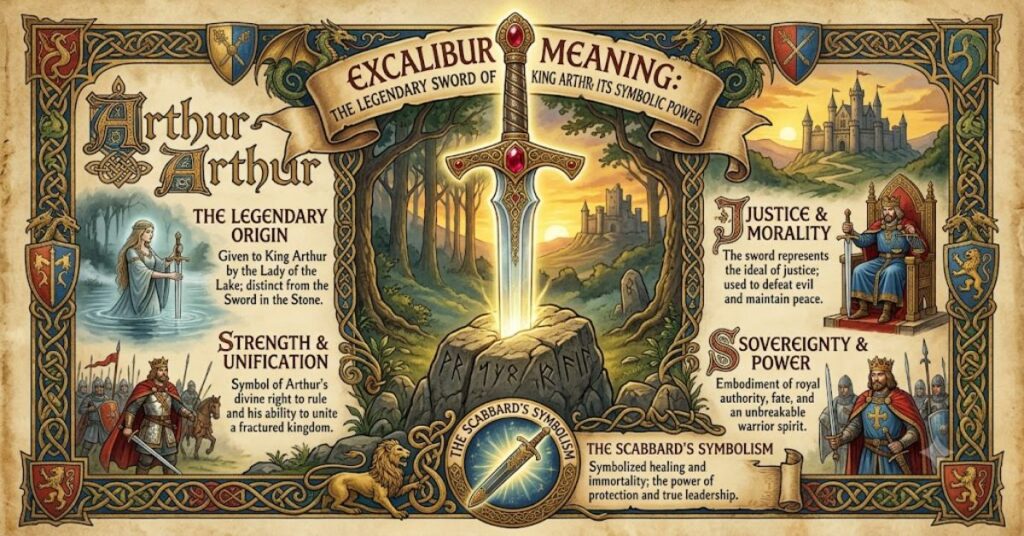
The Excalibur meaning is closely connected to the legendary sword of King Arthur in Arthurian mythology. More than a powerful weapon, Excalibur represents rightful rule, courage, and the responsibility that comes with authority. Medieval stories often describe it as a magical sword capable of extraordinary feats, including cutting through armour and protecting its owner through supernatural qualities. Its famous scabbard was said to prevent Arthur from losing blood during battle, making the object a symbol of protection as well as power.
The legend of Excalibur has evolved over centuries, appearing in medieval romances, historical interpretations, literature, films, and popular culture. Although historians debate whether Arthur himself was based on a real figure, the sword remains one of the strongest symbols associated with British mythology.
Origins of the Excalibur Legend
The earliest Arthurian stories did not always include Excalibur by name. The sword became more clearly defined through medieval writers who expanded Arthur’s mythology.
One important source is Geoffrey of Monmouth’s Historia Regum Britanniae, written around 1136. Later authors, especially French medieval romance writers, developed Arthur’s world further by adding magical elements and deeper symbolism.
The sword eventually became associated with:
- Royal legitimacy
- Divine approval
- Military strength
- Moral responsibility
Rather than simply proving physical power, Excalibur showed that a ruler needed wisdom and virtue.
The Symbolism Behind King Arthur’s Sword
| Symbolic Meaning | Explanation |
| Sovereignty | Represents Arthur’s rightful claim to rule Britain |
| Justice | Reflects the king’s duty to protect his people |
| Divine Authority | Suggests approval from higher powers |
| Strength | Represents courage and victory |
| Honour | Connects leadership with moral behaviour |
The deeper interpretation of Excalibu’r focuses less on the sword itself and more on what it represents. A ruler holding such a weapon must demonstrate fairness and responsibility.
Excalibur and the Sword in the Stone
A common source of confusion is the relationship between Excalibu’r and the Sword in the Stone.
Many modern adaptations combine the two objects, but medieval traditions often treated them separately.
| Sword | Role in Arthurian Tradition |
| Sword in the Stone | Proved Arthur’s rightful claim to kingship |
| Excalibur | Magical weapon associated with Arthur’s reign |
According to some versions, Arthur received Excalibur from the Lady of the Lake after becoming king. This distinction highlights how different writers shaped the legend according to their own themes.
Magical Powers and the Famous Scabbard
Arthurian stories describe Excalibur as more than an ordinary blade. Some versions portray it as a weapon that could cut through any material, making it nearly impossible for enemies to defeat Arthur in combat.
However, the scabbard was considered equally important. Legends claimed it protected Arthur from serious wounds by preventing excessive bleeding.
This detail adds another layer to the story. The power of Excalibur was not only about defeating enemies but also preserving the king’s life and maintaining stability.
Cultural Impact Through History
The legend of Excalibur has influenced centuries of storytelling.
Its influence appears in:
- Medieval literature
- Opera and theatre
- Fantasy novels
- Films and television
- Video games
- Historical tourism
Modern audiences often recognise Excalibur as a symbol of heroic leadership. Films and fantasy works have introduced new interpretations while keeping the central idea of a powerful and meaningful sword.
Three Lesser-Known Insights About Excalibur
One overlooked aspect of the legend is that Excalibur reflects medieval ideas about leadership rather than only warfare. The sword represented a contract between ruler and society.
Another important point is that Arthurian legends were shaped by political concerns. Medieval writers often used Arthur’s image to discuss ideal kingship, loyalty, and national identity.
A third insight is that Excalibur’s popularity comes from adaptability. Because the sword represents broad human values—justice, courage, and responsibility—it continues to fit different cultural periods.
The Future of Excalibur in 2027
Interest in Arthurian mythology is expected to continue through museums, academic research, fantasy entertainment, and digital storytelling. Advances in historical research and digital reconstruction may provide new ways to explore medieval Britain and the development of Arthurian legends.
However, Excalibur will likely remain primarily a cultural symbol rather than a historical object. The absence of archaeological evidence proving the sword’s existence does not reduce its importance as a mythological icon.
Key Takeaways
- Excalibur represents much more than a legendary weapon.
- The sword became associated with Arthur’s legitimacy and moral duty.
- Medieval writers transformed Excalibur into a symbol of ideal leadership.
- The scabbard added themes of protection and preservation.
- Different versions of Arthurian stories present different origins for the sword.
- Modern culture continues to reinterpret Excalibur for new audiences.
Conclusion
The Excalibur meaning extends far beyond the image of a magical sword carried by King Arthur. Across centuries of storytelling, it has represented the qualities expected from a true leader: justice, courage, responsibility, and wisdom. While historians cannot confirm the existence of Arthur or his legendary weapon, the cultural influence of Excalibur remains undeniable.
From medieval manuscripts to modern entertainment, the sword continues to inspire writers, artists, and audiences around the world. Its lasting appeal comes from its ability to represent an enduring idea: power is meaningful only when guided by honour and responsibility.
FAQ
What does Excalibur symbolise?
Excalibur symbolises rightful leadership, justice, strength, and divine authority. It represents the responsibilities that come with power rather than power alone.
Was Excalibur a real sword?
There is no historical evidence proving that Excalibur existed. It remains part of Arthurian mythology and medieval storytelling traditions.
What makes Excalibur different from other legendary swords?
Excalibur stands apart because it represents kingship and moral authority, not only combat ability. Its magical qualities reinforce Arthur’s special role.
Did King Arthur pull Excalibur from the stone?
Many modern stories combine the two legends, but traditional accounts often describe the Sword in the Stone and Excalibur as separate weapons.
Who gave Arthur Excalibur?
In many versions of Arthurian mythology, the Lady of the Lake gives Excalibur to Arthur after he becomes king.
Methodology
This article was prepared using established Arthurian scholarship, medieval literary sources, and historical research on European mythology. Key references include medieval texts such as Geoffrey of Monmouth’s writings and later Arthurian romances. Because Arthurian legends combine history, folklore, and literary invention, interpretations vary between scholars. The article separates documented medieval traditions from fictional adaptations.
Editorial Disclosure: This article was drafted with AI assistance and should be reviewed by a human editor before publication. All historical claims and references should be independently verified before final release.
References (APA)
Geoffrey of Monmouth. (2007). The History of the Kings of Britain. Broadview Press.
Loomis, R. S. (1959). The Development of Arthurian Romance. Harper & Brothers.
Lacy, N. J. (1991). The New Arthurian Encyclopedia. Garland Publishing.
Putter, A., & Gilbert, J. (2014). The Spirit of Medieval English Popular Romance. Routledge.