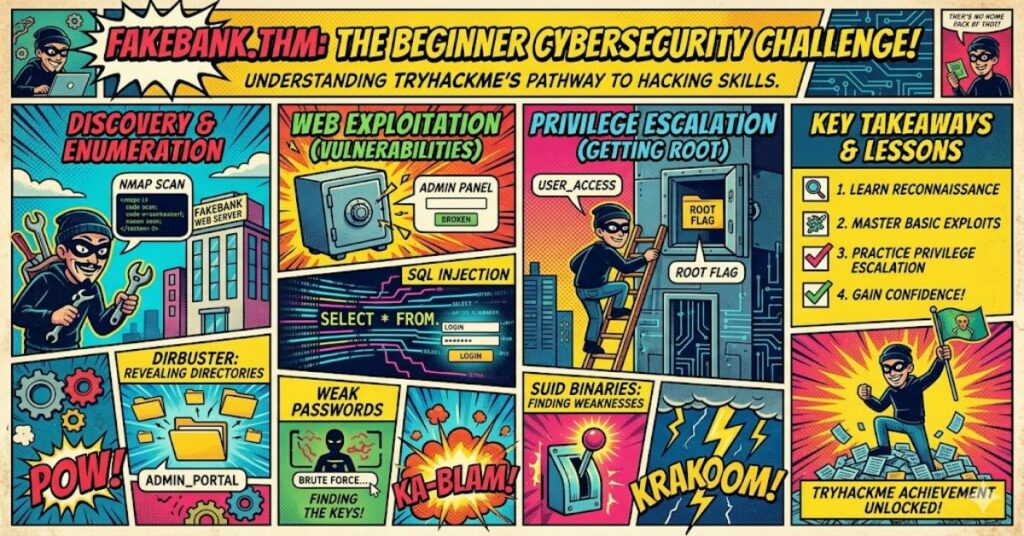
The keyword fakebank.thm is commonly associated with beginner cybersecurity training on the TryHackMe platform. Rather than being a real financial institution, the domain is a simulated web application created to help newcomers understand how security professionals evaluate websites, identify weaknesses, and document findings responsibly.
Many learners first encounter the domain while exploring introductory cybersecurity rooms focused on ethical hacking fundamentals. The goal is not to teach unauthorized access techniques against real systems. Instead, it provides a safe environment where students can practice observation, analytical thinking, and structured security assessment.
The popularity of the exercise reflects a broader trend in cybersecurity education. Modern training platforms increasingly rely on realistic simulations because they allow students to learn practical skills without introducing risk to actual organizations. By interacting with a controlled target, learners gain experience that can later be applied in defensive security, penetration testing, vulnerability management, and security operations.
Understanding why fakebank.thm exists, what educational objectives it serves, and how it fits into the cybersecurity learning journey provides far more long-term value than simply chasing a challenge completion flag.
What Is fakebank.thm?
fakebank.thm is a training domain used within TryHackMe educational content. It functions as a simulated banking website that intentionally contains weaknesses suitable for beginner-level learning exercises.
The platform uses the scenario to introduce concepts such as:
- Website reconnaissance
- Content discovery
- Web application structure
- Security assessment methodology
- Ethical hacking principles
- Responsible disclosure concepts
The environment is isolated and designed specifically for training purposes.
Why Cybersecurity Platforms Use Simulated Targets
Real-world security training presents a challenge. Students need practical experience, but organizations cannot expose production systems to experimentation.
Simulated targets solve this problem.
| Training Goal | Simulated Lab Benefit |
| Hands-on practice | Safe environment |
| Learning methodology | Repeatable exercises |
| Understanding vulnerabilities | Controlled exposure |
| Building confidence | Reduced risk |
| Career preparation | Realistic scenarios |
This approach has become standard across modern cybersecurity education platforms.
Educational Concepts Behind the Lab
Reconnaissance
One of the first lessons taught through environments like fakebank.thm is reconnaissance.
Security professionals rarely begin by attempting to exploit anything. Instead, they gather information about:
- Website structure
- Public content
- Available pages
- Technologies in use
- Potential attack surface
This mirrors real-world defensive and offensive security workflows.
Documentation
Another overlooked skill is documentation.
Successful cybersecurity professionals spend significant time recording:
- Observations
- Evidence
- Findings
- Risk assessments
- Remediation recommendations
Training environments encourage disciplined note-taking because it reflects professional practice.
Risk Awareness
Labs help students understand that vulnerabilities often result from:
- Misconfigurations
- Weak development practices
- Poor access controls
- Lack of validation
- Inadequate monitoring
The lesson is not simply that weaknesses exist, but why they occur.
Real-World Relevance
The concepts introduced through fakebank.thm have applications across multiple cybersecurity careers.
| Role | How Lab Skills Apply |
| Security Analyst | Identifying suspicious activity |
| Penetration Tester | Assessing web applications |
| SOC Analyst | Investigating alerts |
| Security Engineer | Hardening systems |
| Vulnerability Manager | Prioritizing risks |
The exercise acts as an entry point rather than an advanced technical assessment.
Benefits for Beginners
Low Barrier to Entry
Many cybersecurity learners become overwhelmed by advanced terminology.
Beginner labs help bridge the gap by providing:
- Guided objectives
- Clear learning outcomes
- Practical examples
- Immediate feedback
Confidence Building
Completing a structured exercise often provides a learner’s first experience applying theory in practice.
This confidence is valuable when progressing toward more advanced topics such as:
- Web security testing
- Network analysis
- Incident response
- Cloud security
- Threat hunting
Risks and Limitations of Challenge-Based Learning
Training labs are useful, but they have limitations.
Predictable Environments
Educational platforms intentionally simplify scenarios.
Real-world systems are usually:
- Larger
- More complex
- Better monitored
- Less predictable
Solution Memorization
A common mistake among beginners is memorizing challenge answers rather than understanding methodology.
Professionals focus on:
- Process
- Critical thinking
- Risk analysis
- Evidence collection
These skills transfer between environments.
Unrealistic Expectations
Completing beginner rooms does not automatically prepare someone for professional penetration testing.
Cybersecurity careers require ongoing learning and practical experience.
Three Important Insights Often Missed by Beginners
1. Methodology Matters More Than the Flag
Many learners focus entirely on reaching the final objective.
Employers, however, value repeatable methodology more than challenge completion.
2. Documentation Is a Career Skill
The strongest technical finding has little value if it cannot be explained clearly to stakeholders.
3. Defensive Understanding Is the Long-Term Goal
The most successful cybersecurity professionals understand both how weaknesses occur and how they should be prevented.
The Future of fakebank.thm-Style Training in 2027
Cybersecurity education continues to evolve.
By 2027, training environments will likely incorporate:
- AI-assisted tutoring
- Personalized learning paths
- Cloud-native infrastructure scenarios
- Defensive security simulations
- Threat detection exercises
Industry demand for cybersecurity talent remains strong, which increases the importance of accessible training environments.
However, educators are also emphasizing responsible use, ethics, and compliance alongside technical skills.
Key Takeaways
- fakebank.thm is an educational target, not a real banking platform.
- The lab introduces foundational cybersecurity concepts.
- Reconnaissance and documentation are core learning outcomes.
- Practical methodology matters more than challenge completion.
- Simulated environments provide safe hands-on experience.
- Real-world security work requires broader skills than solving labs alone.
Conclusion
fakebank.thm has become a recognizable starting point for many cybersecurity learners because it demonstrates how practical training can complement theoretical knowledge. The domain exists to provide a safe, structured environment where beginners can explore web security concepts without affecting real organizations.
Its lasting value lies not in any individual challenge outcome but in the habits it encourages: observation, documentation, analytical thinking, and ethical conduct. Those skills remain relevant across defensive security, penetration testing, security engineering, and incident response.
For newcomers entering the field, the most important lesson is that cybersecurity is a discipline built on process and responsibility. Training platforms provide the foundation, but long-term success comes from understanding why security weaknesses occur and how they can be prevented.
FAQ
What is fakebank.thm?
fakebank.thm is a simulated website used in beginner cybersecurity training exercises on TryHackMe. It is designed for educational purposes.
Is fakebank.thm a real bank?
No. It is a fictional environment created specifically for cybersecurity education and hands-on learning.
Which TryHackMe room uses fakebank.thm?
The domain is commonly associated with introductory cybersecurity learning paths and beginner web-security exercises.
Can skills learned from fakebank.thm help in a cybersecurity career?
Yes. Learners practice methodology, documentation, reconnaissance, and analytical thinking that are useful across multiple security roles.
Is it ethical to practice on fakebank.thm?
Yes. The environment is intentionally provided for authorized educational use.
Should beginners focus on solutions or methodology?
Methodology is more valuable. Understanding the process behind findings creates transferable skills.
Methodology
This article was prepared using publicly available educational information from cybersecurity training providers, introductory web-security learning materials, and industry best practices. The analysis focuses on educational objectives rather than exploitation procedures.
Limitations: Specific challenge content may change as training platforms update their rooms. Readers should refer to official platform documentation for the latest learning objectives.
Editorial Disclosure: This article was drafted with AI assistance and should be reviewed and verified by a human editor before publication.