
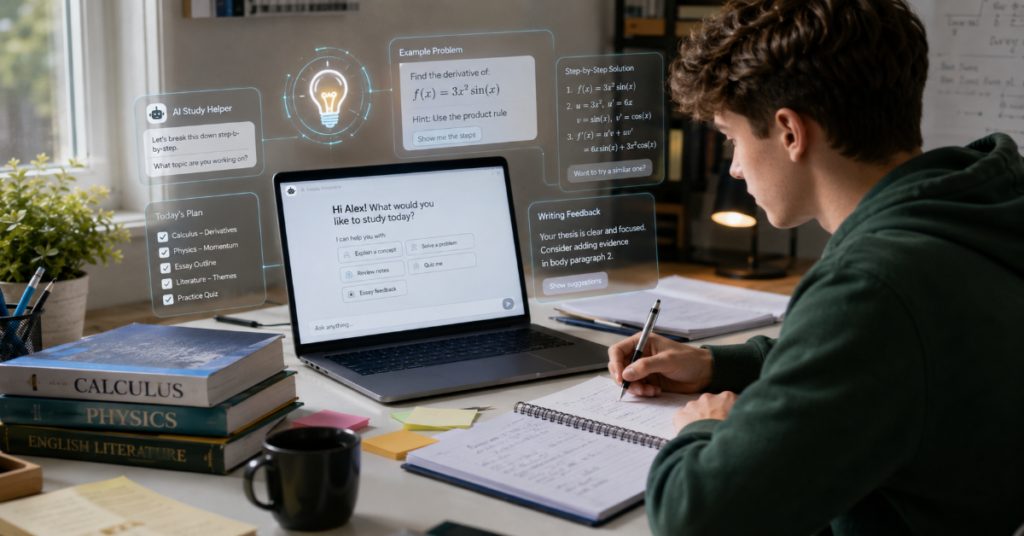
A homework helper is any tool, person or system that helps a student understand an assignment, practise a skill or complete a study task more effectively. In 2026, the phrase often points to AI chatbots, tutoring apps, answer-checking tools and step-by-step study platforms. The important distinction is simple: good homework support teaches the method; weak support only gives the answer.
That difference now matters more than ever. Pew Research Center reported in January 2025 that 26% of U.S. teens ages 13 to 17 had used ChatGPT for schoolwork, double the 13% reported in 2023. Awareness also rose sharply, with 79% of teens saying they had heard of ChatGPT.
Schools are not treating this as a passing trend. UNESCO’s 2023 guidance on generative AI in education warned that rapid AI development had outpaced policy debate and called for a human-centred approach to learning, teaching and assessment. (UNESCO) OpenAI also introduced Study Mode in 2025 to push ChatGPT toward guided problem-solving rather than direct answer delivery. (OpenAI)
This article follows the uploaded Postcard.fm production brief for the topic “homework helper,” including the required structure, SEO fields, E-E-A-T controls, future outlook, FAQ, methodology, references and visual strategy.
What a Homework Helper Actually Does
A strong homework helper performs four jobs.
First, it translates the task. Many students do not fail because the material is impossible; they fail because the question is dense, vague or unfamiliar. A useful tool restates the assignment in clearer language without changing the teacher’s intent.
Second, it diagnoses the missing skill. In algebra, the real issue may be factoring rather than the word problem. In history, it may be source evaluation rather than memorising dates. In writing, it may be paragraph structure, citation handling or argument flow.
Third, it demonstrates the process. Good support shows steps, explains why each step matters and checks whether the student can repeat the method independently.
Fourth, it verifies the final work. That includes checking calculations, grammar, citation format, logic, evidence quality and whether the answer actually responds to the prompt.
A poor tool skips all of this and outputs a finished response. That may save time once, but it creates a learning debt. The student submits work they cannot defend, repeat or build on.
Homework Helper vs Answer Generator
| Feature | Strong homework support | Risky answer generator |
| Main purpose | Builds understanding | Produces a finished answer |
| Student role | Active problem-solver | Passive copier |
| Best use case | Explaining steps, checking logic, practising | Last-minute shortcuts |
| Academic integrity risk | Lower when disclosed and allowed | High if submitted as original work |
| Long-term effect | Better skill retention | Higher dependency risk |
| Teacher alignment | Can follow class rules | Often ignores assignment policy |
The difference is not the tool itself. It is the workflow. The same chatbot can be a tutor, a calculator, a writing coach or a cheating engine depending on how the student uses it.
For related ethical study habits, Postcard.fm’s guide to assessment preparation explains why students should use official practice resources and learning workflows instead of answer dumps. (Postcard)
Why Homework Help Changed After Generative AI
Traditional homework help used to mean parents, classmates, tutors, textbooks, search engines, forums or recorded lessons. Generative AI changed the experience in three ways.
The first shift is immediacy. Students can now ask for help at midnight, paste a confusing question and receive an explanation in seconds.
The second shift is personalisation. A student can ask for a simpler explanation, a harder version, a quiz, a hint or a correction. OpenAI describes Study Mode as a learning experience that asks interactive questions, adapts to a learner’s goals and guides the user step by step. (OpenAI Help Center)
The third shift is invisibility. A student can use AI privately, which makes it harder for parents and teachers to know whether the student received guidance or outsourced the work.
That is why the most important question is no longer “Should students use homework tools?” It is “What kind of use improves learning without crossing academic boundaries?”
Structured Insight Table: Where Homework Support Helps Most
| Student problem | Best support method | What to avoid |
| “I don’t understand the question” | Ask for the prompt to be restated in simpler terms | Asking for the final answer |
| “I keep making math mistakes” | Request one worked example, then solve a new one alone | Copying the same solution pattern without checking |
| “My essay is weak” | Ask for feedback on thesis, evidence and structure | Asking the tool to write the essay |
| “I missed class” | Use notes, teacher materials and AI summaries together | Treating AI as the only source |
| “I need revision” | Generate practice questions and self-test | Reading summaries without recall practice |
| “I’m stuck on coding” | Ask for debugging hints and error explanations | Pasting generated code without understanding it |
Practical Workflow for Students
The best homework helper workflow has five stages.
1. Identify the task
Before using any tool, the student should write one sentence answering: “What is this assignment asking me to do?”
Example: “This biology homework is asking me to explain how photosynthesis converts light energy into chemical energy.”
That sentence reduces confusion and keeps the tool focused.
2. Ask for hints before answers
A safer prompt is: “Give me a hint, not the answer.”
For math, ask for the first step only. For writing, ask whether the thesis is clear. For science, ask what concept the question is testing. This keeps the student inside the learning process.
3. Attempt the work independently
The student should produce their own answer before requesting feedback. That matters because feedback on real work is more useful than a polished answer generated from nothing.
4. Verify with trusted sources
AI can be wrong. It can invent citations, misread a question or produce an answer that conflicts with the class textbook. UNESCO’s guidance stresses that AI in education needs human-centred oversight, policy safeguards and responsible use rather than blind adoption. (UNESCO)
5. Follow the teacher’s AI policy
Some teachers allow AI for brainstorming but not final drafting. Others permit grammar support but require disclosure. Students should check the rules before submitting work.
Risks and Trade-Offs
The main risk is dependency. If students repeatedly use tools to avoid friction, they may weaken the exact skills homework is meant to develop.
The second risk is false confidence. A clean AI answer can look correct while missing the teacher’s method, rubric or required source.
The third risk is academic integrity. A student who submits AI-written work as their own may violate school policy even if the content is accurate.
The fourth risk is privacy. Students should not paste personal data, school login details, private class materials or identifiable information into tools unless the platform is approved by the school.
The fifth risk is unequal access. Students with paid tools, faster internet or AI-literate parents may receive better support than classmates without those advantages.
The Center for Democracy and Technology reported in 2025 that AI use had become widespread among teachers and students during the 2024 to 2025 school year, while also warning that risks grow as adoption expands. (cdt.org)
What Parents Should Look For
Parents do not need to ban every digital tool. They need to watch the pattern.
A healthy pattern sounds like this:
• “Explain this concept another way.”
• “Quiz me on this chapter.”
• “Check whether my reasoning is correct.”
• “Show me a similar problem.”
A risky pattern sounds like this:
• “Write my essay.”
• “Give me the answers only.”
• “Make this look like I wrote it.”
• “Solve every question from this worksheet.”
Parents should ask students to explain the finished work aloud. If the student cannot explain it, the tool did too much.
What Teachers Should Clarify
Teachers can reduce misuse by giving specific rules.
Instead of saying “Do not use AI,” a clearer policy might say:
• AI may be used to explain concepts.
• AI may be used to generate practice questions.
• AI may not be used to write final answers.
• Any AI assistance must be disclosed in one sentence.
• Students must be able to explain all submitted work.
This kind of rule separates learning support from misconduct.
It also helps teachers design better homework. Assignments that require personal reflection, class-specific evidence, oral defence, drafts, process notes or in-class checkpoints are harder to outsource.
Market and Cultural Impact
Homework support has moved from private tutoring into everyday software. That shift changes family routines, teacher expectations and student habits.
Private tutoring once depended on money, location and scheduling. AI support is cheaper and more available, although quality varies. That could narrow some gaps for students who need explanations after school hours. It could also widen gaps if higher-income families combine AI tools with expert tutoring while others rely on free, less reliable systems.
Culturally, students are learning to treat help as conversational. They no longer search only for web pages; they ask tools to explain, compare, quiz, rewrite and simulate. That is a major literacy shift.
The practical question for schools is not whether students will use these tools. Many already do. The question is whether schools will teach responsible use explicitly.
Original Insights for Editors
- The real homework risk is not AI use; it is invisible AI use. When students disclose how they used support, teachers can correct the workflow. When use is hidden, teachers only see the final product.
- “Show your work” needs an update. In 2026, teachers should ask students to show decision points, drafts, false starts and source choices, not just final calculations.
- The best homework helper design is friction-positive. Tools should slow students down at key moments by asking them to predict, attempt or explain before revealing a full solution.
The Future of Homework Helper Tools in 2027
By 2027, homework support will likely become more guided, policy-aware and integrated into school systems.
The direction is already visible. UNESCO has called for generative AI use in education to be governed by human-centred policies, capacity building and safeguards. (UNESCO) OECD work on AI and education continues to focus on how powerful AI changes curriculum, teaching and student skills. (OECD)
The next generation of tools will probably include more step-based tutoring, teacher dashboards, school-approved prompts, age-sensitive settings and disclosure logs. Some systems may refuse to provide direct answers when the task appears to be graded. Others may ask students to solve a similar problem first.
The uncertain part is enforcement. Students can often move between approved and unapproved tools. That means policy alone will not solve the issue. Schools will need assessment redesign, AI literacy and clearer communication with families.
The most useful 2027 homework helper will not be the one that answers fastest. It will be the one that helps students prove they understand.
Takeaways
• Homework support works best when it explains process, not just content.
• AI tools should be treated as study aids, not substitute students.
• Students need teacher-specific rules because acceptable use varies by class.
• Parents can detect overuse by asking students to explain their work aloud.
• Teachers should assess drafts, reasoning and reflection, not only final answers.
• Privacy and data handling matter, especially for minors.
• The future of homework help depends on guided learning design, not answer automation.
Conclusion
A homework helper can be valuable when it keeps the student inside the learning process. It can clarify confusing instructions, explain difficult concepts, generate practice questions and check reasoning. Used badly, it can also flatten learning into answer collection.
The line is practical rather than technical. A good tool asks the student to think. A weak use of the same tool lets the student skip thinking altogether.
For students, the rule is simple: use support to understand work you can explain yourself. For parents, the goal is guided independence. For teachers, the challenge is to create assignments and policies that reward reasoning, process and honest disclosure.
Homework is not disappearing. It is being renegotiated. The best response is not panic, but better rules, better workflows and better study habits.
FAQ
What is a homework helper?
A homework helper is a person, platform or tool that helps a student understand and complete schoolwork. It may include tutoring, AI chatbots, study apps, search tools, grammar checkers or practice resources. The best ones teach the method instead of simply giving answers.
Is using AI for homework cheating?
It depends on the teacher’s policy and how the student uses it. Asking for explanations, hints or practice questions is often acceptable. Submitting AI-written answers as original work can violate academic integrity rules. Students should follow class instructions and disclose AI help when required.
What is the safest way to use a homework helper?
The safest method is to ask for clarification, attempt the work independently, request feedback, verify facts with trusted sources and submit only work the student understands. The student should be able to explain every answer aloud.
Can a homework helper improve grades?
Yes, if it helps the student practise, correct mistakes and understand concepts. It may hurt learning if it becomes a shortcut. Better grades should come from stronger understanding, not from copied answers.
What should parents check before allowing homework apps?
Parents should review privacy settings, age suitability, cost, data collection, school policy and whether the tool encourages learning or answer copying. They should also ask the child to explain how they used the tool.
Are free homework tools reliable?
Some are useful, but reliability varies. Free tools may have weaker safeguards, less accurate explanations or more intrusive data practices. Students should verify important answers with textbooks, class notes or teacher-approved resources.
How can teachers prevent misuse?
Teachers can set clear AI rules, require process notes, use oral checks, assign class-specific evidence and evaluate drafts. Clear policy works better than vague bans.
Methodology
This article was prepared from the uploaded Postcard.fm article production prompt, which specified the keyword, structure, SEO requirements, trust standards, FAQ format, visual strategy and editorial controls.
The analysis was validated against recent education and technology sources, including Pew Research Center, UNESCO, OECD, OpenAI and the Center for Democracy and Technology. Claims about student AI adoption, generative AI guidance and study-mode design were grounded in those sources rather than assumed.
References
Center for Democracy and Technology. (2025). Hand in hand: Schools’ embrace of AI connected to increased risks to students.
Miao, F., & Holmes, W. (2023). Guidance for generative AI in education and research. UNESCO.
OpenAI. (2025). Introducing study mode.
Pew Research Center. (2025). About a quarter of U.S. teens have used ChatGPT for schoolwork, double the share in 2023.
OECD. (2025). What should teachers teach and students learn in a future of powerful AI?