
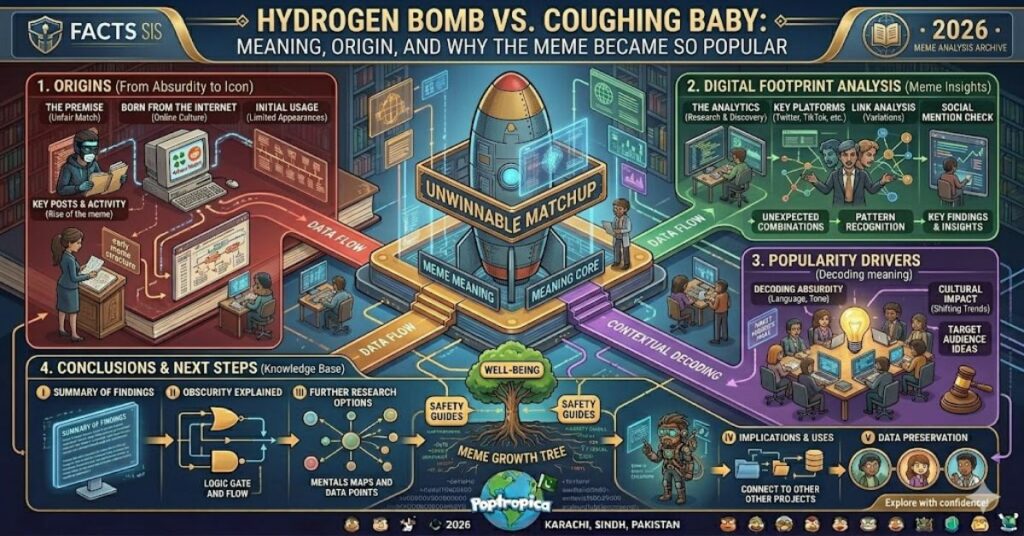
If you have spent any time on social media in recent years, you have probably encountered the phrase hydrogen bomb vs coughing baby. The expression is a humorous internet meme that describes an absurdly uneven contest where one side possesses overwhelming power while the other side has virtually no chance of success.
The image created by the phrase is intentionally ridiculous. A hydrogen bomb represents one of the most destructive weapons ever developed, while a coughing baby symbolizes vulnerability and weakness. By placing these two opposites against each other, the meme instantly communicates a mismatch so extreme that the outcome is obvious.
Although the phrase is often used as a joke, it has become a useful shorthand for discussing power imbalances in many areas of life. People use it when comparing athletes, debating fictional characters, evaluating technology, discussing business competition, or joking about everyday situations. Its popularity comes from how quickly it conveys an idea that would otherwise require several sentences to explain.
This article explores the meaning, origins, cultural significance, and future of one of the internet’s most enduring modern memes.
What Does the Meme Mean?
At its core, the phrase describes an encounter where one participant is overwhelmingly stronger than the other.
Examples include:
- An amateur player competing against a world champion.
- A small startup facing a dominant multinational corporation.
- A beginner debating a recognized expert.
- A weak fictional character fighting an all-powerful villain.
The humor comes from exaggeration. The comparison is intentionally extreme, making the imbalance impossible to ignore.
Why the Phrase Works So Well
Internet memes succeed when they communicate complex ideas quickly.
The phrase works because it combines:
| Element | Purpose |
| Hydrogen bomb | Symbolizes overwhelming power |
| Coughing baby | Symbolizes fragility and weakness |
| Direct comparison | Creates immediate contrast |
| Absurdity | Makes the meme memorable |
| Simplicity | Easy to adapt to many situations |
Unlike niche jokes that require extensive context, almost anyone can understand the contrast immediately.
The Origins of Hydrogen Bomb vs Coughing Baby
Pinpointing the exact origin of internet memes is difficult. Like many online jokes, the phrase evolved through repeated use across multiple communities.
The meme gained visibility on platforms such as:
- X (formerly Twitter)
- Tumblr
- Discord communities
- Gaming forums
By the early 2020s, the expression had become a common reaction image and text format. Users frequently posted it alongside comparisons that highlighted dramatic differences in strength, influence, or capability.
Rather than belonging to a single creator, the phrase emerged through collective internet culture.
How the Meme Is Used Today
Gaming Communities
Gaming discussions frequently feature the meme.
Players may compare:
- Professional esports teams versus casual players.
- High-level equipment versus starter gear.
- Overpowered characters versus weak opponents.
The phrase instantly tells readers that the contest is unlikely to be competitive.
Sports Discussions
Sports fans often use the meme after lopsided results.
For example:
- Championship contenders versus struggling teams.
- Elite athletes competing against inexperienced opponents.
- Record-breaking performances against average competitors.
The comparison adds humor while emphasizing the scale of the difference.
Pop Culture Debates
Online fandoms regularly compare fictional characters.
Questions such as:
- Who would win in a fight?
- Which superhero is stronger?
- Which anime character has greater abilities?
often produce “hydrogen bomb vs coughing baby” responses when one side is clearly more powerful.
Cultural Significance
The meme reflects a broader internet tendency toward exaggeration.
Online communication rewards:
- Speed
- Humor
- Visual imagery
- Memorable phrases
The expression succeeds because it delivers all four.
It also illustrates how internet culture creates new forms of language. Rather than writing lengthy explanations about unequal competition, users can simply reference the meme and achieve the same effect.
Common Situations Where People Use the Phrase
Education
Students might joke about:
- A difficult exam versus their preparation level.
- An advanced mathematics problem versus a beginner learner.
Technology
People sometimes compare:
- Enterprise-grade systems versus simple consumer tools.
- Powerful AI models versus outdated software.
Business
The phrase appears when discussing:
- Market leaders versus new entrants.
- Large corporations versus small competitors.
- Major brands versus unknown alternatives.
Structured Insight Table
| Context | What the Meme Communicates |
| Gaming | Extreme skill gap |
| Sports | One-sided competition |
| Business | Dominant market position |
| Technology | Massive capability difference |
| Education | Knowledge imbalance |
| Pop Culture | Unequal fictional power levels |
Risks of Overusing the Meme
While funny, the phrase can oversimplify situations.
Three limitations include:
- Ignoring nuance – Real-world competitions are often more complex than they appear.
- Underestimating challengers – Smaller competitors sometimes succeed despite disadvantages.
- Reducing serious discussions to jokes – Not every comparison benefits from meme language.
This is an important distinction because real outcomes can surprise observers.
Three Lesser-Known Insights
1. The Meme Functions as Cognitive Compression
Instead of explaining a power imbalance in detail, users communicate the idea through a familiar cultural reference.
2. Its Popularity Reflects Internet Attention Patterns
Online audiences favor quick, memorable expressions. The phrase delivers a complete argument in just four words.
3. It Has Expanded Beyond Humor
Many people now use the expression semi-seriously when discussing competition, market dominance, or capability gaps.
The Future of Hydrogen Bomb vs Coughing Baby in 2027
Predicting the future of internet culture is difficult, but several trends suggest the meme will remain recognizable through 2027.
First, meme culture increasingly recycles and adapts established formats rather than constantly inventing entirely new ones.
Second, the phrase remains flexible. It can be applied to politics, gaming, entertainment, technology, sports, and everyday life.
Third, social media platforms continue to reward concise communication. Memes that efficiently express ideas tend to have longer lifespans than highly specialized jokes.
The exact popularity level may fluctuate, but the concept behind the meme is unlikely to disappear.
Key Takeaways
- The phrase represents an extremely uneven matchup.
- It relies on dramatic contrast for humor.
- The meme emerged through online communities rather than a single creator.
- Gaming, sports, and pop culture discussions frequently use it.
- The expression acts as a shortcut for describing power imbalances.
- Its flexibility has contributed to its longevity.
- Despite its humor, it can oversimplify complex situations.
Conclusion
The phrase hydrogen bomb vs coughing baby has become one of the internet’s most effective shorthand expressions for describing overwhelming imbalance. By contrasting immense destructive power with extreme vulnerability, it communicates a clear idea instantly.
Its enduring popularity comes from simplicity, flexibility, and humor. Whether discussing sports, gaming, business competition, technology, or fictional battles, users can apply the meme to almost any situation where one side appears vastly stronger than the other.
At the same time, the meme highlights how internet culture continually develops new forms of communication. What began as a joke evolved into a widely understood cultural reference that now functions as a shared language across online communities.
FAQ
What does hydrogen bomb vs coughing baby mean?
It describes a matchup where one side is overwhelmingly stronger or more capable than the other.
Is hydrogen bomb vs coughing baby a real comparison?
No. It is a satirical meme designed to exaggerate an imbalance for humorous effect.
Where did the meme originate?
The phrase developed through online communities and spread across social media platforms rather than coming from a single identifiable creator.
Why is the meme so popular?
Its simplicity, visual imagery, and ability to communicate a complex idea quickly make it highly effective.
Is the phrase used outside gaming?
Yes. People use it in sports, business, technology, education, entertainment, and everyday conversations.
Can the meme be used seriously?
Sometimes. Although primarily humorous, people often use it to emphasize genuine differences in power, resources, or capability.
Methodology
This article was prepared using publicly documented discussions of internet meme culture, historical observations of social media usage patterns, and analysis of how the phrase is commonly applied across online communities. The analysis focuses on cultural interpretation rather than attributing the meme to a single creator because no universally accepted origin exists.
Limitations include the decentralized nature of internet culture and the difficulty of establishing definitive authorship for viral expressions. Alternative interpretations may exist across different online communities.
Editorial Disclosure: This article was drafted with AI assistance and should be reviewed and fact-checked by a human editor before publication.