
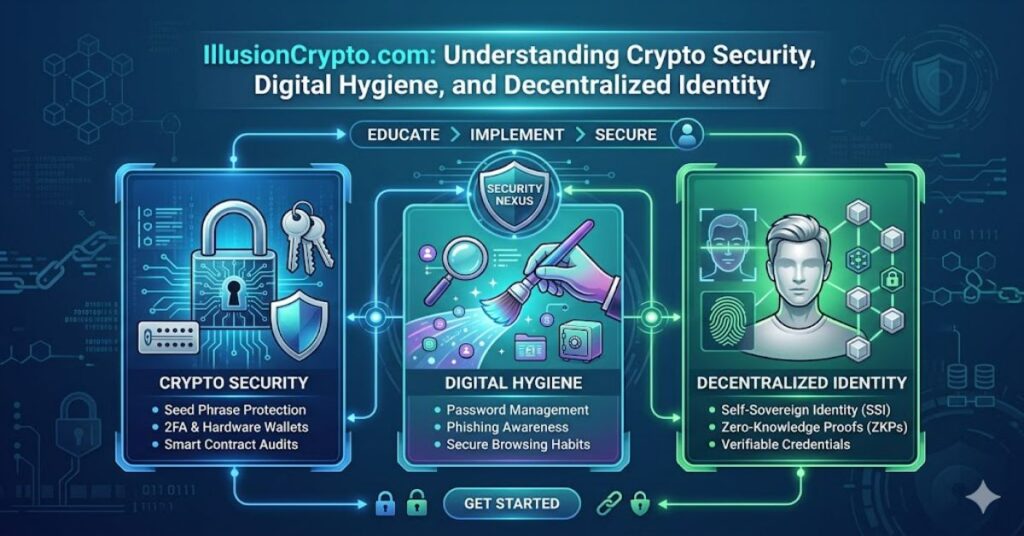
illusioncrypto-com-guide is presented as an educational platform focused on crypto security, digital hygiene, and decentralized identity (DID). As digital assets become more mainstream, the need for reliable educational resources has grown significantly. Many users enter the Web3 ecosystem with limited understanding of private key management, wallet security, phishing prevention, or identity protection.
The challenge is not a lack of information. The internet contains countless articles, videos, and tutorials about cryptocurrencies. The real problem is separating trustworthy guidance from hype, misinformation, and marketing disguised as education.
Platforms that concentrate on foundational knowledge occupy an increasingly important role. Rather than promoting speculative investments, they help users understand how blockchain networks work, how digital identities function, and how to reduce personal risk.
This shift reflects a broader change within the cryptocurrency industry. During earlier market cycles, attention focused heavily on price movements and token speculation. Today, security awareness has become a critical topic because attacks against wallets, exchanges, and users continue to evolve.
Understanding crypto security requires more than learning technical terminology. It involves developing habits, evaluating risks, and recognizing potential threats before assets are compromised. Likewise, digital hygiene extends beyond cryptocurrency and applies to nearly every aspect of online life.
This article examines the core themes associated with illusioncrypto-com-guide and explains why crypto security, digital hygiene, and decentralized identity matter for anyone participating in the modern digital economy.
Why Crypto Security Matters More Than Ever
Blockchain technology itself is often highly secure. Most losses occur because of human error, social engineering, or poor operational security.
Common threats include:
- Phishing websites
- Malicious browser extensions
- Fake wallet applications
- Social engineering attacks
- Seed phrase theft
- Smart contract exploits
Unlike traditional banking systems, blockchain transactions are typically irreversible. Once assets are transferred to an attacker-controlled address, recovery is often impossible.
This creates a unique responsibility for users. Security awareness becomes a personal obligation rather than a service provided entirely by a financial institution.
The Cost of Security Mistakes
Many new investors underestimate how small mistakes can lead to significant losses.
Examples include:
- Storing seed phrases digitally
- Reusing passwords
- Connecting wallets to unknown applications
- Approving malicious smart contracts
The financial consequences can range from minor losses to complete account compromise.
Digital Hygiene: The Foundation of Web3 Safety
Digital hygiene refers to the routine habits that help individuals maintain security and privacy online.
Many cybersecurity professionals argue that consistent habits provide greater protection than expensive software alone.
Core Digital Hygiene Practices
| Practice | Purpose | Impact Level |
| Strong passwords | Prevent credential theft | High |
| Password managers | Reduce reuse risk | High |
| Multi-factor authentication | Add verification layer | High |
| Software updates | Patch vulnerabilities | High |
| Device encryption | Protect local data | Medium |
| Security awareness training | Reduce human error | High |
For cryptocurrency users, digital hygiene becomes especially important because attackers often target individuals rather than blockchain protocols.
Original Insight #1: Security Fatigue Is Becoming a Hidden Risk
Many users become overwhelmed by complex security recommendations.
As a result, they stop following basic best practices altogether.
A simpler approach often produces better outcomes. Consistently using strong passwords and MFA may provide greater protection than attempting to implement dozens of advanced security techniques incorrectly.
Understanding Decentralized Identity (DID)
One of the most discussed concepts in Web3 is decentralized identity.
Traditional identity systems rely on centralized organizations such as governments, corporations, and online platforms. Users often have little control over how their personal information is stored or shared.
DID systems seek to change this model.
How DID Works
A decentralized identity framework typically includes:
- Digital credentials
- Cryptographic verification
- User-controlled storage
- Blockchain-based trust mechanisms
Instead of repeatedly submitting sensitive personal information, users may eventually be able to verify credentials while revealing only necessary data.
Potential Benefits
| Feature | Traditional Identity | Decentralized Identity |
| Data control | Organization-controlled | User-controlled |
| Privacy | Limited | Potentially stronger |
| Portability | Restricted | Higher |
| Verification | Central authority | Cryptographic proofs |
| Interoperability | Often limited | Potentially broader |
Despite these advantages, large-scale implementation remains a work in progress.
The Role of Educational Platforms in Web3
Educational platforms serve an important function within the cryptocurrency ecosystem.
Many users first encounter blockchain technology through investment-related content. Unfortunately, investment discussions often overlook security fundamentals.
An educational resource focused on security and identity can help fill this gap.
What Effective Crypto Education Should Include
Strong educational content generally covers:
- Wallet management
- Threat modeling
- Blockchain fundamentals
- Smart contract risks
- Identity protection
- Privacy considerations
- Regulatory developments
The most valuable resources emphasize understanding rather than speculation.
Original Insight #2: Education May Produce Better Long-Term Outcomes Than Security Products
Security products can reduce risk, but they cannot fully compensate for poor decision-making.
An informed user often avoids threats before technical defenses become necessary.
This suggests that educational platforms may deliver long-term value that exceeds the benefits of many standalone security tools.
Risks and Trade-Offs of Self-Education
While educational resources are valuable, they also present challenges.
Not every guide remains accurate over time.
The cryptocurrency sector changes rapidly, introducing new protocols, attack vectors, and regulatory developments.
Potential Limitations
- Outdated tutorials
- Platform bias
- Incomplete explanations
- Technical complexity
- Information overload
Readers should cross-reference critical security advice using multiple reputable sources.
Original Insight #3: The Biggest Risk Is False Confidence
One overlooked danger is false confidence.
Users who learn a few advanced concepts sometimes overestimate their security posture.
Security is not a destination. It is an ongoing process requiring regular reassessment and adaptation.
Market Impact of Security-Focused Crypto Education
The Web3 sector continues to mature.
As institutional participation increases, expectations around compliance, identity verification, and user protection are also changing.
Educational platforms contribute to market maturity by helping users:
- Understand risks
- Reduce fraud exposure
- Improve operational security
- Make informed decisions
Greater security awareness can also improve public trust in blockchain technologies.
Structured Insight Table
| Trend | Current Status | Potential Impact |
| Wallet adoption | Growing | More security education needed |
| DeFi participation | Expanding | Increased attack surface |
| Identity solutions | Emerging | New privacy opportunities |
| Regulatory oversight | Increasing | Higher compliance requirements |
| User education demand | Rising | Growth of learning platforms |
The Future of IllusionCrypto.com in 2027
The future of educational platforms focused on crypto security will likely depend on several broader industry developments.
First, decentralized identity technologies may become more practical as standards mature and interoperability improves.
Second, regulators worldwide continue exploring frameworks related to digital assets, identity verification, and consumer protection.
Third, artificial intelligence is changing cybersecurity itself. AI-driven phishing attacks are becoming more sophisticated, increasing the need for user education.
By 2027, successful educational platforms may increasingly combine:
- Security awareness training
- Interactive learning experiences
- Identity management education
- Privacy-focused frameworks
- Real-world threat intelligence
However, adoption rates remain uncertain. Many DID initiatives still face usability and infrastructure challenges that could slow mainstream deployment.
Key Takeaways
- Crypto security depends heavily on user behavior rather than blockchain technology alone.
- Digital hygiene remains one of the most effective defenses against cyber threats.
- Decentralized identity offers promising privacy benefits but faces adoption hurdles.
- Security education can create long-term value by reducing preventable mistakes.
- False confidence remains a major risk for both beginners and experienced users.
- Educational resources should prioritize understanding over speculation.
- The future of Web3 depends partly on improving user awareness and trust.
Conclusion
IllusionCrypto.com represents a category of educational platforms focused on helping users understand the security, privacy, and identity challenges associated with digital assets. Whether discussing wallet protection, digital hygiene, or decentralized identity, the underlying goal remains the same: reducing risk through knowledge.
The cryptocurrency sector continues to attract new participants, many of whom have limited cybersecurity experience. This creates a strong need for educational resources that explain complex concepts in practical terms. Security awareness, identity management, and privacy protection are no longer niche topics. They are becoming core skills for digital participation.
While technology continues to evolve, the importance of informed decision-making remains constant. Tools and platforms may change, but understanding risks, protecting credentials, and maintaining strong security habits will continue to play a central role in safe participation within Web3.
FAQ
What is illusioncrypto-com-guide?
illusioncrypto-com-guide is described as an educational platform focused on crypto security, digital hygiene, decentralized identity, and safe participation in the Web3 ecosystem.
Is illusioncrypto-com-guide a cryptocurrency exchange?
Based on the provided description, it is positioned as an educational resource rather than a cryptocurrency exchange or trading platform.
Why is digital hygiene important for cryptocurrency users?
Digital hygiene helps reduce exposure to phishing attacks, credential theft, malware, and account compromise, all of which can result in asset loss.
What is decentralized identity (DID)?
Decentralized identity is a model that allows individuals to control and manage digital credentials using cryptographic verification rather than relying solely on centralized organizations.
Can education improve crypto security?
Yes. Understanding threats, wallet management, and safe online practices can significantly reduce common security mistakes.
What are the biggest risks facing Web3 users today?
Phishing attacks, malicious smart contracts, fake applications, social engineering schemes, and poor operational security remain major threats.
Methodology
This article was produced using the information supplied in the topic brief and supplemented with generally accepted cybersecurity, blockchain, and decentralized identity concepts. No claims regarding ownership, funding, traffic, partnerships, or operational metrics of IllusionCrypto.com were made unless provided in the source brief.
Limitations include the absence of independently verified company documentation, usage statistics, and direct interviews with platform operators. Readers should verify platform-specific claims through official sources before making decisions based on educational content.