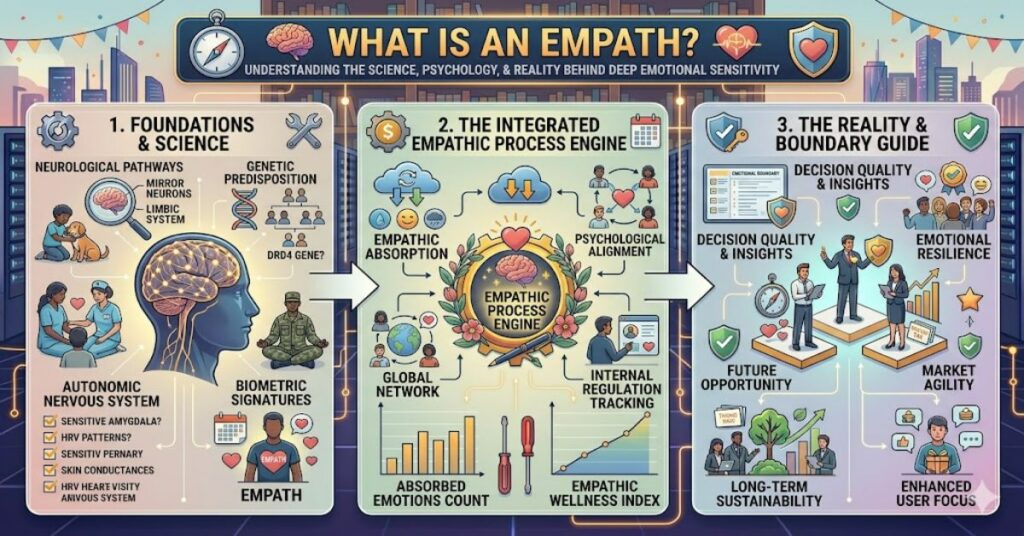
If you’ve ever wondered what is an empath, the simplest answer is this: an empath is someone who believes they can strongly sense, absorb, or internalize the emotions of other people. Unlike ordinary empathy, where a person understands another individual’s feelings, empaths often describe experiencing those emotions as if they were their own.
The concept has become increasingly popular through social media, self-help literature, wellness communities, and discussions around emotional intelligence. Many people identify as empaths because they notice that crowded environments, emotional conversations, or conflict-heavy situations leave them mentally and physically drained.
However, the idea of being an empath exists at an interesting intersection between psychology, personality traits, and popular culture. Modern psychology recognizes empathy as a measurable human characteristic, but it does not officially recognize “empath” as a clinical category or diagnosis.
This distinction matters. Emotional sensitivity is real. Emotional contagion—the tendency to absorb others’ emotional states—is also well documented. Yet many claims surrounding empaths extend beyond what scientific research currently supports.
Understanding the difference between evidence-based psychology and popular interpretations helps create a clearer picture. Rather than asking whether empaths are “real” or “not real,” a more useful question is why some people experience emotional environments more intensely than others.
What is an Empath
At its core, an empath is commonly described as someone who:
- Detects emotional shifts quickly
- Feels strong emotional responses to others’ experiences
- Becomes overwhelmed in emotionally intense environments
- Has heightened sensitivity to social dynamics
- Requires solitude to recharge after social interaction
Many self-identified empaths report feeling exhausted after spending time around anxious, angry, or distressed individuals.
The concept goes beyond simple compassion. Supporters of the empath framework argue that emotional information is experienced directly rather than merely understood intellectually.
Empath vs. Empathy: What’s the Difference?
One of the biggest misunderstandings involves confusing empathy with being an empath.
| Trait | Empathy | Empath |
| Definition | Understanding another person’s emotions | Feeling others’ emotions as if they were your own |
| Scientific Recognition | Well established in psychology | Not a clinical category |
| Experience | Cognitive and emotional understanding | Reported emotional absorption |
| Measurement | Psychological scales available | No standardized clinical measure |
| Universality | Common human trait | Self-identified characteristic |
Empathy is considered a normal human ability. The empath concept represents an intensified version of emotional sensitivity.
The Psychology Behind Emotional Absorption
Several psychological concepts help explain experiences often associated with empaths.
Emotional Contagion
Emotional contagion refers to the tendency for people to unconsciously mimic and absorb emotional states around them.
For example:
- Anxiety spreads through groups.
- Laughter becomes contagious.
- Workplace stress influences team members.
Researchers have documented emotional contagion across social and organizational settings for decades.
High Sensitivity
Some individuals exhibit characteristics associated with high sensory and emotional sensitivity.
Traits may include:
- Strong emotional reactions
- Deep information processing
- Increased awareness of social cues
- Greater sensitivity to stimulation
These characteristics can overlap significantly with descriptions commonly used by self-identified empaths.
Mirror Neuron Theories
Neuroscientists have explored how certain brain systems may contribute to empathy and emotional understanding.
Mirror neuron research suggests humans possess neural mechanisms that help interpret and reflect the experiences of others. However, researchers continue debating exactly how these systems function in complex emotional experiences.
Common Characteristics Associated With Empaths
Many people who identify with the term report similar experiences.
Strong Intuition
Empaths often claim they can sense emotional tension before it becomes visible.
Sensitivity to Crowds
Busy environments can feel emotionally overwhelming.
Deep Listening Skills
Many empaths become trusted confidants because they naturally pay attention to emotional nuance.
Need for Recovery Time
Social interactions may require longer recovery periods compared to less sensitive individuals.
Emotional Boundaries Challenges
Some struggle to distinguish their own emotions from those of others.
Comparison Table: Potential Strengths and Challenges
| Potential Strengths | Potential Challenges |
| Strong emotional awareness | Emotional exhaustion |
| Excellent listening skills | Difficulty setting boundaries |
| Relationship insight | Compassion fatigue |
| Conflict detection | Overstimulation |
| Supportive communication | Anxiety from emotional overload |
Neither side tells the complete story. Emotional sensitivity can be beneficial when managed effectively.
Real-World Examples
Healthcare Professionals
Nurses, therapists, social workers, and counselors often report experiencing emotional fatigue due to constant exposure to distress.
This does not necessarily make them empaths, but it demonstrates how sustained emotional exposure affects people.
Caregivers
Family caregivers supporting individuals with chronic illness frequently experience emotional contagion and caregiver burnout.
Crisis Responders
Emergency responders often develop coping mechanisms specifically designed to prevent emotional overload while maintaining compassion.
These examples illustrate that emotional absorption is a real phenomenon even if the label “empath” remains debated.
Structured Insight Table: Evidence vs Popular Belief
| Claim | Evidence Level | Current Understanding |
| People absorb emotions from others | Strong | Supported by emotional contagion research |
| Some people are more emotionally sensitive | Strong | Supported by personality research |
| Empaths can read minds | Weak | No scientific evidence |
| Emotional environments affect wellbeing | Strong | Supported by psychological studies |
| Certain individuals feel emotions more intensely | Moderate to Strong | Supported by sensitivity research |
This distinction helps separate evidence-backed observations from extraordinary claims.
Risks and Trade-Offs of High Emotional Sensitivity
The empath label often focuses on strengths while overlooking challenges.
Compassion Fatigue
Repeated exposure to others’ distress can produce emotional exhaustion.
This phenomenon is well documented among healthcare professionals and caregivers.
Boundary Erosion
Highly sensitive individuals may prioritize others’ emotional needs over their own.
Over time, this can contribute to stress and burnout.
Misattribution
A common risk is attributing all emotional experiences to external influences rather than considering personal stressors, health conditions, or environmental factors.
Decision-Making Challenges
Excessive emotional input can sometimes interfere with objective decision-making.
Three Underreported Insights
1. Emotional Sensitivity Is Not Always Emotional Intelligence
Many discussions treat these concepts as interchangeable.
In reality, emotional intelligence involves recognizing, understanding, and managing emotions—not simply feeling them intensely.
2. Boundaries Matter More Than Sensitivity
Research on burnout consistently suggests that healthy boundaries predict long-term wellbeing better than emotional awareness alone.
3. The Empath Identity Can Sometimes Increase Stress
Some individuals begin interpreting every emotional fluctuation as evidence of emotional absorption. This can reinforce anxiety rather than improve self-understanding.
Cultural Impact of the Empath Movement
Interest in empaths has grown significantly since the late 2010s.
Several factors contributed:
- Increased focus on mental health
- Social media communities
- Growing interest in emotional intelligence
- Expansion of wellness industries
The concept resonates because many people feel emotionally overwhelmed in a highly connected world.
While psychology tends to focus on measurable traits, popular culture often frames empath experiences in more spiritual or intuitive terms.
The Future of Empaths in 2027
By 2027, discussions around empathy and emotional sensitivity will likely become more evidence-driven.
Several trends support this possibility:
Growing Mental Health Awareness
Organizations continue investing in emotional wellbeing initiatives.
Workplace Burnout Research
Employers increasingly recognize emotional exhaustion as a productivity and retention issue.
Neuroscience Advances
Research into empathy, emotional regulation, and social cognition continues expanding.
Digital Overload
As online interactions intensify, understanding emotional boundaries may become even more important.
The term “empath” itself may remain culturally popular, but future discussions will likely focus more on measurable concepts such as emotional regulation, sensitivity, resilience, and empathy.
Key Takeaways
- Empaths are commonly described as people who deeply absorb others’ emotions.
- Psychology recognizes empathy and emotional contagion, though “empath” is not a clinical diagnosis.
- High emotional sensitivity can be both beneficial and challenging.
- Strong boundaries help prevent emotional burnout.
- Emotional intelligence involves managing emotions, not just experiencing them.
- Scientific evidence supports emotional influence between people but not extraordinary empathic claims.
- Future research may provide deeper insight into why some individuals experience emotional environments more intensely.
Conclusion
Understanding what is an empath requires balancing personal experiences with scientific evidence. Many people genuinely experience strong emotional sensitivity and report feeling deeply affected by the moods, stress, and wellbeing of those around them. Psychology provides several frameworks—including empathy, emotional contagion, and sensitivity research—that help explain these experiences.
At the same time, the empath concept extends beyond what current science can definitively measure. Some claims remain matters of personal belief rather than established fact.
The most useful perspective may be to focus less on labels and more on practical skills. Whether someone identifies as an empath, a highly sensitive person, or simply emotionally aware, the ability to understand emotions while maintaining healthy boundaries remains essential.
Emotional sensitivity can become a powerful strength when paired with self-awareness, resilience, and emotional regulation. Without those tools, it can become overwhelming. The difference often lies not in how much a person feels, but in how effectively they manage what they feel.
FAQ
Is being an empath a medical condition?
No. Empath is not recognized as a medical diagnosis or psychiatric disorder.
Can someone become an empath?
People can develop stronger emotional awareness and empathy skills over time, though personality traits also play a role.
Are empaths the same as highly sensitive people?
Not exactly. The concepts overlap significantly, but they originate from different frameworks and are not identical.
Why do empaths feel exhausted around certain people?
Many report emotional overload, overstimulation, or compassion fatigue when exposed to intense emotional environments.
Can empathy be measured scientifically?
Yes. Psychologists use validated assessment tools to measure different aspects of empathy.
Are there benefits to being emotionally sensitive?
Yes. Strong emotional awareness can improve communication, relationship building, listening skills, and social understanding.
Methodology
This article synthesizes findings from contemporary psychology, neuroscience, emotional intelligence research, and mental health literature. The goal was to distinguish evidence-supported concepts such as empathy and emotional contagion from broader cultural interpretations of empath experiences.
Known limitations include ongoing debates regarding measurement of subjective emotional experiences and the absence of a clinical definition for “empath.” Both scientific perspectives and commonly reported personal experiences were considered to provide a balanced overview.
References
Aron, E. N. (2023). The Highly Sensitive Person. Harmony Books.
American Psychological Association. (2024). Empathy and interpersonal relationships. https://www.apa.org
Greater Good Science Center. (2024). The science of empathy. University of California, Berkeley. https://greatergood.berkeley.edu
National Institute of Mental Health. (2024). Emotional health and wellbeing resources. https://www.nimh.nih.gov
Singer, T., & Klimecki, O. M. (2014). Empathy and compassion. Current Biology, 24(18), R875–R878.