
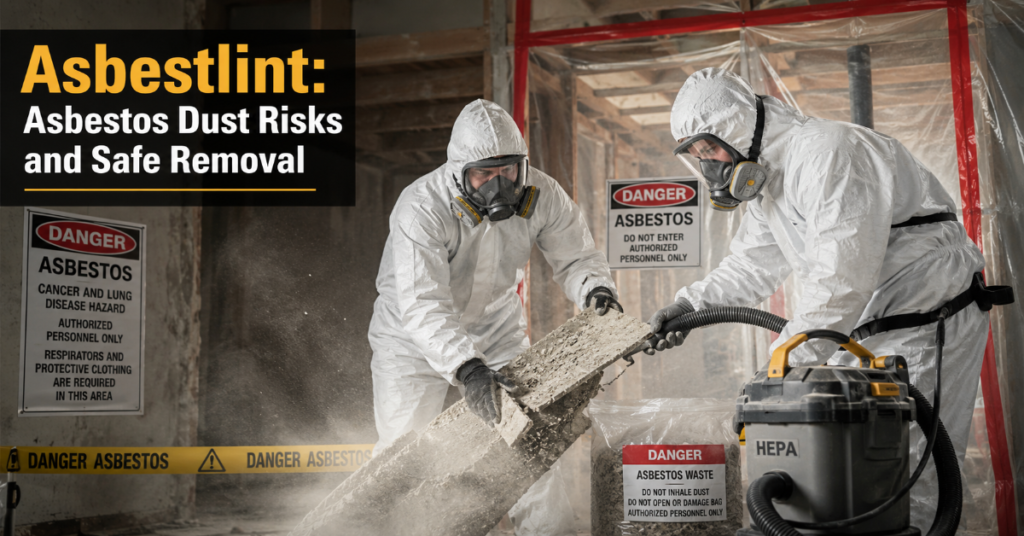
Asbestlint refers to very fine, lint-like dust or fiber debris that contains asbestos or has been contaminated by asbestos-containing materials. It may collect behind panels, around old pipe insulation, inside ceiling cavities, near boilers, under old flooring or in poorly ventilated industrial areas.
The word itself is informal. You are unlikely to see it used as a formal laboratory category or legal definition. In practice, however, it describes a real hazard: loose asbestos-contaminated particulate matter that can be inhaled when disturbed.
That matters because asbestos fibers are not like ordinary household dust. When airborne, they can enter the lungs and remain there for many years. The World Health Organization states that all major forms of asbestos are carcinogenic to humans and that exposure can cause lung cancer, mesothelioma, cancer of the larynx, ovarian cancer and asbestosis.
The risk is especially serious during renovation, demolition, repair work and maintenance in older buildings. The U.S. Environmental Protection Agency notes that regulated demolition and renovation work requires thorough inspection for asbestos-containing materials before work begins.
This article explains what asbestlint is, where it appears, how it differs from warning tape, why it is dangerous and what responsible handling looks like in 2026.
What Asbestlint Actually Means
Asbestlint is best understood as asbestos-contaminated dust.
It may include:
- Microscopic asbestos fibers
- Dust from damaged asbestos insulation
- Fiber debris released from ceiling tiles or boards
- Contaminated residue near old mechanical systems
- Particles disturbed during drilling, sanding, cutting or demolition
The term is often used descriptively because the material can look like light dust, fluff or lint. That appearance is misleading. Asbestos fibers are microscopic, so a surface may look only slightly dusty while still presenting a serious inhalation risk.
Structured Insight Table
| Question | Practical Answer |
| Is asbestlint a legal term? | Usually no. It is informal language for asbestos-contaminated dust. |
| Can it be identified by sight? | No. Laboratory testing is needed. |
| Where is it found? | Older buildings, industrial sites, ceiling voids, pipe routes and demolition zones. |
| Is it safe to sweep? | No. Sweeping can make fibers airborne. |
| Who should handle it? | Licensed asbestos inspectors and abatement professionals. |
Where Asbestlint Commonly Appears
The highest-risk locations are usually older structures where asbestos-containing materials were installed before modern restrictions or bans.
Common locations include:
1. Pipe Insulation and Boiler Rooms
Older thermal insulation around pipes, boilers and heating systems can deteriorate over time. Once damaged, fibers may settle nearby as dust.
2. Ceiling Cavities
Suspended ceilings can hide old sprayed coatings, insulation fragments, damaged panels or dust from earlier maintenance.
3. Behind Wall Panels
Dust can collect behind service panels, risers and access hatches, especially where electrical or plumbing work has disturbed old materials.
4. Flooring Systems
Old vinyl tiles, backing layers and adhesives may contain asbestos. Removal work can release contaminated dust if not controlled.
5. Industrial Maintenance Areas
Factories, shipyards, power plants and older mechanical workshops may have asbestos in gaskets, brake components, fireproofing or heat-resistant materials.
OSHA notes that many current worker exposures happen during renovation, removal and maintenance of buildings or structures that contain asbestos materials.
Why Asbestlint Is So Dangerous
The danger is not only that asbestos is present. The danger is that it is loose, fine and easily disturbed.
Intact asbestos-containing materials may sometimes be managed in place if they are sealed, stable and unlikely to be damaged. Loose dust is different. Once fibers become airborne, workers or occupants may inhale them without noticing.
Main Risk Factors
| Risk Factor | Why It Matters |
| Fiber size | Microscopic fibers can travel deep into the lungs. |
| Air movement | Fans, HVAC systems and open doors can spread contamination. |
| Poor visibility | Hazardous fibers may be present even when dust seems minor. |
| Repeated disturbance | Small releases can become cumulative exposure. |
| Delayed disease | Illness may appear decades after exposure. |
WHO identifies inhalation as a key route of exposure in workplaces, surrounding environments and buildings that contain friable asbestos materials.
Health Risks Linked to Asbestos Dust
Asbestos-related diseases often develop after long latency periods. That means a person may feel healthy for years after exposure before symptoms appear.
Asbestosis
Asbestosis is scarring of lung tissue caused by inhaled asbestos fibers. It can lead to breathlessness, persistent coughing and reduced lung function.
Lung Cancer
Asbestos exposure increases lung cancer risk. Smoking can further increase the danger for exposed workers.
Mesothelioma
Mesothelioma is a rare but aggressive cancer of the lining of the lungs, abdomen or heart. It is strongly associated with asbestos exposure.
Other Cancers
WHO states that asbestos exposure can also cause cancer of the larynx and ovaries.
This is why suspected asbestlint should never be treated as ordinary dust.
How to Recognize Possible Asbestlint on a Worksite
You cannot confirm asbestos dust by sight alone. Still, some warning signs should trigger caution.
Look for:
- Fine gray, white or brown dust near old insulation
- Dust around damaged ceiling boards or pipe lagging
- Debris inside ceiling voids or service shafts
- Fluffy residue near old heating systems
- Powdery material released during renovation work
- Unlabeled materials in buildings built before asbestos restrictions
The correct response is not to inspect aggressively. The correct response is to stop, secure the area and arrange professional sampling.
What to Do Immediately if You Suspect Asbestlint
If suspected asbestos-contaminated dust appears during work, the first few minutes matter.
Stop Work
Do not continue drilling, sanding, cutting, sweeping or moving debris.
Keep People Away
Restrict access to the area. Use signs, barriers or tape if available.
Avoid Air Movement
Do not use fans. If safe and appropriate, stop local airflow that may spread dust.
Do Not Clean It Yourself
Household vacuums and dry sweeping can spread fibers. EPA asbestos guidance emphasizes special work practices for custodial, maintenance and construction staff when asbestos-containing materials may be disturbed.
Call a Qualified Professional
A licensed asbestos professional can inspect, sample, contain and remove the material safely.
Asbestlint vs Asbestafzetlint
These two terms are easy to confuse, especially in Dutch-language workplace contexts.
| Term | Meaning | Risk Level | Practical Use |
| Asbestlint | Fine asbestos-contaminated dust or lint-like debris | High | Hazardous material requiring professional assessment |
| Asbestafzetlint | Asbestos warning or barrier tape | Low by itself | Used to mark restricted asbestos zones |
The distinction is important. Asbestafzetlint is a warning marker. Asbestlint is the suspected hazardous material.
Professional Testing and Removal
A proper asbestos response usually follows a controlled process.
1. Initial Risk Assessment
A competent person reviews the site, building age, material type, damage pattern and work history.
2. Sampling
Professionals may collect bulk material samples, dust samples or air samples using controlled methods.
3. Laboratory Analysis
Testing may use methods such as polarized light microscopy, phase contrast microscopy or transmission electron microscopy, depending on the material and regulatory context.
4. Containment
The affected area may be sealed with negative pressure systems, barriers and controlled entry points.
5. Removal or Encapsulation
Depending on the condition and location, professionals may remove the material or seal it to prevent fiber release.
6. Clearance Testing
Air monitoring and final inspection help confirm whether the area is safe to reoccupy.
OSHA’s construction asbestos standard sets an eight-hour permissible exposure limit of 0.1 fiber per cubic centimeter and a 30-minute excursion limit of 1.0 fiber per cubic centimeter.
Practical Implications for Employers and Property Owners
Suspected asbestlint is not only a health issue. It is also a management, legal and financial issue.
The UK Health and Safety Executive states that the dutyholder for a building must protect people from asbestos exposure risks, including workers and others who use the building.
For employers, the implications include:
- Work stoppages
- Worker exposure records
- Contractor liability
- Insurance disputes
- Regulatory inspections
- Remediation costs
- Delayed renovation timelines
For landlords and facility managers, the main lesson is simple: asbestos management should happen before disturbance, not after dust appears.
Real-World Impact in Older Buildings
The biggest risk is not always dramatic demolition. Sometimes the hazard begins with routine maintenance.
Examples include:
- A contractor removes an old ceiling tile without checking the material.
- A plumber drills through pipe insulation during repairs.
- A landlord replaces flooring without testing old adhesive.
- A maintenance worker sweeps dust from a boiler room.
- A ventilation system spreads particles from a disturbed ceiling void.
These scenarios are common because the work looks ordinary. The hidden danger is that ordinary work can disturb legacy asbestos materials.
Three Original Insights for 2026
1. The Highest-Risk Moment Is Often Before the Official Project Begins
Many asbestos incidents happen during “quick checks,” pre-renovation access, ceiling opening or small maintenance tasks. Formal demolition controls may not yet be in place.
2. Dust Pathways Matter as Much as Source Materials
A damaged pipe wrap is one issue. Dust movement through ducts, cable trays, stairwells and clothing can turn one location into a wider contamination problem.
3. Language Confusion Can Create Safety Failures
Terms like asbestlint, asbestos dust, asbestos residue, asbestos debris and warning tape may be used inconsistently. Site supervisors should use plain hazard language: suspected asbestos-contaminated dust, do not disturb, professional testing required.
The Future of Asbestlint in 2027
The future of asbestos safety will likely focus less on discovering new asbestos use and more on managing old materials inside aging buildings.
Several trends are already visible.
First, demolition and renovation controls are becoming more documentation-heavy. EPA guidance on asbestos-containing materials and demolition emphasizes inspection before regulated renovation or demolition work begins.
Second, building owners are under growing pressure to maintain better asbestos registers. HSE’s duty-to-manage framework makes responsibility clear for owners, landlords and maintenance controllers in relevant buildings.
Third, air monitoring technology is likely to improve, but it will not replace professional judgment. Real-time particle alerts may help detect unusual dust events, yet asbestos confirmation will still require validated sampling and laboratory analysis.
By 2027, the practical standard should be earlier identification, better building records and stronger contractor training. The weak point will remain cost. Many older schools, factories, apartments and public buildings still face expensive inspection and remediation needs.
Key Takeaways
- Asbestlint is informal language for asbestos-contaminated dust or lint-like fiber debris.
- It cannot be confirmed safely by appearance alone.
- Renovation, demolition and maintenance work are major exposure scenarios.
- The safest first response is to stop work and prevent disturbance.
- Dry sweeping, drilling and ordinary vacuuming can increase airborne fiber risk.
- Professional sampling and licensed remediation are essential.
- Clear terminology prevents confusion between hazardous dust and warning tape.
Conclusion
Asbestlint is dangerous because it looks ordinary. A thin layer of dust behind a ceiling panel or around old pipe insulation may not appear serious, but if it contains asbestos fibers, the health consequences can be severe and long delayed.
The safest approach is caution. Do not disturb suspected asbestos dust. Do not clean it with standard tools. Do not rely on appearance or assumptions. Stop work, isolate the area and bring in qualified asbestos professionals for testing and control.
For property owners, employers and contractors, the larger lesson is prevention. Asbestos surveys, clear records, trained workers and careful planning are cheaper than exposure incidents, contaminated worksites and legal consequences. The hazard may be hidden, but the responsibility to manage it is not.
Frequently Asked Questions
What is asbestlint?
Asbestlint is an informal term for fine asbestos-contaminated dust or lint-like fiber debris. It may appear when asbestos-containing materials are damaged, disturbed or degraded.
Can you identify asbestlint by looking at it?
No. Suspected asbestos dust cannot be confirmed by sight. A qualified professional should collect samples and send them to an accredited laboratory.
Is asbestlint the same as asbestafzetlint?
No. Asbestlint refers to suspected asbestos dust. Asbestafzetlint usually means warning tape used to mark or restrict an asbestos hazard area.
What should I do if I find suspected asbestos dust?
Stop work, keep people away, avoid disturbing the material, prevent air movement if safe and contact a licensed asbestos professional.
Can asbestos dust cause cancer?
Yes. WHO states that asbestos exposure can cause lung cancer, mesothelioma, cancer of the larynx and ovarian cancer.
Can I vacuum asbestlint myself?
No. Ordinary vacuums can spread fibers. Asbestos cleanup requires specialist procedures, protective equipment and proper waste handling.
Where is asbestos dust most often found?
It is most often found near old insulation, ceiling cavities, pipe lagging, boiler rooms, flooring adhesives, service shafts and renovation zones in older buildings.
Methodology
This article was drafted from the supplied Postcard.fm production prompt and the keyword detail provided for “asbestlint.” The safety and health sections were validated against public guidance from WHO, OSHA, EPA and HSE. The article avoids claiming firsthand site testing or direct inspection because no original field investigation was provided.
Known limitations: asbestos rules vary by country, state and municipality. Site conditions also vary depending on fiber type, material condition, ventilation, work activity and exposure duration. Before publication, a human editor should verify all citations, check local regulatory requirements and confirm that any internal links added from Postcard.fm are live and relevant.
Suggested editorial disclosure: This article was drafted with AI assistance and reviewed and verified by the author. All data, citations and claims should be independently confirmed before publication.
References
Environmental Protection Agency. (2025). Asbestos-containing materials and demolition.
Environmental Protection Agency. (2026). Safe work practices for asbestos.
Health and Safety Executive. (n.d.). The duty to manage asbestos in buildings: Overview.
Occupational Safety and Health Administration. (n.d.). 1926.1101: Asbestos.
Occupational Safety and Health Administration. (2002). Asbestos standard for the construction industry.
World Health Organization. (2024). Asbestos.