
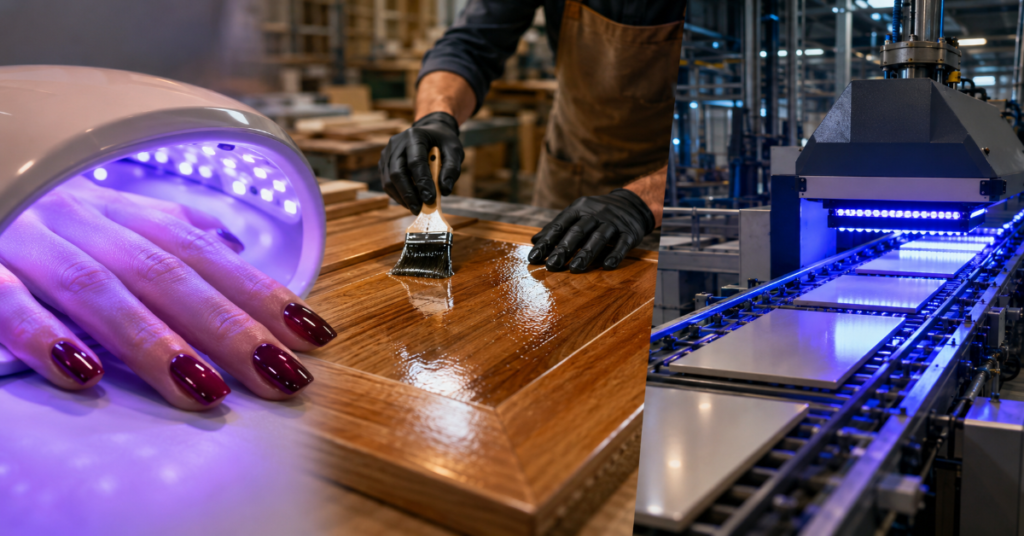
UVLack is a light-cured coating system. The term is often used for UV lacquer in industrial finishing and UV gel polish in nail care. In both cases, the coating stays liquid until exposed to ultraviolet or LED light, then hardens through a process called photopolymerization.
That makes it very different from regular lacquer or nail polish. Traditional coatings usually dry as solvents evaporate. UV-curable coatings harden because reactive ingredients form a cross-linked polymer network when activated by light. This is why a nail gel can become glossy and hard in under a minute, while a furniture panel can move through a finishing line only seconds after coating.
The technology matters because it solves a real production problem: waiting. Waiting for coatings to dry slows salons, factories, packaging lines and repair workflows. UVLack reduces that delay.
But the same technology also creates new responsibilities. A poorly matched lamp can leave uncured material on the surface. Thick or dark coatings may not cure evenly. Some gel nail ingredients have raised allergy and regulatory concerns. In Europe, the photoinitiator TPO was prohibited in cosmetic products from September 1, 2025 under Commission Regulation (EU) 2025/877.
So the best way to understand UVLack is not as a miracle finish. It is a high-performance coating system that works extremely well when chemistry, lamp output, surface preparation and safety practices are aligned.
What Is UVLack?
UVLack usually refers to one of two related product families:
- UV lacquer for industrial surfaces
Used on wood, flooring, furniture, paper, packaging, plastics, electronics and decorative panels. - UV gel polish for nails
Used as base coat, color coat, top coat, builder gel or reinforcement gel in salon and home manicure systems.
Both rely on similar chemistry. A typical UV-curable formula includes:
- Oligomers: the backbone of the cured film
- Monomers: reactive diluents that adjust viscosity and hardness
- Photoinitiators: compounds that start curing when exposed to light
- Pigments: colorants for nail gels, inks or decorative finishes
- Additives: flow agents, adhesion promoters, matting agents or stabilizers
The key ingredient class is the photoinitiator. Without it, the coating may remain tacky or soft even after exposure.
How UVLack Cures
UVLack cures through photopolymerization. Light energy activates photoinitiators, which produce reactive species that bind monomers and oligomers into a solid polymer film.
The curing process usually follows this sequence:
| Stage | What Happens | Why It Matters |
| Surface preparation | Dust, oil, moisture or old residue is removed | Poor preparation weakens adhesion |
| Application | Coating is brushed, sprayed, rolled or printed | Film thickness affects curing depth |
| Light exposure | UV or LED lamp activates photoinitiators | Lamp wavelength must match formula |
| Polymerization | Liquid coating cross-links into a hard film | Final hardness, gloss and durability form here |
| Post-cure inspection | Surface is checked for tack, defects or under-cure | Prevents failure during use |
This is why “just cure it longer” is not always the right answer. A lamp with the wrong wavelength may not fully activate the formula no matter how long the exposure lasts.
UVLack in Nail Care
In beauty, UVLack is commonly understood as UV gel polish. It is applied in thin layers and cured under a nail lamp.
A typical manicure system includes:
- Base coat
- Color gel
- Top coat
- Optional builder or strengthening layer
The appeal is obvious. Gel polish usually lasts longer than standard polish, resists chipping and keeps a high-gloss finish. For salons, it also improves scheduling because clients do not need long drying time.
Still, safety depends on correct use. The FDA states that nail products sold in the United States must be safe when used according to label directions or customary use, while also noting that many nail products contain ingredients that can be harmful if misused.
Recent research has also made the lamp discussion more serious. A 2023 Nature Communications study found that radiation from UV nail polish dryers caused DNA damage and mutations in tested mammalian cells. The study was laboratory-based, not a direct real-world cancer-risk measurement in salon users, but it raised valid questions about repeated exposure.
A separate 2023 Scientific Reports study found that a 4-minute exposure did not significantly reduce human keratinocyte viability, while a 20-minute exposure produced more significant effects. That suggests real-world exposure time matters.
Practical Nail Safety Notes
| Risk | Why It Happens | Better Practice |
| Allergic reaction | Skin contact with uncured acrylates or methacrylates | Avoid flooding cuticles |
| Under-curing | Weak lamp, thick layers or wrong wavelength | Use matched brand lamp and thin coats |
| Nail thinning | Aggressive filing or peeling off gel | Soak off properly |
| UV exposure | Lamp emits UV radiation | Use fingerless UV gloves or sunscreen |
| Ingredient compliance | Some photoinitiators face bans | Check updated ingredient lists |
The safest gel system is not only the best-looking one. It is the one cured correctly, removed carefully and used with current ingredient compliance in mind.
UVLack in Industrial Coatings
In manufacturing, UVLack is used when speed and finish quality matter. Industrial UV coatings appear in:
- Wood flooring
- Furniture panels
- Cabinet doors
- Printed packaging
- Labels
- Plastic components
- Electronics coatings
- Automotive interior trim
The business case is simple. A traditional coating may need minutes or hours to dry. A UV-curable coating can harden in seconds.
The EPA lists UV-cured coatings among examples of low or no VOC and hazardous air pollutant compliant coating technologies, alongside waterborne, high-solids and powder coatings.
That does not mean every UV system is automatically clean or risk-free. It means UV curing can reduce reliance on high-solvent evaporation systems when properly formulated.
UVLack vs Regular Lacquer
| Feature | UVLack | Regular Lacquer |
| Curing method | UV or LED light activation | Air drying or solvent evaporation |
| Typical speed | Seconds to minutes | Minutes to hours |
| Finish | High gloss, hard surface | Varies by resin and solvent system |
| VOC profile | Often lower | Often higher |
| Equipment needed | Curing lamp or tunnel | Usually no lamp needed |
| Repairability | Can be harder to spot-repair | Often easier to blend |
| Cost | Higher setup cost | Lower entry cost |
| Skill requirement | Requires wavelength and film control | More forgiving in small applications |
The main advantage of UVLack is production efficiency. The main disadvantage is system dependency. You need the right lamp, coating thickness, substrate and process controls.
Market and Real-World Impact
UV-curable coatings are growing because they fit several industrial priorities at once: faster throughput, lower emissions pressure, better finish consistency and reduced floor space for drying.
Market estimates vary by research firm because some count only coatings, while others include UV-curable resins, inks and formulated products. Future Market Insights estimated the global UV coatings market at USD 4.49 billion in 2025, with projected growth to USD 7.47 billion by 2035.
MarketsandMarkets estimated the UV LED market at USD 1.03 billion in 2024 and projected growth to USD 2.16 billion by 2030. That matters because LED curing is becoming central to both beauty products and industrial lines.
Structured Insight Table
| Trend | What It Means | Who Feels It First |
| LED curing adoption | Less heat and longer lamp life than mercury lamps | Nail brands, printers and electronics coaters |
| Lower-VOC pressure | More demand for compliant finishes | Furniture and packaging manufacturers |
| Ingredient scrutiny | Reformulation around photoinitiators | Nail gel makers and salon suppliers |
| Faster production lines | More output with less drying space | Wood, label and panel factories |
| Compatibility lock-in | Coatings and lamps must match | Small salons and factories changing suppliers |
One overlooked point is that UVLack does not only change the coating. It changes the entire workflow around the coating.
Risks and Trade-Offs
1. Incomplete Cure
Incomplete cure is the most important practical failure.
It can happen when:
- The layer is too thick
- Pigment blocks light penetration
- The lamp is weak
- The wavelength does not match the photoinitiator
- Exposure time is too short
- Equipment is old or dirty
In nails, under-cured gel can increase allergy risk because uncured reactive ingredients may contact skin. In manufacturing, under-cure can cause blocking, odor, poor scratch resistance or coating transfer.
2. Lamp Compatibility
Not all UV lamps are interchangeable. Some formulas cure best at 365 nm, others at 395 nm or 405 nm. A consumer may buy a cheap lamp and blame the gel when the real issue is wavelength mismatch.
3. Brittleness
A harder coating is not always better. If the substrate flexes, a very hard UV film can crack. This matters in flexible plastics, nail overlays and wood products exposed to humidity changes.
4. Regulatory Change
The EU ban on TPO in cosmetic products from September 1, 2025 is a major example of how UVLack chemistry can be affected by regulation.
This does not mean all UV gel polish is unsafe. It means brands must keep formulations current and users should pay attention to ingredient labels, especially when buying imported or old stock.
5. Removal Damage
For nails, removal is often where damage happens. Peeling gel off the nail plate can remove keratin layers. Over-filing can thin the natural nail. Acetone soaking can dry surrounding skin.
The coating may be durable, but the natural nail underneath is not an industrial substrate.
Three Original Insights Buyers Often Miss
1. Lamp Quality Can Matter More Than Product Price
A premium gel or lacquer can fail under the wrong lamp. A cheaper product may perform better if the lamp and chemistry are matched. For salons, the lamp is not an accessory. It is part of the formula system.
2. UVLack Can Create Supplier Lock-In
Industrial buyers may assume they can switch coatings freely. In practice, changing supplier often requires testing viscosity, line speed, lamp intensity, adhesion, gloss and cure depth. That can make a low-cost coating more expensive than it looks.
3. Fast Curing Can Move the Bottleneck
UV curing speeds up finishing, but quality control may become the slower part of the line. Factories that upgrade curing without upgrading inspection may push defects downstream faster.
The Future of UVLack in 2027
The future of UVLack in 2027 will be shaped by three forces: regulation, LED adoption and sustainability pressure.
First, ingredient scrutiny will continue. The EU’s TPO prohibition has already shown that cosmetic UV-curing chemistry can change quickly when toxicological classifications shift. Brands selling internationally will likely reformulate for stricter markets first, then standardize those formulas globally to simplify supply chains.
Second, LED curing will keep gaining ground. LED systems offer longer service life, lower heat output and more controllable wavelength profiles than many older mercury lamps. That supports both salon safety practices and industrial energy planning.
Third, manufacturers will push for lower-VOC, bio-based and more energy-efficient coatings. The EPA’s recognition of UV-cured coatings as part of low or no VOC compliant coating categories supports that direction, but sustainability claims will need careful verification.
The uncertain part is cost. New photoinitiators, safer monomers and bio-based resins may improve safety profiles, but they can raise prices. By 2027, the strongest UVLack products will likely be those that combine performance with transparent compliance documentation.
Takeaways
- UVLack is a curing system, not just a shiny coating.
- Its performance depends on chemistry, lamp output and application thickness.
- In nail care, the main concerns are under-curing, allergies, UV exposure and removal damage.
- In manufacturing, the major benefits are speed, finish consistency and lower solvent dependence.
- The EU TPO ban shows that photoinitiator regulation is now a serious business risk.
- LED curing will likely become the dominant direction across consumer and industrial uses.
- Buyers should evaluate the full system, not only the bottle, can or coating price.
Conclusion
UVLack became popular because it solves one of the oldest coating problems: slow drying. It gives salons faster service, manufacturers quicker production and consumers a longer-lasting glossy finish. That makes it useful across beauty, furniture, packaging, electronics and industrial surface protection.
But it is not a product to use blindly. The coating must be paired with the right lamp, applied at the right thickness and removed or maintained correctly. The safest choice is not always the hardest or glossiest finish. It is the system with clear instructions, reliable curing data, compliant ingredients and realistic performance claims.
For 2026 and 2027, UVLack will remain important because it fits the demand for faster, cleaner and more durable coatings. The winners will be brands and manufacturers that treat curing as a controlled technical process, not a marketing phrase.
FAQ
What does UVLack mean?
UVLack usually means UV lacquer or UV gel polish. It is a coating that hardens under UV or LED light instead of drying naturally in open air.
Is UVLack the same as gel nail polish?
In nail care, yes. UVLack often refers to gel nail polish cured under a UV or LED lamp. In industrial use, it usually means UV-curable lacquer for wood, packaging, plastics or other surfaces.
Is UVLack better than regular lacquer?
It depends on the job. UVLack cures faster and often gives stronger gloss, hardness and abrasion resistance. Regular lacquer may be cheaper, easier to repair and simpler for small projects.
Does UVLack need a special lamp?
Yes. It needs a UV or LED curing lamp that matches the coating’s required wavelength. Using the wrong lamp can leave the coating under-cured.
Is UVLack safe for nails?
It can be safe when used correctly, but risks include allergic reactions, UV exposure and nail damage from poor removal. Avoid skin contact with uncured gel and follow manufacturer curing times.
Why was TPO banned in EU nail products?
The EU prohibited TPO in cosmetic products from September 1, 2025 after its classification raised reproductive toxicity concerns. The ban applies to cosmetic products, including many UV-curing nail systems.
Can UVLack be used on wood?
Yes. UV lacquer is widely used on wood flooring, furniture panels, cabinetry and decorative surfaces because it cures quickly and creates a hard protective finish.
Methodology
This article was developed from the supplied Postcard.fm production brief, current regulatory sources, scientific literature on UV nail lamps, FDA nail product guidance, EPA coating information and recent market reporting. The analysis separates verified facts from practical interpretation and avoids fabricated testing claims.
Known limitations: product performance varies by brand, lamp wavelength, film thickness, pigment load and user technique. Industrial results also depend on line speed, substrate type, curing system and quality-control standards. Before publication, all APA references should be manually checked against the original source or publisher page.
References
European Commission. (2025). TPO in nail products: Questions and answers. European Commission.
U.S. Food and Drug Administration. (2024). Nail care products. FDA.
U.S. Environmental Protection Agency. (2025). Compliant low/no VOC/HAP inks and coatings. EPA.
Zhivagui, M., Hoda, A., Valenzuela, N., et al. (2023). DNA damage and somatic mutations in mammalian cells after irradiation with a nail polish dryer. Nature Communications.
Słabicka-Jakubczyk, A., et al. (2023). Influence of UV nail lamps radiation on human keratinocytes viability. Scientific Reports.
Future Market Insights. (2025). UV coatings market outlook 2025 to 2035.
MarketsandMarkets. (2025). UV LED market report 2025 to 2030.