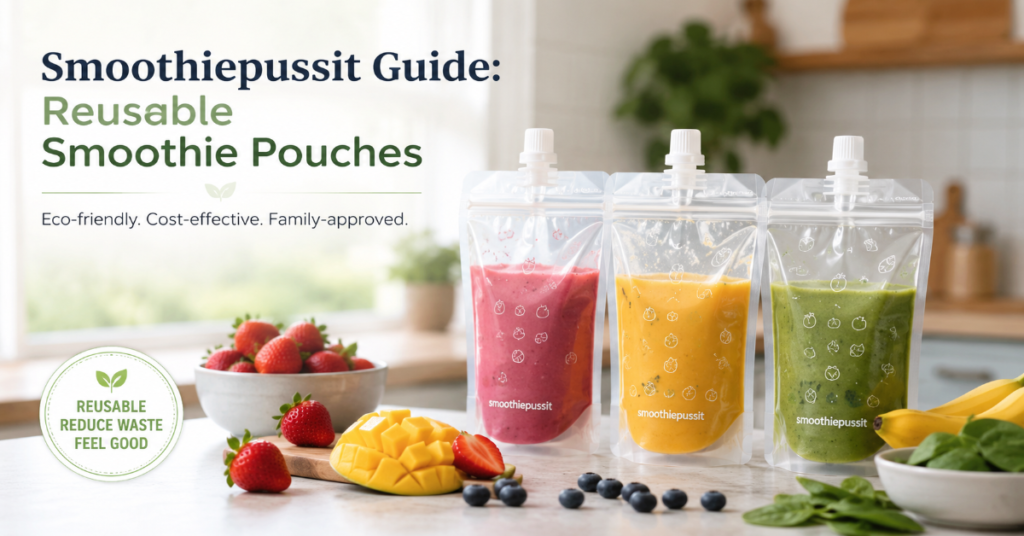
Smoothiepussit are portable smoothie pouches designed to hold blended drinks, fruit purées, yogurt mixtures, vegetable blends or baby-food-style soft meals. The word is commonly used for refillable or ready-filled squeeze pouches that let children or adults eat directly from a capped spout without needing a bowl, spoon or bottle.
Their appeal is simple. A parent can blend banana, berries and yogurt at home, pour the mixture into a pouch, cap it and place it in a lunch bag. A toddler can eat with less mess. A school-age child gets a controlled snack. An adult can carry a smoothie to work or the gym without using a bulky bottle.
The rise of reusable pouches also reflects a larger packaging shift. Regulators, retailers and households are paying closer attention to single-use packaging waste. The European Commission’s Packaging and Packaging Waste Regulation entered into force on February 11, 2025 and will generally apply from August 12, 2026, with goals around reducing packaging waste, increasing recyclability and encouraging reuse systems.
Smoothiepussit sit inside that practical tension. They are useful, but they are not automatically sustainable. A reusable pouch only makes sense if it is durable, safe for food contact, easy to clean and used many times.
Why Smoothiepussit Became Popular
The product solves four everyday problems at once.
First, it gives parents more control over ingredients. Store-bought pouches can be convenient, but homemade versions allow control over sugar, fiber, fruit balance and dairy choice.
Second, it saves space. A flexible pouch fits into lunch boxes, stroller pockets, travel bags and gym compartments better than a rigid container.
Third, it reduces mess. The cap and spout system helps children eat soft foods without tipping a cup or dropping a spoon.
Fourth, it supports batch prep. A family can prepare several pouches at once and refrigerate or freeze them depending on the material instructions.
The market has responded with many formats, from disposable baby food pouches to reusable silicone models and multi-layer plastic refillable packs. Retail listings now commonly emphasize features such as reusable construction, smoothie compatibility, baby food use, leak control and dishwasher-safe claims.
How Smoothiepussit Work
Most smoothiepussit use the same basic structure.
| Part | Function | Why It Matters |
| Pouch body | Holds smoothie, purée or yogurt | Determines durability, flexibility and cleaning difficulty |
| Fill opening | Lets users add food | Wider openings are easier to fill and wash |
| Spout | Controls flow | Narrow spouts reduce spills but clog with thick blends |
| Cap | Seals the pouch | Silicone or screw caps reduce leaks |
| Seams | Hold pressure | Weak seams fail when squeezed hard |
| Measurement marks | Show volume | Helps with portion control |
The pouch works best with smooth textures. Thin smoothies flow easily. Thick purées also work if the spout is wide enough. Chunky blends with berry skins, whole seeds, oats or nut butter can clog smaller openings.
Main Types of Smoothiepussit
1. Disposable Pre-Filled Pouches
These are ready-to-eat supermarket pouches filled with fruit purée, yogurt or baby food.
Best for: travel emergencies, occasional convenience and shelf-stable snacks
Weakness: higher packaging waste and less ingredient control
2. Refillable Plastic Pouches
These are reusable pouches made from food-contact plastic or layered polymer materials.
Best for: families wanting an affordable reusable option
Weakness: seams and corners can trap residue if the opening is narrow
3. Silicone Smoothie Pouches
These are thicker, softer and usually more durable.
Best for: repeated use, toddler feeding and freezer-friendly storage
Weakness: higher upfront cost and heavier feel
4. Hybrid Pouch Systems
These combine a flexible body with detachable caps, funnels, cleaning brushes or storage trays.
Best for: families doing weekly meal prep
Weakness: more parts to lose, wash and store
Which Smoothie Pouch Type Is Best?
| Type | Cost | Cleaning Ease | Durability | Best Use Case |
| Disposable pouch | Low per item, high over time | No cleaning | Single use | Emergency snacks |
| Refillable plastic pouch | Low to medium | Medium | Medium | School lunches |
| Silicone pouch | Medium to high | High | High | Daily family use |
| Hybrid system | High | Medium to high | High | Batch prep |
The best everyday option for most households is a wide-opening reusable pouch. If budget allows, silicone is often easier to wash and inspect.
Material Safety: What Buyers Should Check
Food-contact safety is the most important buying factor.
In the United States, the FDA explains that food contact substances used in packaging and food-contact articles must be authorized when required and reviewed for intended safe use.
That does not mean every product sold online has equal quality. Buyers should look for clear material statements, not vague claims.
Useful label terms
| Label Claim | What It Suggests | What to Verify |
| BPA-free | No bisphenol A intentionally used | Does not prove full material safety |
| Food-grade silicone | Designed for food contact | Check whether brand gives testing details |
| Phthalate-free | Avoids certain plasticizers | More relevant for flexible plastics |
| Dishwasher safe | Can tolerate dishwasher cycles | Check top-rack only limits |
| Freezer safe | Can be frozen | Leave expansion space |
A pouch used for children should also be easy to inspect. Transparent or semi-transparent materials help users see residue, mold or cracks.
How to Fill Smoothiepussit Cleanly
The biggest frustration is messy filling. A pouch that spills during prep defeats the purpose.
Best method for thin smoothies
Use a narrow spout blender cup or small pitcher. Pour slowly while holding the pouch upright inside a mug.
Best method for thick purées
Use a spoon or piping-style food bag. Thick blends move slowly and need wider openings.
Best method for batch prep
Place several pouches upright in a tray, fill each halfway first, then top them off. This prevents overfilling one pouch while others remain empty.
Do not overfill
Leave a small air gap. Overfilled pouches leak more easily when squeezed or frozen.
How Often Should Smoothiepussit Be Washed?
Wash them after every use.
Dairy, fruit sugars and soft purées can leave residue around seams and spouts. A quick rinse is not enough if the pouch contained yogurt, milk, banana, mango or oats.
Cleaning workflow
- Rinse immediately after use.
- Open the pouch fully.
- Wash with warm water and mild dish soap.
- Scrub corners and spout threads.
- Rinse thoroughly.
- Dry fully before storage.
The drying step matters. A sealed damp pouch creates the wrong environment for food storage.
What Can You Put in Smoothiepussit?
Smooth blends work best.
Good options
- Banana and yogurt
- Apple purée
- Mango and carrot blend
- Strawberry smoothie
- Oat milk and berry smoothie
- Soft vegetable purée
- Baby food style lentil and vegetable mash
Risky options
- Large chia seeds
- Whole berries with skins
- Thick peanut butter blends
- Crunchy granola
- Carbonated drinks
- Hot liquids unless the product specifically allows them
Heat is especially important. Many reusable pouches are not designed for boiling liquids or microwave heating. Always follow the manufacturer’s temperature limits.
Practical Benefits for Families
Smoothiepussit are most useful where speed, portion control and portability overlap.
School lunches
They help parents pack fruit-based snacks without sending a spoon, cup or glass container.
Daycare
A labeled pouch can be easier for caregivers to manage than multiple small containers.
Travel
They reduce reliance on packaged snacks at airports, bus stations and road stops.
Baby feeding
Soft purées in a squeeze pouch can support controlled feeding, but babies should still be supervised. Pouches are convenient, not a replacement for varied textures and spoon-feeding practice.
Risks and Trade-Offs
Smoothiepussit are practical, but they come with real limitations.
Hygiene risk
The biggest risk is poor cleaning. Corners, spouts and caps can trap residue.
False sustainability
A reusable pouch used only a few times may not be environmentally better than disposable packaging. Reuse count matters.
Cap loss
Small caps disappear easily in school bags, cars and dishwashers.
Texture dependency
The pouch format favors smooth food. It is not ideal for chunky meals.
Brand quality variation
Some listings use safety claims without providing testing detail. This is why material transparency matters.
Where Smoothiepussit Add the Most Value
| Use Case | Value Level | Reason | Main Caution |
| Toddler snacks | High | Less mess and easy portions | Supervise use |
| School lunch | High | Portable and compact | Label clearly |
| Gym smoothies | Medium | Lightweight alternative to bottle | Choose larger capacity |
| Baby purées | Medium to high | Convenient feeding | Maintain texture variety |
| Travel snacks | High | Reduces emergency snack buying | Keep cool if dairy-based |
| Meal prep | Medium | Batch-friendly | Cleaning workload increases |
Market and Cultural Impact
The demand for reusable snack systems reflects three broader consumer shifts.
First, families are questioning ultra-convenience. They still want fast food solutions, but they want more control over ingredients.
Second, waste regulation is moving from voluntary behavior to policy direction. The EU’s PPWR is one example of governments pushing packaging systems toward recyclability, waste reduction and reuse.
Third, children’s food culture is changing. Parents are more aware of sugar concentration, fiber loss and portion size in packaged snacks. Smoothiepussit do not solve those issues automatically, but they make homemade alternatives easier to carry.
Smoothiepussit vs Bottles, Jars and Snack Cups
| Option | Portability | Mess Control | Cleaning | Best For |
| Smoothie pouch | High | High | Medium | Kids and travel |
| Bottle | Medium | Medium | Easy | Thin drinks |
| Glass jar | Low | Low to medium | Easy | Home storage |
| Snack cup | Medium | Medium | Easy | Solid snacks |
| Thermos | Medium | High | Medium | Temperature control |
Smoothiepussit win on portability. Bottles win on cleaning. Glass jars win on visibility and long-term storage. The right choice depends on where the food will be eaten.
The Future of Smoothiepussit in 2027
The future of smoothiepussit will likely be shaped by three pressures: packaging regulation, safer materials and household convenience.
By 2027, more brands may promote reusable pouch systems as packaging rules tighten in regions influenced by the EU PPWR. SGS noted that the regulation includes conditions for reusable packaging and directs further work on minimum rotations for reuse systems by February 12, 2027.
The next design improvements will probably focus on:
- Wider cleaning access
- Fewer detachable parts
- Stronger cap retention
- Clearer food-contact testing labels
- Better freezer-to-lunchbox workflows
The uncertain part is consumer behavior. Reusable products only succeed when they are easier than disposable habits. If cleaning remains annoying, many households will drift back to pre-filled pouches.
Takeaways
- Smoothiepussit work best for smooth foods, not chunky blends.
- Wide-mouth designs are easier to fill, clean and inspect.
- Food-contact material claims should be clear, specific and verifiable.
- Silicone pouches often suit daily use better than thin plastic pouches, but they cost more.
- Reuse count determines whether the sustainability argument is credible.
- The biggest practical failure point is not filling. It is drying and storage.
- Parents should balance pouch convenience with varied textures, spoon practice and whole-food snacks.
Conclusion
Smoothiepussit are useful because they solve a real household problem: how to carry soft, homemade food without spills, bulky containers or constant reliance on packaged snacks. They are especially helpful for toddlers, school lunches, daycare bags, travel days and controlled smoothie portions.
But they should be bought carefully. A good pouch needs safe food-contact materials, a reliable cap, easy cleaning access and enough durability to justify repeated use. A poor pouch becomes clutter quickly.
The strongest case for smoothiepussit is not that they are trendy or automatically eco-friendly. It is that they make homemade food more portable. When families use them often, wash them properly and choose materials carefully, they can become a small but meaningful part of a better snack routine.
FAQ
What are smoothiepussit used for?
Smoothiepussit are used for smoothies, fruit purées, yogurt blends, soft baby foods and portable homemade snacks. They are designed to be squeezed through a spout, making them useful for children, travel and lunch boxes.
Are smoothiepussit safe for babies?
They can be safe when made from suitable food-contact materials and used under supervision. Parents should avoid damaged pouches, clean them after every use and continue offering varied textures outside pouch feeding.
How do you fill a smoothiepussi without spilling?
Place the pouch upright in a mug, use a small pitcher or blender cup with a spout and fill slowly. For thick purées, a spoon or wide-mouth pouch works better than pouring.
Can smoothiepussit go in the dishwasher?
Some can, but not all. Check the manufacturer’s instructions. Even dishwasher-safe pouches may need manual cleaning around the cap threads, corners and spout.
Can you freeze reusable smoothie pouches?
Many reusable pouches are freezer safe, but users should leave expansion space and avoid overfilling. Always check the product’s temperature guidance first.
What material is best for smoothiepussit?
Food-grade silicone is often the most durable and easiest to inspect, while refillable plastic pouches are usually cheaper. The best choice depends on budget, cleaning habits and use frequency.
Do smoothiepussit reduce waste?
They can reduce waste when reused many times. If a pouch is rarely used, lost quickly or thrown away after a few uses, the sustainability benefit becomes weak.
Methodology
This article was drafted from the provided production brief, including the keyword definition, search intent, Finnish follow-up questions and editorial requirements for Postcard.fm.
Public validation used food-contact safety guidance from the FDA, current EU packaging policy information from the European Commission and examples of commercially available reusable pouch formats from retail listings. Product examples were used only to understand common design claims, not to endorse specific brands.
Known limitations: no laboratory testing, migration testing or brand-by-brand durability trial was conducted for this draft. A human editor should verify all material claims, add genuine hands-on testing notes if available and confirm any internal Postcard.fm links before publication.
References
European Commission. (2025). Packaging waste: Packaging and Packaging Waste Regulation 2025/40.
U.S. Food and Drug Administration. (2024). Food packaging and other substances that come in contact with food: Information for consumers.
U.S. Food and Drug Administration. (2024). Packaging and food contact substances.
SGS. (2025). EU issues new legislation for packaging and packaging waste.
Reuters. (2024). EU Parliament backs clampdown on single-use plastic packaging.