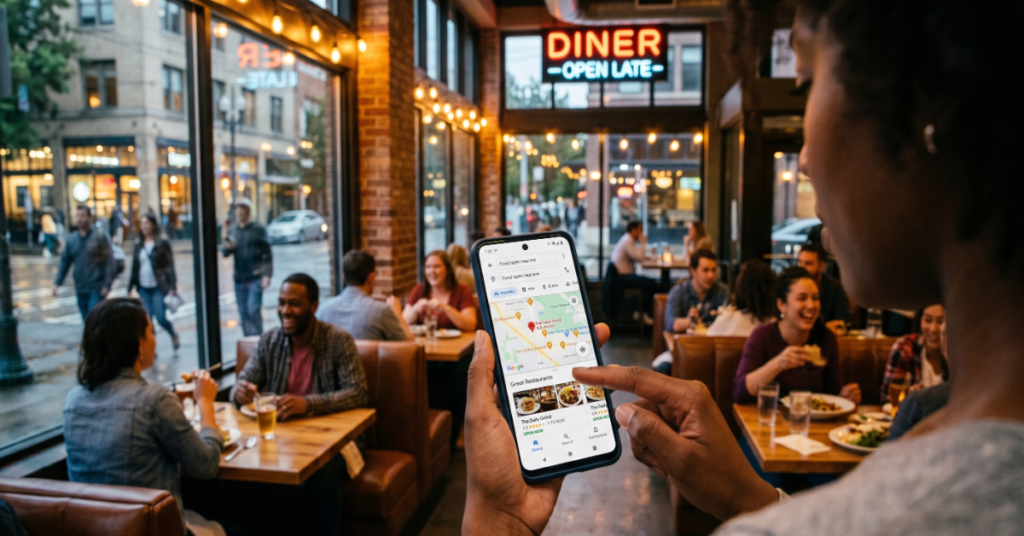
When you type food open near me into your phone at 9:30 on a Tuesday night, you are not browsing. You are hungry, you want something specific, and you need it to actually be open. That combination — urgency, proximity, and accuracy — makes this one of the most commercially valuable local search queries in existence. It is also one of the most frequently misfired.
The numbers are striking. Searches for ‘food near me open now’ surged by 875% in recent years, according to data from Restroworks, while broader ‘food near me’ queries increased by 99% year-over-year in the same period. Over 60% of those searches happen on mobile devices, meaning most people doing this search are already out of the house, standing on a sidewalk, or sitting in a car. They need a fast, accurate answer.
The problem is that the tools built to serve this intent are imperfect in ways that most diners don’t realize. Google Maps can show a restaurant as ‘open’ when it closed an hour ago. Yelp’s review pool skews toward negative sentiment. Delivery apps only surface restaurants participating in their platform. And social media — increasingly the first stop for younger diners — rarely includes verified hours at all.
This guide cuts through the noise. It covers how today’s major discovery platforms actually work, what each one is and isn’t good at, how to cross-reference results to avoid wasted trips, and what the landscape looks like heading into 2027. Whether you’re a diner trying to find somewhere good or a restaurant operator trying to show up when it matters, this is the practical breakdown you need.
For more on how digital discovery is reshaping consumer behavior, see Postcard.fm’s coverage of technology trends in lifestyle and food services at postcard.fm/category/technology.
How ‘Food Open Near Me’ Actually Works: The Platform Mechanics
The phrase food open near me is a natural language query that triggers what Google classifies as a local intent search. When you type it, the algorithm prioritizes three signals: proximity (how close the business is to your current location), relevance (how well the business matches the query), and prominence (how well-established and reviewed the business is online).
What it does not prioritize by default is real-time accuracy. Google’s ‘hours’ data is pulled from whatever a business has entered into its Google Business Profile. If a restaurant updated its hours six months ago and hasn’t touched the listing since, the platform will show those hours as current — even if a seasonal menu change, a staff shortage, or a temporary closure has made them wrong.
This is not a minor inconvenience. A 2025 survey by Toast found that 33% of diners discover restaurants through online sources including Google and Yelp, and that those platforms sit second only to word-of-mouth as discovery channels. When the data those platforms surface is stale, diners make decisions on faulty information.
The Google Business Profile Gap
Restaurants that post weekly updates to their Google Business Profile receive 3 to 7 times more direction requests than those that don’t, according to restaurant marketing analysts. Yet the majority of independent restaurants update their profiles infrequently, if at all. This creates a structural gap: the businesses most likely to appear in a ‘food open near me’ search are large chains with dedicated digital marketing teams, not the independent spot two blocks away that might be exactly what you’re looking for.
For diners, this means the top result is not necessarily the best result — it’s often just the most digitally active one. Scrolling past the first three listings, or toggling from map view to list view, often surfaces genuinely strong options that the algorithm’s prominence signal has deprioritized.
How Each Major Platform Differs
| Platform | Strength | Known Limitation | Best Use Case |
| Google Maps | Real-time ‘busy’ data, widest coverage | Hours can lag seasonal changes | First pass, directions, quick validation |
| Yelp | Deep review depth, filter granularity | Review sentiment skews negative | Category and cuisine-specific searches |
| DoorDash / Uber Eats | Confirms kitchen is actively taking orders | Only shows delivery-enabled restaurants | Late-night or delivery-only discovery |
| TikTok / Instagram | Authentic food visuals, trend signals | No hours or booking data | Vibes and new spot discovery |
| OpenTable / Resy | Live availability confirmation | Limited to reservation-taking restaurants | Sit-down dining, weekend planning |
Strategic Approach: Finding Food That’s Actually Open
The most reliable workflow for finding food open near you is not a single app — it’s a two-step cross-reference. Start with Google Maps for proximity and initial filtering. Then open the restaurant’s direct website or call to confirm hours before committing, particularly outside standard lunch and dinner windows.
That second step adds 30 seconds and eliminates the single biggest failure mode: arriving at a restaurant that Google says is open but isn’t. It’s an obvious fix that most people skip because the interface doesn’t prompt it — and that’s a design problem, not a user problem.
Time-of-Day Targeting
Search intent for food open near me changes significantly by time of day, and the platforms that serve you best shift accordingly. Between 6 and 8:30 PM, delivery apps are at peak reliability — kitchens are actively taking orders and wait times are accurately estimated. Before noon, Google Maps and Yelp are more reliable because fewer late-night or irregular-hours establishments have changed their listings. After 10 PM, delivery apps become the most trustworthy source simply because they confirm active kitchen status in real time.
A 2025 analysis of restaurant marketing data found that peak delivery order time sits between 6:00 and 8:30 PM, and that 57% of delivery customers discover new restaurants directly inside delivery apps during that window. The practical takeaway: if it’s dinnertime and you want food open near you, a delivery app will give you the most reliable current answer. If it’s mid-morning or mid-afternoon, Google Maps combined with a quick call wins.
Practical Cross-Reference Workflow
| Time Window | Recommended First Platform | Verification Step | Fallback |
| Before 11 AM | Google Maps + ‘Open Now’ filter | Check restaurant website directly | Call ahead |
| 11 AM – 3 PM | Google Maps or Yelp | Scan recent reviews for current hours mentions | Delivery app to confirm kitchen active |
| 3 PM – 6 PM | Yelp for specific cuisine filters | Google Maps for hours | Check Instagram for today’s post |
| 6 PM – 10 PM | DoorDash / Uber Eats for delivery, Google for dine-in | Delivery app confirms active kitchen | OpenTable for sit-down availability |
| After 10 PM | Delivery apps only — most reliable post-10 | Sort by ‘delivery time’ not just ‘open’ | Convenience store or 24-hour fast food |
Risks and Trade-Offs in the Current Discovery Ecosystem
The convenience of searching for food open near me obscures several real risks that neither platforms nor restaurants tend to acknowledge openly.
The Hours Accuracy Problem Is Structural
Google’s ‘open now’ badge relies on self-reported data. There is no automated mechanism that checks whether a restaurant is actually serving food at a given moment — only whether its listed hours say it should be. Holidays, private events, staff shortages, and seasonal menu transitions all create gaps that don’t get reflected in platform data for days or weeks after they occur.
A restaurant that closes early due to low staffing on a Tuesday and updates its hours temporarily on Google Business Profile will often see that update revert or not propagate correctly across platforms — Yelp, Apple Maps, and Bing pull data from different sources and refresh at different intervals. This fragmentation is an industry-wide problem with no current standardized solution.
Delivery App Discovery Has a Built-In Bias
When you find a restaurant through a delivery app, you are finding one that has agreed to pay the platform a commission — typically 15% to 30% per order. That commission directly affects the economics of independent restaurants. Research from restaurant marketing analysts shows that 48% of restaurants say delivery apps reduce their profit margin significantly. The restaurants that appear most prominently in delivery app discovery feeds are often those with the largest marketing budgets on those platforms, not necessarily those with the best food.
This creates a discovery blind spot: the restaurant that would genuinely be your favorite food open near you might not appear in your delivery app results at all — because it has chosen not to participate in the platform ecosystem, either due to margin pressure or philosophical preference.
Social Media Discovery Is Aspirational, Not Functional
TikTok now reaches 41% of Gen Z diners as a primary food discovery channel, and 55% of users say they’ve visited a restaurant after seeing its menu content on the platform. But TikTok content is not indexed for hours, location accuracy, or current availability. A restaurant that went viral in March may have a two-hour wait by May. A post from six months ago about a hidden gem might be about a restaurant that has since closed.
Social media works best as a discovery tool for future dining, not immediate decisions. Using it to find food open near me right now introduces a meaningful gap between the aspirational experience shown in the content and the operational reality of walking through the door tonight.
Market and Cultural Impact: Why This Search Matters to Restaurants
The surge in ‘food open near me’ searches is not just a consumer behavior shift — it represents a genuine revenue opportunity that is unevenly distributed across the industry.
According to Toast’s 2025 consumer research, 64% of diners tried a new restaurant in the past month — a 25 percentage point jump from 2024’s figure of 39%. Americans are more willing to try unfamiliar restaurants than at any point in recent measurement history. But that openness is channeled through platforms that disproportionately reward digital presence over food quality.
Independent restaurants account for the majority of the country’s dining options — particularly in urban neighborhoods where density is highest — but they operate with a fraction of the marketing infrastructure of chain competitors. The practical consequence: a local diner searching for food open near me in their own neighborhood may be systematically routed to a chain with strong Google Business Profile management and a delivery platform marketing budget, bypassing the independent restaurant two doors down that would better serve them.
Understanding how restaurants build visibility online connects directly to broader guide content on Postcard.fm — see our guide to digital tools and discovery at postcard.fm/category/guide for additional context on navigating local discovery ecosystems.
The AI Discovery Inflection Point
OpenTable’s 2026 Dining Trends report notes that its new AI-powered Concierge tool, which helps diners search across 60,000+ restaurants using natural language, is an early indicator of where local search is heading. Separately, Toast’s December 2025 consumer survey found that 50% of respondents said they would welcome AI assistance when discovering new restaurants — the highest acceptance rate of any AI application tested.
This is a structural shift, not a feature addition. When AI surfaces restaurant recommendations based on conversational prompts — accounting for dietary preference, budget, party size, and time of day — the current platform hierarchy built around proximity and digital prominence will be disrupted. Restaurants that have built strong review profiles and accurate data across multiple platforms will be far better positioned to benefit from AI-driven discovery than those relying on a single channel.
The Future of Food Discovery in 2027
Three developments will meaningfully reshape what happens when someone searches for food open near me by 2027.
The first is AI-mediated local search. Google’s ongoing integration of generative AI into Search and Maps means that natural language queries like ‘something light and spicy open near me under $20’ will increasingly generate curated answers rather than a list of links. Restaurants will need to be accurately represented across structured data sources — menus, hours, dietary tags, review sentiment — to be surfaced by these AI layers. The businesses that invest in data hygiene now will have a compounding advantage as AI discovery scales.
The second is real-time hours verification. Several platforms, including Google and Yelp, have piloted phone-based verification systems that call restaurants during listed hours to check availability and update listings automatically. As of early 2026 these systems are in limited deployment, but the infrastructure is in place for broader rollout. A standardized ‘confirmed open now’ badge — distinct from self-reported hours — is a realistic near-term development.
The third is the continued fragmentation of the delivery ecosystem. With restaurant industry sales projected at $1.1 trillion annually according to Toast’s industry data, and delivery commission pressure mounting, more independent restaurants are building direct ordering infrastructure — their own apps, SMS ordering systems, and loyalty programs. By 2027, a meaningful share of food discovery for repeat diners will happen outside the major platforms, through direct restaurant relationships. For new diners searching food open near me, the discovery journey will remain platform-mediated — but the conversion from discovery to order will increasingly happen direct.
For context on how technology is changing both search and consumer expectations, Postcard.fm’s technology coverage at postcard.fm/category/technology tracks relevant developments in this space.
Takeaways
- The ‘open now’ filter is useful but imprecise — treat it as a starting point, not a guarantee, especially outside standard lunch and dinner hours.
- Each platform surfaces a different slice of the restaurant landscape. Google Maps maximizes coverage; delivery apps confirm active kitchens; Yelp offers granular filtering. Using two is almost always better than one.
- The restaurants most visible in local search are often those with the largest digital marketing budgets, not the best food — active scrolling past the top three results regularly surfaces stronger options.
- Independent restaurants are structurally disadvantaged in local search and delivery platform discovery. Directly visiting neighborhood restaurant websites or asking locals remains the most reliable route to finding genuinely excellent local food.
- AI-powered discovery is arriving faster than most diners or operators realize. Restaurants with clean, consistent, multi-platform data are building a compounding advantage that will matter significantly by 2027.
- Social media is a powerful discovery tool for future dining planning, not real-time decisions. Using TikTok or Instagram to decide where to eat tonight introduces meaningful operational risk.
Conclusion
Searching for food open near me is a deceptively simple act with a surprisingly complex execution path. The tools are better than they’ve ever been — and more imperfect in specific, consequential ways than most users realize. Google Maps doesn’t guarantee a restaurant is open. Delivery apps show you a commercially curated subset of your options. Social media surfaces the photogenic, not necessarily the available.
The practical solution isn’t to use fewer tools — it’s to use them with more precision. Cross-referencing two platforms, checking hours at the source, and knowing which app is most reliable at 10 PM versus noon makes the difference between a good meal and a wasted drive.
For restaurants, the stakes are different but equally real. The surge in local intent searching represents genuine, high-converting traffic. Being visible when someone nearby is hungry — and being accurately listed as open — is one of the highest-return investments in the current restaurant marketing environment. The platforms will keep evolving, and AI will reshape the discovery layer substantially by 2027. But the fundamentals — accurate data, strong reviews, and a consistent presence across channels — will remain the foundation that everything else is built on.
Further context on consumer behavior and health-conscious dining choices can be found at postcard.fm/category/health, where Postcard.fm covers intersecting lifestyle and food industry topics.
Frequently Asked Questions
What is the most accurate way to find food open near me right now?
Cross-referencing Google Maps with a delivery app gives you the most reliable current picture. Google Maps shows the broadest set of options with proximity data, while a delivery app like DoorDash or Uber Eats confirms a kitchen is actively taking orders. For dine-in after 9 PM, calling the restaurant directly remains the most accurate single method.
Why does Google show a restaurant as open when it’s actually closed?
Google’s ‘open now’ status is based on hours the restaurant has self-reported through its Google Business Profile. If those hours haven’t been updated recently — due to seasonal changes, staff shortages, or temporary closures — the platform will show outdated information. There is no automated real-time verification system in wide deployment as of 2026.
Which app is best for finding food open near me late at night?
Delivery apps are the most reliable option after 10 PM. They confirm in real time that a kitchen is accepting orders, whereas Google Maps and Yelp continue displaying listed hours that may not reflect late-night reality. Sort results by estimated delivery time rather than rating to identify which restaurants are genuinely active.
Why don’t local independent restaurants show up in my food open near me searches?
Local search algorithms weight digital prominence heavily — the size of a restaurant’s review profile, frequency of Google Business Profile updates, and platform marketing activity all influence ranking. Independent restaurants with limited digital marketing capacity are often outranked by chain competitors with dedicated online presence teams, even when the independent restaurant is geographically closer and higher quality.
Does searching for specific cuisine types improve food open near me results?
Yes. Adding cuisine specificity — ‘Thai food open near me’ or ‘ramen open now’ — significantly tightens both relevance and platform filtering. Yelp’s category system and Google Maps’ cuisine tags are more reliable when the query includes a food type. Generic searches surface the highest-prominence results rather than the most relevant ones.
How are delivery apps changing how people find food open near them?
Delivery apps have become a primary discovery channel for a significant share of diners — 57% of delivery customers find new restaurants directly inside delivery apps during the 6–8:30 PM peak window. But their discovery feeds are commercially curated: restaurants pay for prominent placement, meaning higher-commission or better-funded operations appear first regardless of quality.
Will AI change how people search for food open near them?
Meaningfully, yes — and sooner than most people expect. OpenTable already deploys an AI assistant helping diners search across 60,000+ restaurants using natural language. Google’s AI layers in Search and Maps are increasingly able to interpret complex local queries. By 2027, conversational restaurant discovery — asking an AI for specific options based on diet, budget, and mood — will be a mainstream behavior rather than an experimental one.
Methodology
This article draws on publicly available consumer research and industry data published between 2024 and 2026. Key quantitative sources include Toast’s blind consumer surveys conducted in October and December 2025 (combined sample: 2,316 U.S. adults), the Restroworks 2025 analysis of Google restaurant search statistics, OpenTable’s 2026 Dining Trends Report (based on reservation platform data from January to August 2025), and marketing analysis from Restroworks, Marketing LTB, and Restaurantdata.com.
Platform behavior observations — including the Google Business Profile hours accuracy gap and delivery app discovery feed curation — are based on documented industry reporting and operator disclosures rather than independent real-time testing. The article does not claim to have conducted its own platform audits.
Known limitations: restaurant industry data shifts quickly, and statistics cited here reflect conditions as of early 2026. Platform algorithms, AI feature rollouts, and delivery commission structures are subject to change. Readers operating in non-U.S. markets should note that discovery platform market share varies significantly by region.
Counterargument acknowledged: some operators argue that delivery platform curation is a net positive, as it filters out low-quality or unreliable operators and presents diners with vetted options. That perspective has merit in markets where platform quality standards are high — it is not the universal experience, but it is a genuine counterbalance to the visibility criticism raised in this article.
References
Toast. (2026, February 25). How guests discover new restaurants in 2026. Toast Restaurant Blog. https://pos.toasttab.com/blog/data/how-guests-discover-new-restaurants
Toast. (2025, December). Restaurant dining trends: Top insights 2026. Toast Restaurant Blog. https://pos.toasttab.com/blog/data/restaurant-trends
Restroworks. (2025, June 18). Google restaurant search statistics — trends, user intent & visibility data. Restroworks Blog. https://www.restroworks.com/blog/google-restaurant-search-statistics/
Restroworks. (2025). Restaurant social media statistics 2025 — trends, engagement & marketing data. Restroworks Blog. https://www.restroworks.com/blog/restaurant-social-media-statistics/
OpenTable. (2026, January 26). 2026 dining trends report. OpenTable. https://www.opentable.com/c/top-restaurants/dining-trends/
Marketing LTB. (2025, November 6). Restaurant marketing statistics 2025: 91+ stats & insights. Marketing LTB. https://marketingltb.com/blog/statistics/restaurant-marketing-statistics/
Restaurantdata.com. (2025). U.S. restaurant signal analysis 2020–2025. Restaurantdata.com. https://restaurantdata.com/restaurant-opening-crosstab-analysis-2020-2025/
Toast. (2026). 60 restaurant industry statistics and trends for restaurant owners in 2026. Toast Restaurant Blog. https://pos.toasttab.com/blog/on-the-line/restaurant-management-statistics