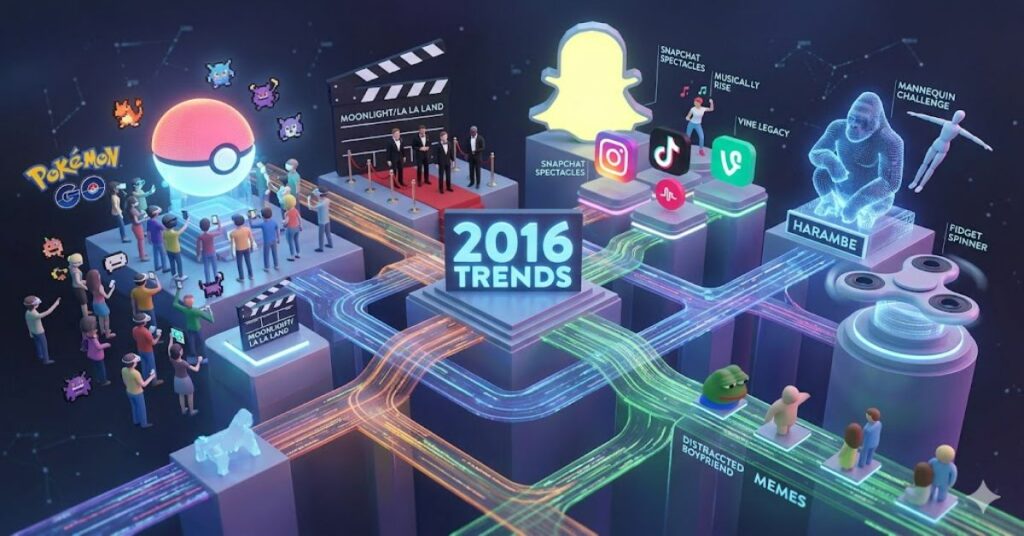
When people look back at 2016 trends, they often remember a unique combination of social media innovation, viral internet culture, and mobile technology breakthroughs. The year was defined by the height of Vine’s popularity, the widespread use of Snapchat dog filters, viral challenges such as the Mannequin Challenge and Bottle Flip, and the global success of Pokémon Go.
Unlike earlier internet eras dominated by desktop experiences, 2016 represented a turning point where smartphones became the primary gateway to entertainment, communication, and content creation. Social networks increasingly rewarded short-form video, visual storytelling, and user participation. What appeared to be harmless internet trends at the time ultimately influenced major business models that now dominate platforms such as TikTok, Instagram Reels, and YouTube Shorts.
Looking back from today’s perspective, 2016 serves as a fascinating case study in how digital culture evolves. Many of the platforms, features, and viral moments that seemed temporary became foundational elements of modern online behavior.
This article explores the defining trends of 2016, their cultural impact, the lessons they offer, and how their influence continues to shape digital experiences nearly a decade later.
Why 2016 Was a Cultural Turning Point
Several factors converged in 2016:
- Smartphones became more powerful and affordable.
- Mobile internet speeds improved globally.
- Social media platforms prioritized visual content.
- User-generated content became mainstream.
- Brands increasingly relied on influencer marketing.
These developments created an environment where trends could spread worldwide within hours rather than weeks.
The Rise of Participation Culture
Previous internet eras focused heavily on content consumption. By 2016, users were expected to create, remix, and share content themselves.
Whether posting a six-second Vine, recording a Snapchat Story, or participating in a viral challenge, audiences became active contributors rather than passive viewers.
This shift fundamentally changed entertainment, advertising, and communication.
The Biggest 2016 Trends at a Glance
| Trend | Primary Platform | Peak Period | Long-Term Impact |
| Vine Videos | Vine | Early–Late 2016 | Influenced TikTok and Shorts |
| Snapchat Filters | Snapchat | Throughout 2016 | Popularized AR filters |
| Pokémon Go | Mobile Gaming | Summer 2016 | Mainstreamed AR gaming |
| Mannequin Challenge | Multiple Platforms | Late 2016 | Viral participation culture |
| Bottle Flip Challenge | YouTube & Social Media | Mid-2016 | User-generated challenge format |
| Live Streaming | Facebook & Periscope | 2016 | Influenced creator monetization |
Vine and the Birth of Short-Form Video Dominance
Few platforms symbolize 2016 better than Vine.
Owned by X (formerly Twitter), Vine allowed users to create six-second looping videos that encouraged creativity through strict limitations.
Why Vine Worked
The platform rewarded:
- Quick storytelling
- Visual humor
- Repeat viewing
- Easy sharing
Creators such as King Bach and Lele Pons built massive audiences through short, highly engaging content.
Lasting Impact
One overlooked insight is that Vine essentially tested the algorithmic entertainment model later perfected by TikTok.
The format proved that viewers preferred endless streams of short content over traditional long-form consumption.
Although Vine shut down in 2017, its influence remains visible across modern social media.
Snapchat Filters and the Visual Identity Revolution
In 2016, Snapchat transformed everyday communication.
The platform’s facial recognition technology allowed users to overlay animations and effects onto selfies.
The dog filter became particularly iconic.
More Than a Novelty
While many viewed filters as simple entertainment, they represented an early mass-market adoption of augmented reality.
Brands soon recognized opportunities to:
- Launch sponsored lenses
- Increase engagement
- Create interactive advertising campaigns
Strategic Implications
An important lesson from this period is that consumers became increasingly comfortable interacting with digital overlays.
This paved the way for AR commerce, virtual try-on tools, and immersive advertising experiences used today.
Pokémon Go and the Mainstream Arrival of Augmented Reality
When Pokémon GO launched in July 2016, it quickly became one of the most successful mobile games ever released.
The game encouraged players to explore real-world locations while capturing virtual creatures.
What Made It Different?
Unlike traditional gaming experiences, Pokémon Go blended:
- Geolocation technology
- Augmented reality
- Social interaction
- Physical movement
Documented Real-World Impact
Research conducted by universities worldwide examined how the game influenced:
- Walking behavior
- Community engagement
- Public space usage
Many local businesses reported increased foot traffic near in-game locations.
Hidden Limitation
While Pokémon Go demonstrated AR’s potential, it also revealed infrastructure challenges such as battery consumption, GPS accuracy issues, and public safety concerns.
These limitations continue to affect AR development today.
The Mannequin Challenge and Viral Participation
The Mannequin Challenge became one of the defining internet phenomena of late 2016.
Participants froze in place while a camera moved through the scene, creating the illusion of time standing still.
Why It Spread So Quickly
Several characteristics contributed:
- Simple participation requirements
- Strong visual appeal
- Group involvement
- Cross-platform compatibility
Schools, sports teams, celebrities, and corporations all participated.
Unlike many trends driven by influencers alone, this challenge spread through community engagement.
The Bottle Flip Craze
One of the most unexpected moments of 2016 involved a partially filled water bottle.
The objective was simple:
Flip the bottle and land it upright.
Cultural Significance
The challenge reflected a growing trend toward low-cost, highly shareable content.
Participants required no specialized equipment or technical skills.
The simplicity helped it spread across schools, sports events, and social media feeds worldwide.
What Brands Learned
Marketers discovered that audiences often engage more with authentic, spontaneous content than polished advertising campaigns.
This lesson continues to influence content marketing strategies.
Data Table: Key Drivers Behind 2016 Internet Culture
| Driver | Effect on Users | Modern Equivalent |
| Smartphone Cameras | Easier content creation | TikTok creators |
| Mobile Apps | Instant sharing | Instagram Reels |
| AR Filters | Interactive experiences | Meta AR effects |
| Viral Challenges | Community participation | TikTok challenges |
| Algorithmic Discovery | Faster trend spread | Recommendation feeds |
| Livestreaming | Real-time interaction | Twitch and YouTube Live |
The Business Impact of 2016 Trends
Many discussions focus on nostalgia, but the economic consequences were equally significant.
Influencer Marketing Expansion
Brands increasingly partnered with digital creators rather than relying solely on traditional advertising.
The creator economy traces much of its modern structure back to this period.
Platform Monetization
Companies learned that:
- User-generated content reduces production costs.
- Engagement drives advertising revenue.
- Community participation improves retention.
These lessons continue to shape social media business models.
Emerging Trend That Few Predicted
One analytical insight often missed is how 2016 normalized personal branding among everyday users.
Today, millions of individuals manage personal online identities using strategies once reserved for celebrities and businesses.
Risks and Trade-Offs Behind the Viral Era
Not every outcome was positive.
Attention Fragmentation
Short-form content encouraged rapid consumption patterns.
Critics argued this reduced attention spans and increased distraction.
Platform Dependency
Many creators built careers entirely on Vine, only to face uncertainty when the platform shut down.
This highlighted a risk that remains relevant today: dependence on third-party platforms.
Privacy Concerns
The widespread use of filters, facial recognition, and location-based gaming also raised questions about:
- Data collection
- User tracking
- Digital privacy
Many regulatory debates occurring today have roots in technologies popularized during 2016.
The Future of 2016 Trends in 2027
Looking toward 2027, the influence of 2016 trends is unlikely to disappear.
Several developments suggest continued evolution:
Augmented Reality Expansion
Major technology companies continue investing in:
- AR glasses
- Spatial computing
- Mixed-reality experiences
The experimentation seen in Snapchat filters and Pokémon Go established consumer familiarity with these technologies.
Creator Economy Growth
Industry forecasts continue to project growth in creator-driven media and influencer marketing.
The foundations of these industries were strengthened during the social media boom of 2016.
Increased Regulation
Governments worldwide are examining:
- Children’s online safety
- Platform accountability
- Data privacy standards
Future growth may depend as much on regulation as technological innovation.
While the direction of specific platforms remains uncertain, the behaviors established during 2016 are likely to persist.
Key Takeaways
- 2016 represented a major shift from content consumption to content participation.
- Vine demonstrated the viability of short-form video years before TikTok’s rise.
- Snapchat normalized augmented reality for mainstream audiences.
- Pokémon Go proved location-based gaming could achieve mass adoption.
- Viral challenges revealed the power of community-driven engagement.
- Many modern social media strategies trace their origins to behaviors popularized during 2016.
- Regulatory and privacy debates today often stem from technologies that gained traction during that period.
Conclusion
The significance of 2016 trends extends far beyond nostalgia. What appeared to be a collection of viral videos, playful filters, and mobile gaming experiments became the foundation for many aspects of today’s digital culture.
Vine demonstrated the power of short-form entertainment. Snapchat introduced millions of users to augmented reality. Pokémon Go showed how digital experiences could merge with physical environments. Viral challenges revealed how quickly communities could organize around shared online experiences.
The lasting impact of these developments can be seen across nearly every major social platform operating today. Creator economies, algorithm-driven content discovery, augmented reality tools, and participation-based marketing all owe something to the innovations and behaviors that emerged during 2016.
Viewed through a historical lens, 2016 was not merely another year of internet trends. It was a defining chapter in the evolution of digital culture.
FAQ
What were the most popular 2016 trends?
Some of the most influential trends included Vine videos, Snapchat dog filters, Pokémon Go, the Mannequin Challenge, Bottle Flip videos, and the expansion of live-streaming platforms.
Why was Pokémon Go so successful in 2016?
The game combined augmented reality, geolocation technology, and a globally recognized franchise, creating a unique mobile experience that encouraged real-world exploration.
Was Vine bigger than TikTok?
Vine was highly influential but significantly smaller in scale than TikTok. However, many of TikTok’s core content principles were pioneered by Vine creators.
Why were Snapchat filters so popular?
They made content creation simple, entertaining, and highly shareable while introducing users to augmented reality technology.
What viral challenge defined 2016?
The Mannequin Challenge became one of the year’s most recognizable viral movements, attracting participation from celebrities, athletes, schools, and corporations.
Are any 2016 internet trends still relevant today?
Yes. Short-form video, creator-driven content, augmented reality filters, and viral participation campaigns remain central parts of online culture.
Methodology
This analysis was developed using historical reporting, platform archives, academic research examining augmented reality and social media adoption, and publicly available industry data. The article focuses on documented cultural trends rather than anecdotal recollections.
Sources were selected based on relevance, publication credibility, and historical significance. Limitations include the difficulty of measuring the exact cultural impact of viral phenomena, as many effects are qualitative rather than quantitative.
A balanced perspective was maintained by considering both the positive innovations and the challenges associated with social media growth, privacy concerns, and platform dependency.
Editorial Disclosure: This article was drafted with AI assistance and reviewed and verified by [Author Name]. All data, citations, and claims should be independently confirmed by the editorial team before publication.