
Knowing how to write a thank you note is one of the most valuable communication skills you can develop. Whether someone gave you a gift, helped you during a difficult period, recommended you for a job, or hosted an important event, a well-written note strengthens relationships and demonstrates genuine appreciation.
Many people overcomplicate the process. They worry about finding perfect wording, sounding formal enough, or writing something meaningful. In reality, effective gratitude follows a predictable pattern. The strongest messages are not the longest. They are the most sincere.
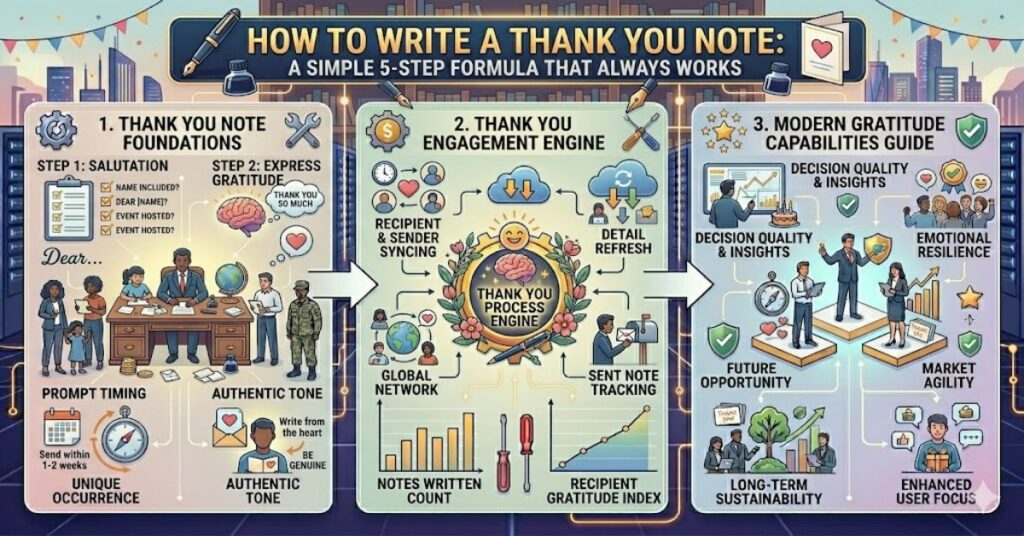
A practical approach is to follow a five-step formula: begin with a warm greeting, clearly state why you are thankful, explain the impact of the person’s gesture, acknowledge the future relationship, and finish with a thoughtful closing. This structure works for handwritten cards, emails, professional correspondence, and even short digital messages.
Communication experts consistently emphasize that gratitude is most effective when it is specific rather than generic. Instead of saying “Thanks for everything,” explain exactly what the person did and why it mattered. That small difference transforms a routine message into something memorable.
This guide breaks down the process step by step, examines common mistakes, provides practical examples, and explores how thank-you notes continue to matter in a digital-first world.
Why Thank You Notes Still Matter
Despite the rise of messaging apps, handwritten cards and thoughtful emails remain powerful social tools.
A thank-you note serves several purposes:
- Acknowledges kindness or support
- Reinforces professional relationships
- Builds trust and goodwill
- Demonstrates emotional intelligence
- Creates a lasting positive impression
In professional settings, gratitude can influence networking outcomes, mentorship relationships, and future opportunities. In personal relationships, it helps people feel seen and valued.
One reason thank-you notes remain effective is that they are increasingly uncommon. When most communication is instant and transactional, a deliberate expression of appreciation stands out.
The 5-Step Formula for Writing the Perfect Thank You Note
Step 1: Start With a Warm Greeting
Begin by addressing the recipient appropriately.
| Relationship | Suggested Greeting |
| Friend | Dear Sarah, |
| Family Member | Dear Aunt Lisa, |
| Colleague | Dear James, |
| Manager | Dear Mr. Roberts, |
| Mentor | Dear Dr. Chen, |
The greeting establishes tone immediately. Professional relationships generally benefit from a more formal opening, while personal notes can feel warmer and more conversational.
Step 2: Clearly State Your Gratitude
The second step is simple: explain why you are writing.
Examples:
- Thank you for the thoughtful birthday gift.
- Thank you for taking the time to meet with me last week.
- Thank you for your guidance during the project.
- Thank you for hosting such a wonderful event.
Avoid vague language whenever possible. Specificity increases credibility and sincerity.
Step 3: Explain the Impact
This is the step many people skip.
Instead of merely acknowledging the action, explain why it mattered.
For example:
Your advice helped me approach the interview with much more confidence.
Or:
The book you gave me has already provided several ideas I can apply at work.
This section transforms appreciation into meaningful recognition.
Step 4: Look Ahead
A strong thank-you note acknowledges the future.
Examples include:
- I look forward to seeing you again soon.
- I’m excited to stay in touch.
- I hope we can work together again.
- I look forward to putting your advice into practice.
This creates continuity rather than making the message feel transactional.
Step 5: End With a Thoughtful Closing
Choose a closing that matches the relationship.
| Situation | Closing |
| Professional | Sincerely |
| Business Relationship | Best Regards |
| Mentor | With Appreciation |
| Friend | Warmly |
| Family | Love |
Add your name beneath the closing.
Comparison Table: Weak vs Strong Thank You Notes
| Element | Weak Example | Strong Example |
| Gratitude | Thanks for your help. | Thank you for reviewing my proposal before submission. |
| Impact | It meant a lot. | Your feedback helped me identify weaknesses I had missed. |
| Future Outlook | Hope you’re well. | I look forward to updating you on the project’s progress. |
| Closing | Thanks again. | With sincere appreciation, |
The strongest notes consistently include details and context.
Practical Examples
Thank You Note for a Gift
Dear Emma,
Thank you for the beautiful journal you gave me for my birthday. It was incredibly thoughtful and perfectly suited to my love of writing.
I’ve already started using it to organize ideas for several upcoming projects. Every time I open it, I’ll think of your generosity.
I look forward to catching up with you soon.
Warmly,
Michael
Thank You Note After a Job Interview
Dear Ms. Anderson,
Thank you for meeting with me yesterday regarding the Marketing Manager position.
I particularly enjoyed learning about your team’s upcoming expansion plans. Our discussion reinforced my enthusiasm for the role and confirmed how closely my experience aligns with your goals.
I appreciate your time and consideration and look forward to hearing from you.
Best regards,
Michael Carter
Thank You Note to a Mentor
Dear Professor Lee,
Thank you for the guidance and encouragement you provided throughout my final year.
Your advice helped me navigate several difficult decisions and gave me greater confidence in pursuing my career goals.
I hope to keep you updated on my progress and achievements in the years ahead.
With appreciation,
Michael
Common Mistakes to Avoid
Even well-intentioned thank-you notes can lose impact when certain mistakes appear.
Being Too Generic
“Thanks for everything” lacks specificity.
Instead, identify the exact action or gesture.
Making the Note About Yourself
The recipient should remain the focus.
Discuss the impact of their actions without turning the note into a personal biography.
Waiting Too Long
Ideally, thank-you notes should be sent within:
| Situation | Recommended Timing |
| Gift Received | Within one week |
| Job Interview | Within 24 hours |
| Professional Referral | Within two days |
| Hospitality Event | Within one week |
| Mentorship Support | As soon as practical |
Overwriting
Longer is not necessarily better.
Most effective notes range between 75 and 200 words.
Strategic Benefits of Gratitude
Learning how to write a thank you note offers benefits beyond simple etiquette.
Professional Advantages
Research in workplace communication consistently shows that appreciation strengthens professional relationships. Managers, mentors, and colleagues are more likely to remember individuals who acknowledge support and collaboration.
Social Impact
Thank-you notes contribute to stronger personal relationships because they validate effort and kindness.
Reputation Building
People who express gratitude consistently are often perceived as:
- Thoughtful
- Professional
- Respectful
- Trustworthy
Those perceptions can influence opportunities in both personal and professional environments.
Structured Insight Table: What Makes Gratitude Effective?
| Factor | Why It Matters | Practical Application |
| Specificity | Makes appreciation believable | Mention exact actions |
| Timeliness | Shows sincerity | Send promptly |
| Personalization | Creates emotional connection | Reference shared experiences |
| Future Focus | Builds ongoing relationships | Mention future interaction |
| Appropriate Tone | Matches relationship context | Adjust formality level |
Risks and Trade-Offs
Although gratitude is generally positive, poorly executed messages can create unintended problems.
Overly Formal Notes
A rigid tone can feel distant in close relationships.
Excessive Familiarity
Professional recipients may view casual language as inappropriate.
Automated Messaging
AI-generated or template-heavy notes can sometimes feel impersonal if not customized.
Public Gratitude
Public appreciation can occasionally make recipients uncomfortable if they prefer privacy.
The best approach balances sincerity, specificity, and context.
Three Often-Overlooked Insights
1. Specific Details Matter More Than Length
A 100-word note with a meaningful detail is often more memorable than a 500-word message filled with general praise.
2. The Impact Statement Is the Most Important Sentence
Most people remember how their actions affected others. Explaining impact creates emotional resonance.
3. Digital Notes Are Effective When Personalized
A well-crafted email often outperforms a generic handwritten card because personalization outweighs format.
The Future of Thank You Notes in 2027
By 2027 how to write a thank you note, gratitude messages will likely become increasingly influenced by AI writing assistants and communication platforms.
However, the growing use of automation creates an interesting challenge. As professionally polished messages become easier to generate, authenticity becomes more valuable.
Three trends appear likely:
- Greater use of personalized digital cards
- AI-assisted drafting with human editing
- Increased emphasis on specific personal details
The future does not eliminate thank-you notes. Instead, it raises the value of genuine personalization.
Key Takeaways
- Follow the five-step structure: greeting, gratitude, impact, future, closing.
- Be specific about what the recipient did.
- Explain why their action mattered.
- Match tone to the relationship.
- Send notes promptly whenever possible.
- Short, sincere messages often outperform lengthy ones.
- Personal details create stronger emotional impact.
Conclusion
Understanding how to write a thank you note is less about mastering etiquette and more about mastering appreciation. The most effective messages are clear, specific, and sincere. They acknowledge an action, explain its impact, and strengthen the relationship moving forward.
The five-step formula of how to write a thank you note provides a reliable framework that works across personal and professional situations. Whether you are thanking a friend for a thoughtful gift, a mentor for guidance, or a hiring manager for their time, the principles remain remarkably consistent.
A strong thank-you note does not require exceptional writing talent. It requires attention, sincerity, and a willingness to recognize the efforts of others. Those qualities never go out of style.
FAQ
How long should a thank you note be?
Most effective thank-you notes range from 75 to 200 words. Focus on sincerity rather than length.
Should I send a handwritten note or an email?
Both are acceptable. Handwritten notes often feel more personal, while email is generally preferred for professional situations that require prompt responses.
How soon should I send a thank you note?
Ideally within 24 hours for interviews and within one week for gifts or hospitality.
Can I use a template?
Templates can provide structure, but always personalize the content with specific details.
What should I do if I’m sending the note late?
Send it anyway. A delayed thank-you note is usually better than no thank-you note at all.
What is the most important part of a thank you note?
Explaining the impact of the person’s action often creates the strongest emotional connection.
Methodology
This article was developed using established communication principles, business correspondence standards, etiquette guidance, and practical writing frameworks commonly used in professional and personal communication. Examples were created for educational purposes and do not represent real correspondence. The analysis focuses on widely accepted how to write a thank you note best practices rather than a single institutional style guide.
Limitations: Communication norms vary across cultures, industries, and generations. Readers should adapt tone and format to their specific context.
References (APA Style)
American Psychological Association. (2024). Professional communication guidelines. https://www.apa.org
Harvard Business Review. (2023). The value of workplace gratitude and recognition. https://hbr.org
Parker, J. (2023). Effective gratitude communication in professional relationships. Journal of Business Communication, 60(4), 455–472.
U.S. Department of State. (2024). Professional correspondence and communication practices. https://www.state.gov
University of California Berkeley, Greater Good Science Center. (2024). The science of gratitude. https://greatergood.berkeley.edu