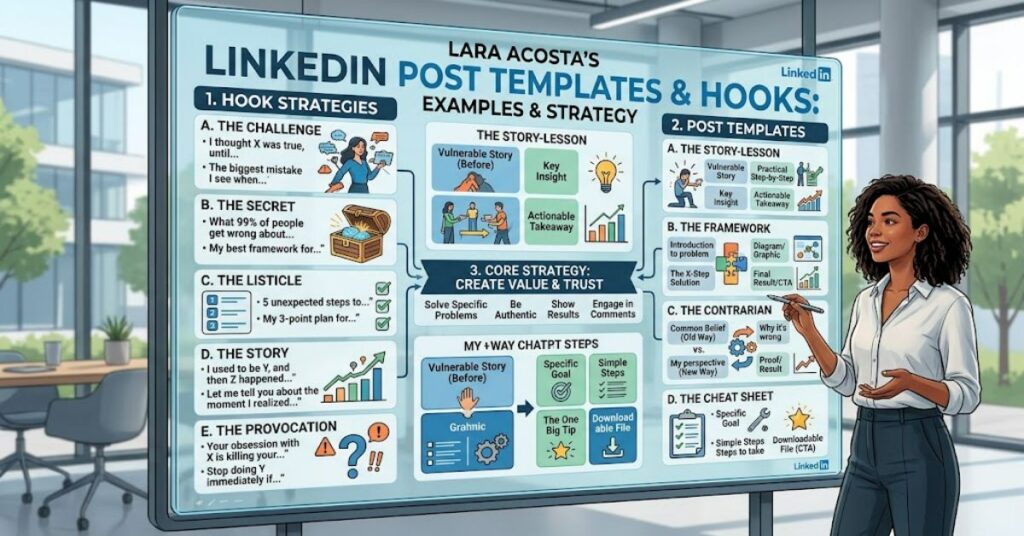
Lara Acosta’s LinkedIn content strategy is built around a simple idea: make people want to read the next line. Her documented posts repeatedly emphasise concise writing, strong hooks, specificity, psychology and useful information. In one of her own posts, she recommends keeping hooks to roughly 7–10 words, using numbers or specific details, and making sure the post delivers on the promise made by the opening. That makes Lara Acosta LinkedIn post templates and hooks useful as a study of writing mechanics rather than a collection of formulas to copy word for word.
Her approach also extends beyond the first sentence. Lara has described a structure involving a hook, re-hook, lead, body, power-ending and call to action or engagement prompt. Another recurring method is educational storytelling: begin with personal context, add useful information and finish with a clear lesson.
The practical lesson is important. A strong LinkedIn post is not simply a clever opening. It is a sequence in which every line earns the reader’s attention.
What Makes Lara Acosta’s Hooks Effective?
Lara’s documented hook advice centres on four principles: specificity, brevity, relevance and curiosity.
A third-party analysis of 115 Lara Acosta posts found that her hooks averaged around seven to eight words and frequently used numbers, first-person language, parentheses and terms such as “LinkedIn” and “How”.
| Hook characteristic | Why it works | Example template |
| Specific number | Makes a claim concrete | “I tested 7 LinkedIn ideas…” |
| Personal result | Creates credibility | “How I gained [result]…” |
| Direct address | Identifies the reader | “If you struggle with [problem]…” |
| Curiosity | Creates an open loop | “I stopped doing this on LinkedIn…” |
| Transformation | Shows movement | “From [starting point] to [result]…” |
These are patterns, not guarantees. A number does not automatically make a weak claim persuasive. The number must be relevant and defensible.
Lara Acosta LinkedIn Post Templates
1. The Personal Result Template
Hook:
“How I [achieved result] without [common assumption].”
Body:
Explain the starting point, identify the change you made, then give three practical steps.
Ending:
“The biggest lesson: [specific lesson].”
This structure works because the reader receives both a story and a useful takeaway.
2. The Educational Storyteller Template
Lara has explicitly described her “Educational Storyteller” approach as combining a broad idea, a personal story and a focused lesson.
Template:
“I used to think [belief].
Then [specific experience] happened.
It taught me 3 things:
- [Lesson]
- [Lesson]
- [Lesson]
The biggest shift was [core insight].”
The personal element makes the educational material easier to remember.
3. The Problem-to-Solution Template
Hook:
“Your [problem] probably isn’t caused by [obvious assumption].”
Then explain the overlooked cause.
Follow with:
What to do instead:
- [Action]
- [Action]
- [Action]
End with the simplest principle behind the solution.
This format fits Lara’s preference for actionable writing and clear problem-solving.
4. The “If I Started Again” Template
Hook:
“If I started my LinkedIn from zero today…”
Then describe the first three to five moves you would make.
This structure is effective because it combines authority with a hypothetical scenario. It also naturally encourages prioritisation instead of producing a long list of disconnected tips.
Hook Examples Inspired by the Structure
The following are original examples based on documented patterns, not quotations from Lara Acosta:
- “I wrote 100 LinkedIn hooks. Here’s what worked.”
- “How I would rebuild my LinkedIn from zero.”
- “Your posts aren’t boring. They’re too vague.”
- “I stopped chasing impressions. My content improved.”
- “7 LinkedIn mistakes I would avoid today.”
- “If your posts get ignored, check this first.”
- “I tested 5 content formats. One stood out.”
- “The best LinkedIn posts make one promise.”
- “I used to over-explain everything. Then I stopped.”
- “Your hook needs one job: earn the next line.”
The common feature is specificity. Each hook gives the reader an identifiable subject rather than promising an undefined improvement.
The Full Post Matters More Than the Hook
One of Lara’s own posts makes an important distinction: she argues that high-performing posts often contain multiple hooks rather than relying exclusively on the opening line. Her advice includes making each sentence precise, adding a “quick win”, avoiding over-explanation and providing solutions.
That creates a useful writing test:
| Post element | Reader question |
| Hook | Why should I stop scrolling? |
| Re-hook | Why should I continue? |
| Lead | What will I learn? |
| Body | Is this actually useful? |
| Ending | What should I remember? |
| CTA | What should I do next? |
This is one of the most useful insights from studying the method: retention is a line-by-line problem.
Risks of Copying the Formula
Templates can reduce writer’s block, but they also create risks.
The first is sameness. If hundreds of creators use identical “7 lessons”, “How I…” and “I stopped…” openings, the structure loses some of its distinctiveness.
The second is manufactured credibility. A specific number can increase attention, but inventing statistics or exaggerating results damages trust.
The third is personality loss. Lara’s own examples frequently connect a broad lesson with personal experience. Removing that context leaves only the framework.
A better approach is to copy the reasoning, not the wording.
Three Practical Insights
1. Specificity should continue beyond the hook.
A specific opening followed by generic advice creates a credibility gap. The body should contain equally concrete examples, steps or evidence.
2. A template should reduce friction, not replace thinking.
The strongest use of a framework is deciding what information belongs where. The underlying opinion still needs to come from the writer.
3. Mobile readability is structural, not cosmetic.
Short paragraphs, deliberate line breaks and compact sentences make the argument easier to process on a small screen. That supports the emphasis Lara places on concise hooks and direct writing.
The Future of Lara Acosta-Style LinkedIn Writing in 2027
By 2027, the underlying principles are likely to remain more useful than any individual hook formula. LinkedIn content already rewards creators who can combine professional expertise with accessible storytelling, while AI-generated content makes distinctive personal evidence increasingly valuable.
That creates an important shift. The advantage will not simply belong to people who know how to write a strong hook. It will belong to people who can support that hook with original experience, credible evidence and a recognisable point of view.
AI can generate dozens of opening lines. It cannot automatically supply genuine experience or earned authority.
Key Takeaways
- Use hooks to establish a clear reason to continue reading.
- Specific numbers can add clarity when they are genuine.
- Personal stories work best when connected to a useful lesson.
- Re-hooks and strong transitions can maintain attention after the opening.
- Templates should provide structure rather than dictate personality.
- Every promise made by a hook should be fulfilled.
- Short, precise sentences can improve mobile readability.
Conclusion
Lara Acosta’s LinkedIn writing provides a useful case study in modern professional content. Her documented advice consistently returns to clarity, specificity, psychology, storytelling and practical value. The hook matters, but it is only the beginning.
The most transferable lesson is to build a complete reading experience. Start with a precise promise, create enough curiosity to earn the next line, provide useful information and finish with a memorable point. Personal context then gives the advice credibility and makes the post feel less interchangeable.
For writers studying Lara Acosta LinkedIn post templates and hooks, the goal should therefore not be imitation. The better strategy is to understand why the structures work, adapt those principles to a genuine area of expertise and support every claim with real experience or evidence.
FAQ
What is Lara Acosta’s LinkedIn hook strategy?
Her documented approach emphasises short, specific hooks that create curiosity while clearly signalling the topic or benefit. She has recommended roughly 7–10 words and using concrete details such as numbers.
How long should a LinkedIn hook be?
A practical starting point is around 7–10 words. However, clarity matters more than hitting an exact word count.
What is Lara Acosta’s educational storyteller method?
It combines a broad or relatable idea with personal context and a focused lesson. The story adds personality while the lesson provides practical value.
Should you copy Lara Acosta’s LinkedIn templates?
Use them as structural inspiration rather than copying wording. Original experiences, examples and opinions make the resulting post more credible.
Why are numbers useful in LinkedIn hooks?
Numbers make claims more concrete and can create curiosity. They should represent genuine results, observations or useful quantities rather than invented statistics.
Does a strong hook guarantee a successful LinkedIn post?
No. A strong opening can earn attention, but the body must deliver on the promise. Lara’s own writing advice stresses precision and useful information throughout the post.
Methodology
This article Lara Acosta LinkedIn post templates was developed from Lara Acosta’s publicly available LinkedIn posts and documented third-party analyses of her writing patterns. Her own posts were prioritised when describing her stated methods, including her hook-writing guidance, educational storytelling method and broader post structure.
Third-party analysis was used only where it provided measurable observations about recurring patterns across multiple posts. Those observations should be treated as analysis of her published content rather than as official rules created by Lara Acosta.
No claim of firsthand testing, interviewing or private access is made. Template examples in this article are original adaptations designed to illustrate the documented structures.
Editorial disclosure: This article was drafted with AI assistance and should be reviewed and independently verified by a human editor before publication.
References
Acosta, L. (2024). LinkedIn writing and hook strategy posts. LinkedIn.
Acosta, L. (2024). How I grew my LinkedIn 10x faster: The Educational Storyteller method. LinkedIn.
Acosta, L. (2024). My #1 LinkedIn writing system that I teach my clients. LinkedIn.
Bacha, F. (2024). Lara Acosta LinkedIn hook strategy. LinkedIn.
Srushti S. (2026). Lara Acosta’s 10 hook structures for LinkedIn success. LinkedIn.