
A low sodium diet limits the amount of sodium consumed each day, primarily by reducing foods that contain large amounts of added salt or naturally occurring sodium. General dietary guidance often places sodium intake somewhere between 1,500 and 2,300 milligrams (mg) per day, although the appropriate target depends on health circumstances and professional advice.
In the UK, the NHS advises adults to consume no more than 6 grams of salt a day. This is equivalent to approximately 2.4 grams, or 2,400mg, of sodium. The distinction between salt and sodium is important because they are related but not identical. Salt contains sodium, while sodium itself is a mineral required by the body.
For many people, reducing sodium is less about removing the salt shaker and more about understanding where sodium enters the diet. Bread, processed meats, cheese, sauces, ready meals, savoury snacks and takeaway foods can all contribute significant amounts.
The challenge is making these reductions sustainable. Food that is simply stripped of seasoning can quickly become unappealing, making it harder to maintain new habits. A better approach combines sensible portion control, label reading and alternative sources of flavour.
How Much Sodium Is Appropriate?
Different organisations use slightly different recommendations.
| Organisation or guidance | General daily recommendation |
| NHS adult salt limit | 6g salt |
| Approximate sodium equivalent | 2,400mg sodium |
| American Heart Association maximum | 2,300mg sodium |
| American Heart Association ideal goal for many adults | 1,500mg sodium |
| World Health Organization | Less than 2,000mg sodium |
These figures are general recommendations rather than universal prescriptions. Someone following a medically supervised diet may have a different target.
The World Health Organization recommends adults consume less than 2,000mg of sodium per day, equivalent to less than 5g of salt. Meanwhile, the American Heart Association recommends no more than 2,300mg daily and identifies 1,500mg as an ideal goal for most adults, particularly those with high blood pressure.
Where Sodium Hides in Everyday Food
One of the biggest difficulties with reducing sodium is that many high-sodium foods do not taste extremely salty.
Processed meats such as bacon, sausages and ham can contribute substantial amounts. Cheese, sauces, stock cubes, instant noodles, soups, crisps and ready meals can also raise daily intake.
| Food category | Lower-sodium alternative |
| Bacon and processed meats | Fresh poultry, fish or lean meat |
| Salted snacks | Unsalted nuts or fresh fruit |
| Tinned foods | No-added-salt or reduced-salt versions |
| Ready meals | Home-cooked meals using fresh ingredients |
| Stock cubes | Reduced-salt stock or homemade stock |
| Sauces | Homemade herb, yoghurt or tomato-based sauces |
| Salted bread products | Compare labels and select lower-salt options |
A particularly useful insight is that sodium reduction cannot be judged solely by how much salt someone adds during cooking. The NHS explains that much of the salt people consume comes from everyday packaged and processed foods.
That makes food labelling one of the most practical tools available.
Reading Food Labels Properly
When comparing products, look at the nutrition information rather than relying on marketing language such as “healthy”, “natural” or “light”.
Pay attention to whether the figure is provided per 100g, per serving or for the entire package. A seemingly modest amount per serving can become substantial if someone eats several servings.
Comparing similar products is often more useful than trying to memorise numerical limits. If two soups are otherwise similar, choosing the one with less salt or sodium is a simple change that can reduce overall intake without changing the meal itself.
This approach also avoids a common mistake: assuming that one lower-sodium purchase makes the whole diet low in sodium. Daily intake is cumulative.
How to Add Flavour Without Excess Salt
Reducing sodium does not mean accepting bland food.
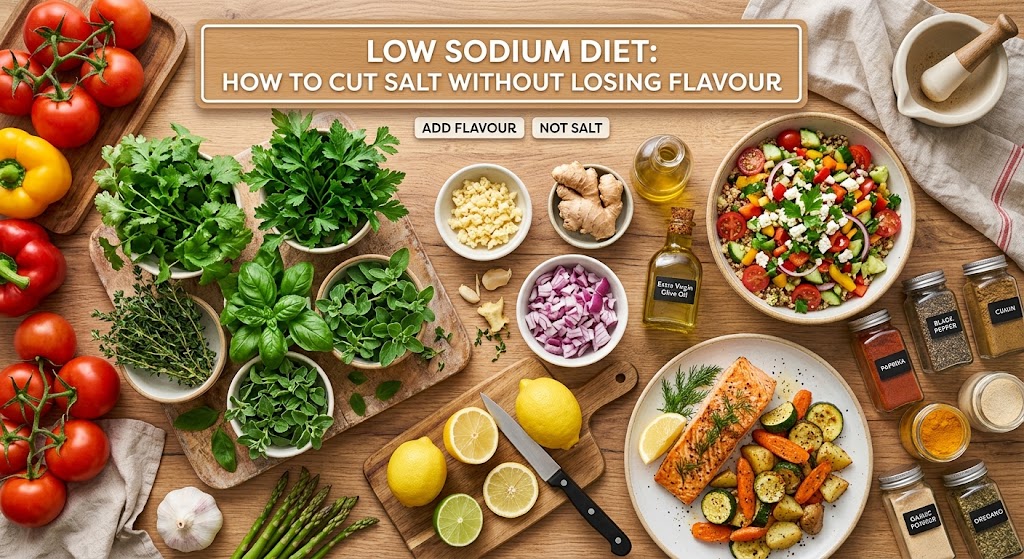
Herbs and spices can provide complexity without relying on large quantities of salt. Garlic, ginger, black pepper, chilli, paprika, cumin, coriander, rosemary and thyme can all contribute distinctive flavour profiles.
Acidic ingredients are useful too. Lemon juice, lime juice and vinegar can make food taste brighter and more seasoned. Fresh ingredients such as tomatoes, onions, peppers and mushrooms can add depth to meals.
A useful cooking principle is to build flavour in layers. Instead of compensating for reduced salt at the end, develop flavour through browning, aromatics, herbs, spices and acidity during preparation.
Health Benefits and Important Considerations
High sodium intake is associated with increased blood pressure, while reducing sodium can help lower blood pressure in many people. Blood pressure is an important risk factor for cardiovascular disease and stroke, making sodium reduction a relevant part of broader heart-health strategies.
However, sodium is not inherently harmful. The body requires sodium for normal physiological functions, including fluid balance, nerve signalling and muscle function.
This is why the goal is moderation rather than complete elimination.
People with medical conditions, prescribed dietary restrictions or questions involving kidney function, heart failure, blood pressure medication or electrolyte balance should follow advice from their healthcare professional rather than adopting an aggressive restriction independently.
The Future of Low Sodium Diets in 2027
The future of sodium reduction is likely to involve both consumers and food manufacturers.
The World Health Organization has continued to promote population-wide sodium reduction through food reformulation, clearer nutrition information and healthier food environments. This is important because individuals cannot always control the sodium content of processed foods or restaurant meals.
By 2027, greater availability of reduced-sodium products could make dietary changes easier. However, product reformulation has to balance sodium reduction with taste, food safety, preservation and consumer acceptance.
Technology may also make nutritional tracking easier, but apps and automated recommendations should not replace professional advice for people with specific medical requirements.
Key Takeaways
- Salt and sodium are different measurements.
- UK adults should generally consume no more than 6g of salt daily.
- Processed foods can contribute substantial sodium without tasting extremely salty.
- Checking serving sizes prevents underestimating intake.
- Herbs, spices, citrus and vinegar can replace some of the flavour traditionally supplied by salt.
- Individual sodium requirements may differ because of health conditions and medical treatment.
Conclusion
A low sodium diet does not need to mean tasteless meals or an extreme restriction of every food containing salt. For most people, the more practical strategy is to identify major sources of sodium and gradually replace them with lower-sodium alternatives.
Cooking more meals from basic ingredients provides greater control, while comparing nutrition labels can help reduce sodium when buying packaged foods. Flavour can then be rebuilt through herbs, spices, garlic, citrus, vinegar and cooking techniques rather than relying heavily on salt.
The precise target should depend on the individual. General guidance from UK and international health organisations provides useful boundaries, but people following medically prescribed diets should use professional advice as their primary reference.
The strongest approach is therefore consistent and realistic: reduce unnecessary sodium while maintaining a varied, nutritious and enjoyable diet.
FAQ
What is a low sodium diet?
It is an eating pattern that limits excessive sodium by reducing high-sodium foods and added salt. Daily targets vary, but commonly discussed limits range from 1,500 to 2,300mg.
How much salt should an adult have each day?
UK guidance recommends that adults consume no more than 6g of salt per day, equivalent to approximately 2,400mg of sodium.
What foods should I avoid on a low sodium diet?
Limit heavily processed meats, salty snacks, many ready meals, high-sodium sauces, stock cubes and foods with substantial sodium listed on their nutrition labels.
Can I eat bread on a low sodium diet?
Yes. Bread can remain part of a balanced diet. Comparing products can help you choose options containing less salt.
Is sea salt better for a low sodium diet?
Switching from table salt to sea salt does not remove the need to limit sodium. All types of salt should be used moderately.
Can reducing sodium lower blood pressure?
Reducing sodium can help lower blood pressure, particularly in people who are sensitive to sodium or already have hypertension.
Methodology
This article was based on established dietary guidance from the NHS, World Health Organization and American Heart Association. Sodium recommendations were compared because organisations use different measurement systems and targets.
No independent clinical testing, dietary experiment or first-hand medical assessment was conducted. The article therefore provides general information rather than personalised medical advice.
Health claims, numerical recommendations and references should be checked against the original sources by a human editor before publication.
References
American Heart Association. (2025). How much sodium should I eat per day?
American Heart Association. (2025). Shaking the salt habit to lower high blood pressure.
National Health Service. (2023). Salt in your diet.
National Health Service. (2020). Vitamins and minerals: Others.
World Health Organization. (2025). Sodium reduction.
World Health Organization. (2026). Healthy diet.