
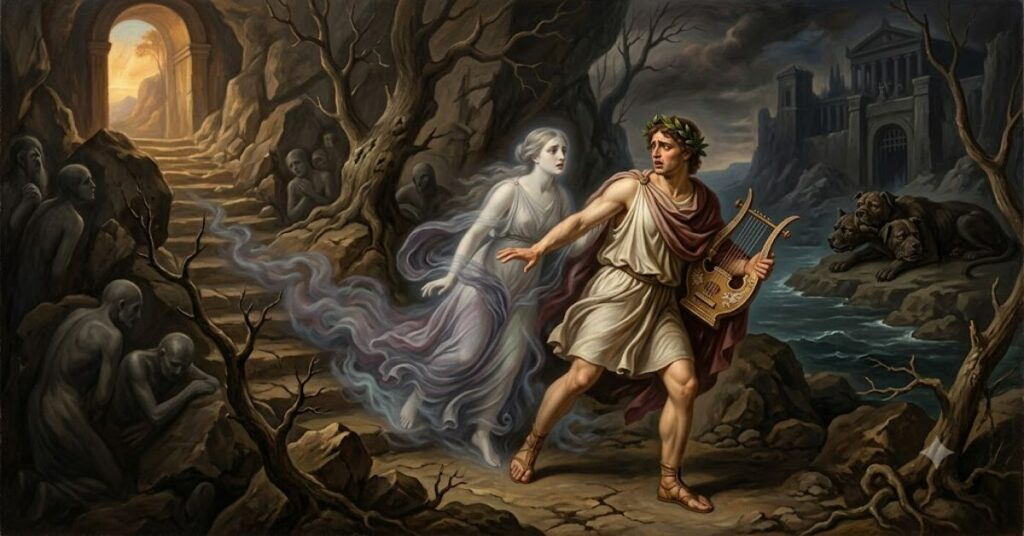
Orpheus and Eurydice is one of ancient Greece’s most tragic love stories. According to Greek mythology, Orpheus, the greatest musician among mortals, lost his new bride Eurydice after she died from a snakebite. Unable to accept her death, he travelled into the Underworld and used his extraordinary music to convince Hades and Persephone to allow her return. However, he lost her forever when he looked back before reaching the surface, breaking the condition placed upon him.
The myth has survived because it explores emotions that remain familiar today: grief after losing someone, the desire to reverse fate, and the painful reality that some things cannot be recovered. Beyond a simple romance, the story examines the relationship between art and power, questioning whether beauty can overcome the limits imposed by destiny.
Ancient Greek writers and later artists repeatedly returned to this tale because it captures a universal human experience. The tragedy of Orpheus and Eurydice is not only about death; it is about trust, patience, and the consequences of doubt.
The Origins of the Orpheus and Eurydice Myth
The earliest references to Orpheus appear in ancient Greek traditions dating back to at least the 6th century BCE. Unlike many Greek heroes who relied on physical strength, Orpheus represented artistic and spiritual power.
He was believed to possess a musical ability so extraordinary that animals, trees, and even stones responded to his songs. Ancient sources connected him with religious movements, especially Orphism, a belief tradition focused on the soul, death, and the possibility of spiritual transformation.
| Element | Meaning in Greek Tradition |
| Orpheus | Symbol of music, poetry, and artistic influence |
| Eurydice | Represents love, beauty, and human vulnerability |
| Underworld journey | Represents confrontation with death |
| Looking back | Symbolises doubt and human weakness |
The story became influential because it combined mythology with philosophical questions about life and mortality.
Orpheus’ Journey Into the Underworld
After Eurydice’s death, Orpheus refused to accept separation from his beloved. Instead of mourning from a distance, he entered the Underworld, a realm normally impossible for living humans to reach.
His music moved the rulers of the dead. Hades and Persephone agreed to release Eurydice under one strict condition: Orpheus must walk ahead and not look back at her until both had reached the world above.
This moment creates the central conflict of the story. Orpheus has achieved the impossible, yet he fails because of uncertainty. His desire to confirm that Eurydice is following him becomes stronger than his trust.
| Story Stage | Symbolic Meaning |
| Eurydice’s death | The inevitability of loss |
| Orpheus’ descent | The power of love and determination |
| The agreement with Hades | Hope combined with limitation |
| Looking back | Fear overcoming faith |
The Deeper Meaning Behind the Tragedy
The enduring strength of this myth comes from its emotional complexity. Orpheus is not defeated by an external enemy. He loses Eurydice because of an internal struggle.
The story presents several important ideas:
Love and grief:
Orpheus’ journey represents the extreme lengths people may go to when facing unbearable loss.
The limits of human control:
Even extraordinary talent cannot completely overcome natural laws and destiny.
The danger of doubt:
The final glance represents impatience and the inability to trust what cannot yet be seen.
Unlike heroic myths where victory comes through strength, this story suggests that emotional discipline can be just as difficult as physical challenges.
Cultural Impact Through History
The influence of Orpheus and Eurydice extends across thousands of years. Artists have adapted the myth through painting, poetry, theatre, and music.
One of the most significant adaptations was the opera L’Orfeo, composed by Claudio Monteverdi in 1607. It is considered one of the earliest major operas and demonstrated how mythology could be transformed into powerful musical storytelling.
The myth has also influenced modern films, novels, and stage productions because its themes remain relevant. Contemporary interpretations often focus less on gods and fate and more on psychological struggles such as grief, memory, and emotional acceptance.
The Future of Orpheus and Eurydice in 2027
Classical mythology continues to find new audiences through digital media, education platforms, games, and modern entertainment. By 2027, myths like Orpheus and Eurydice are likely to remain culturally relevant because they provide adaptable stories rather than fixed historical records.
Digital storytelling tools, interactive learning platforms, and new artistic formats are creating opportunities to reinterpret ancient myths for younger generations.
However, future adaptations face a challenge: balancing creative freedom with respect for historical and cultural origins. The strongest versions will likely preserve the central emotional themes while presenting new perspectives.
Key Insights
- The myth survives because it addresses universal human emotions rather than only ancient beliefs.
- Orpheus represents artistic power rather than traditional physical heroism.
- The final mistake is psychological, showing the consequences of doubt.
- Ancient myths remain valuable because each generation can reinterpret their meanings.
- The story demonstrates that tragedy can reveal deeper truths about human behaviour.
Conclusion
Orpheus and Eurydice remains one of the most powerful stories from ancient Greek mythology because it combines romance, tragedy, music, and philosophy. The tale is not simply about a man losing the woman he loves; it is about humanity’s struggle against forces beyond control.
Orpheus succeeds in reaching the Underworld and achieving what seems impossible, yet his emotional uncertainty changes the outcome. This complexity is what has allowed the myth to survive for centuries.
From ancient poetry to modern films and music, the story continues to inspire because its themes remain deeply human. Love, grief, hope, and regret are experiences shared across cultures and generations.
Frequently Asked Questions
What is the story of Orpheus and Eurydice?
The myth tells of Orpheus, a gifted musician who travels to the Underworld to bring back his wife Eurydice after her death. He loses her again after looking back too soon.
Why did Orpheus look back at Eurydice?
Orpheus looked back because he doubted whether Eurydice was truly following him. His lack of trust caused him to lose her permanently.
What does Orpheus symbolise?
Orpheus symbolises the power of music, creativity, and artistic expression. He represents how art can influence emotions and challenge boundaries.
Is Orpheus and Eurydice a true story?
No. The story is a myth from ancient Greek tradition. It reflects cultural beliefs and philosophical ideas rather than historical events.
Why is this myth still popular today?
The story remains popular because it explores universal themes such as love, death, grief, and the difficulty of accepting loss.
Methodology
This article was created using established classical mythology sources, historical references, and documented interpretations of Greek literature. The analysis focuses on the cultural meaning of the myth rather than treating legendary events as historical facts.
Limitations include variations between ancient versions of the story, as Greek myths changed across different writers and periods.
References (APA Style)
Edmonds, R. G. (2013). Redefining Ancient Orphism: A Study in Greek Religion. Cambridge University Press.
Graf, F., & Johnston, S. I. (2013). Ritual Texts for the Afterlife: Orpheus and the Bacchic Gold Tablets. Routledge.
Powell, B. B. (2017). Greek Mythology. Pearson.