
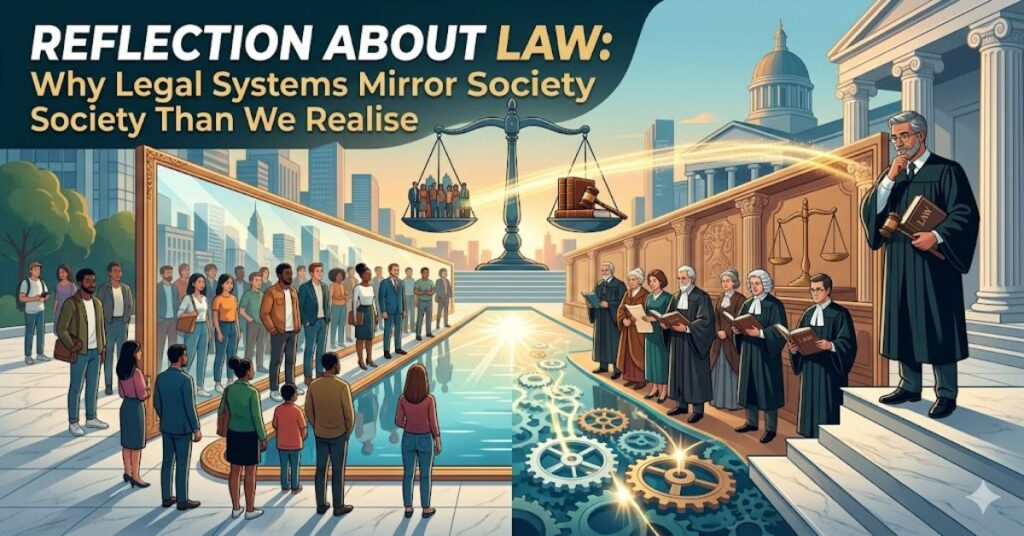
A meaningful reflection about law begins with recognising that law is far more than a set of rules enforced by governments. It is a dynamic social construct that develops alongside society itself. Every legal system seeks to create order, resolve disputes, and protect rights, yet it must also adapt to changing social values, technological advances, and shifting expectations of justice.
History demonstrates that laws are never entirely fixed. Practices once considered acceptable may later become unlawful, while rights previously denied can become legally protected. This continuous evolution highlights an important truth: law reflects the collective beliefs, priorities, and power structures of the communities it governs.
Whether examining constitutional protections, criminal justice reforms, environmental regulations, or digital privacy rights, the same pattern emerges. Law exists within society rather than above it. It responds to public pressure, economic realities, political movements, and judicial interpretation.
This article explores the philosophical, practical, and social dimensions of legal systems. It examines how law maintains stability while embracing change, the challenges it faces in modern society, and why understanding its evolving nature remains essential for citizens, policymakers, and legal professionals alike.
Understanding Law as a Social Construct
Law is often described as a framework of rules created and enforced by institutions. While technically accurate, this definition only scratches the surface.
Legal scholars have long argued that law derives its legitimacy from society’s acceptance of its authority. Without public compliance and institutional trust, legal systems struggle to function effectively.
Law and Social Values
The connection between law and social values is visible throughout history:
| Period | Social Change | Legal Response |
| 19th Century | Industrialisation | Labour regulations and workplace protections |
| Mid-20th Century | Civil rights movements | Anti-discrimination legislation |
| Late-20th Century | Environmental awareness | Environmental protection laws |
| 21st Century | Digital transformation | Data privacy and cybersecurity regulations |
These developments illustrate how legal systems evolve in response to societal needs rather than remaining static.
The Core Purpose of Law
Despite variations across countries and legal traditions, most legal systems pursue several common objectives.
Maintaining Order
One fundamental purpose is preserving social stability. Criminal laws, property rights, and contractual obligations establish predictable expectations that allow societies to function.
Without legal frameworks, economic activity, public safety, and civic cooperation would become significantly more difficult.
Protecting Rights
Modern legal systems increasingly emphasise individual rights and freedoms. Constitutional protections, human rights legislation, and judicial review mechanisms aim to safeguard citizens against abuses of power.
Resolving Disputes
Courts and tribunals provide structured methods for resolving conflicts. Rather than relying on personal retaliation or force, individuals can seek legal remedies through established procedures.
Reflection About Law and Justice
One of the most enduring questions in legal philosophy concerns the relationship between law and justice.
Many people assume that what is legal must also be just. History suggests otherwise.
Certain laws that were once legally valid are now widely regarded as unjust. Examples include discriminatory voting restrictions, segregation policies, and laws denying equal rights to specific groups.
This distinction reveals a critical insight:
Legality and morality are not always identical.
Legal systems constantly face pressure to align formal rules with evolving notions of fairness and human dignity.
The Pursuit of Justice
Justice can be viewed through multiple lenses:
| Type of Justice | Focus |
| Distributive Justice | Fair allocation of resources |
| Procedural Justice | Fair legal processes |
| Restorative Justice | Repairing harm and rebuilding relationships |
| Retributive Justice | Accountability and punishment |
Different legal systems emphasise these principles to varying degrees.
How Law Adapts to Social Change
A central theme in any serious reflection about law is adaptability.
Societies evolve continuously. New technologies emerge. Cultural norms shift. Economic structures transform.
Legal systems must respond to these developments without undermining stability.
Technology and Regulation
Artificial intelligence, biometric surveillance, cryptocurrency, and data collection have created legal challenges that lawmakers could not have anticipated decades ago.
Questions surrounding privacy, algorithmic accountability, and digital ownership demonstrate the need for ongoing legislative reform.
Changing Social Norms
Public attitudes toward equality, marriage, employment rights, and personal autonomy have significantly influenced legal developments worldwide.
In many jurisdictions, courts and legislatures regularly revisit established doctrines to reflect contemporary expectations.
The Influence of Power on Legal Systems
Law is often presented as neutral and objective. In practice, power relationships influence legal development.
Political institutions create legislation.
Judges interpret legal principles.
Economic interests frequently shape regulatory debates.
Public advocacy groups campaign for reform.
This does not mean legal systems lack legitimacy. Rather, it highlights the reality that law operates within broader social and political structures.
Original Insight #1
One overlooked aspect of legal development is that many reforms occur not because institutions initiate change but because public opinion reaches a tipping point where maintaining existing laws becomes politically unsustainable.
Real-World Examples of Law in Action
Understanding legal theory becomes easier when examining real-world examples.
Data Privacy Regulation
The growth of digital platforms has increased concerns about personal data collection and surveillance.
Regulations such as the UK General Data Protection Regulation framework illustrate how lawmakers adapt legal protections to technological realities.
Climate and Environmental Law
Environmental legislation demonstrates how scientific evidence influences legal standards.
Governments increasingly face legal pressure to address carbon emissions, biodiversity loss, and environmental sustainability.
Original Insight #2
Environmental law highlights a unique challenge: legal systems often react more slowly than environmental change itself. This timing gap creates enforcement and policy difficulties that traditional legal models were not designed to address.
Risks and Trade-Offs Within Legal Systems
No legal system is perfect.
Every legal framework involves compromises.
Stability Versus Reform
Rapid legal change may address injustice but can also create uncertainty.
Conversely, excessive stability may preserve outdated rules that no longer serve society effectively.
Individual Rights Versus Public Interests
Many legal disputes involve balancing personal freedoms against broader societal goals.
Examples include:
- Privacy versus national security
- Free expression versus harmful speech
- Property rights versus environmental protection
These tensions rarely have simple solutions.
Original Insight #3
The most difficult legal questions often arise not from disagreements about principles but from conflicts between two legitimate principles that society values equally.
Structured Insight Table: Key Dimensions of Law
| Dimension | Primary Function | Challenge |
| Criminal Law | Public safety | Balancing punishment and rehabilitation |
| Civil Law | Dispute resolution | Accessibility and cost |
| Constitutional Law | Limiting government power | Political interpretation |
| Administrative Law | Regulatory oversight | Bureaucratic complexity |
| International Law | Cross-border cooperation | Enforcement limitations |
The Cultural Impact of Law
Law does more than regulate behaviour.
It shapes culture.
Legal recognition often influences public attitudes toward rights, responsibilities, and social norms.
For example, anti-discrimination legislation can signal societal commitments to equality, while consumer protection laws influence expectations regarding fairness in commercial relationships.
The relationship works in both directions: culture shapes law, and law shapes culture.
The Future of Reflection About Law in 2027
By 2027, legal systems are likely to face increasing pressure from technological innovation, geopolitical uncertainty, and evolving social expectations.
Several trends deserve attention:
Artificial Intelligence Governance
Governments worldwide continue developing frameworks to regulate AI systems while encouraging innovation.
Digital Identity and Privacy
As online interactions become increasingly integrated into daily life, privacy protections and digital identity verification will remain central legal issues.
Climate Litigation
Courts may play a growing role in environmental accountability as climate-related disputes increase.
Access to Justice
Technology could improve legal accessibility through digital courts and automated assistance tools. However, concerns about fairness, transparency, and digital exclusion will remain significant.
Future developments will depend heavily on political priorities, judicial interpretation, and public engagement.
Key Takeaways
- Law reflects society’s values as much as it regulates behaviour.
- Justice and legality are related but distinct concepts.
- Legal systems require continual adaptation to remain effective.
- Technological change presents some of the most significant modern legal challenges.
- Power dynamics influence legal development and reform.
- Environmental and digital issues are reshaping contemporary legal frameworks.
- Successful legal systems balance stability with responsiveness.
Conclusion
A thoughtful reflection about law reveals that legal systems are neither static nor isolated from society. They are living institutions shaped by history, culture, politics, and human aspirations.
The law’s primary challenge is maintaining order while remaining flexible enough to respond to changing circumstances. Throughout history, societies have repeatedly revised legal frameworks to address emerging realities, from industrialisation and civil rights movements to digital privacy and artificial intelligence.
Understanding law requires looking beyond legislation and court decisions. It involves recognising the broader social forces that influence legal development and the ongoing pursuit of justice that drives reform efforts.
While legal systems will always face criticism and limitations, their enduring importance lies in their ability to provide structure, resolve disputes, protect rights, and adapt to societal change. Law remains one of humanity’s most significant tools for organising collective life and pursuing a fairer society.
Frequently Asked Questions
What is a reflection about law?
A reflection about law examines the purpose, impact, and evolution of legal systems. It considers how laws influence society and how societal changes influence legal development.
Why is law considered a social construct?
Law is created by people and institutions rather than existing naturally. Its rules, interpretations, and enforcement mechanisms reflect social values and political decisions.
How does law change over time?
Law evolves through legislation, judicial decisions, constitutional amendments, and social movements that influence public policy.
What is the relationship between law and justice?
Law provides formal rules, while justice concerns fairness and moral principles. The two often overlap but are not always identical.
Why is adaptability important in legal systems?
Societies change continuously. Legal systems must adapt to technological innovation, cultural shifts, and emerging social challenges to remain effective.
How does technology affect modern law?
Technology creates new legal questions involving privacy, cybersecurity, artificial intelligence, intellectual property, and digital rights.
Methodology
This article was developed through analysis of contemporary legal scholarship, public policy discussions, constitutional principles, and recognised legal theory. The discussion draws upon established concepts in jurisprudence, legal sociology, and governance studies.
Sources were selected based on credibility, relevance, and institutional authority. The article intentionally presents multiple perspectives, including both the stabilising and reform-oriented functions of law.
Limitations include the broad scope of the topic and variations between legal systems worldwide. Specific legal rules differ significantly by jurisdiction, and readers should not treat this article as legal advice.
Editorial Disclosure: This article was drafted with AI assistance and reviewed and verified by [Author Name]. All data, citations, and claims should be independently confirmed by the editorial team at Postcard.fm before publication.
References
Bingham, T. (2024). The rule of law. Penguin Books.
European Commission. (2024). Rule of law report 2024. European Union.
Organisation for Economic Co-operation and Development. (2023). Government at a glance 2023. OECD Publishing.
United Nations Development Programme. (2023). Human development report 2023/24. UNDP.
World Justice Project. (2024). Rule of law index 2024. World Justice Project.