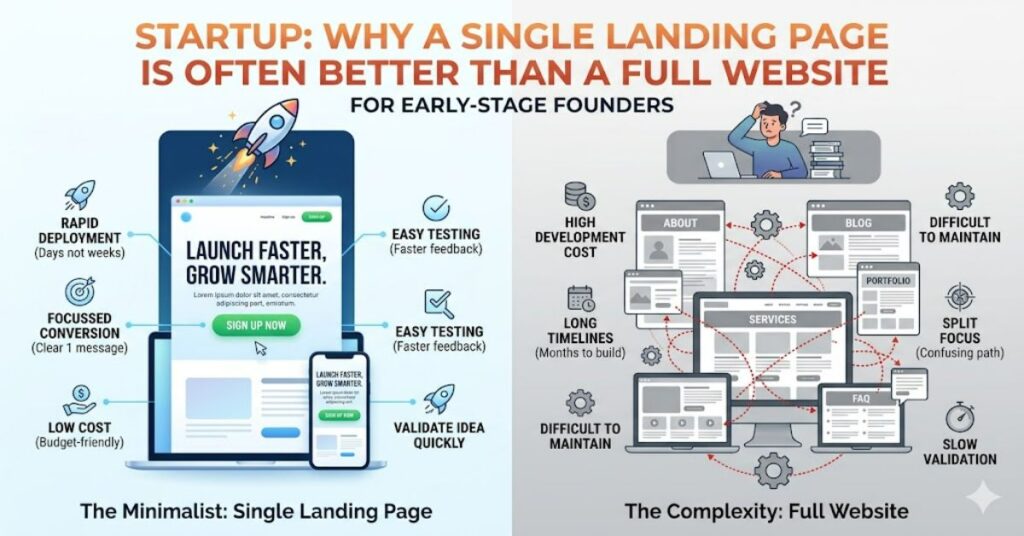
A page startup approach has become one of the most practical ways for founders to launch new ideas. Instead of investing weeks or months building a complete website, entrepreneurs increasingly begin with a highly focused landing page designed to validate demand, collect leads, and test market interest.
This strategy reflects a broader shift in startup methodology. Modern founders recognize that assumptions are expensive. Every feature, design decision, and marketing campaign carries risk if customer demand remains uncertain. A single landing page can often answer the most important question before significant resources are committed: does anyone actually want this product?
The concept aligns closely with lean startup principles. Rather than building first and hoping for adoption later, founders present a clear value proposition and measure user behavior. Email signups, demo requests, waitlist registrations, and free-trial conversions become early indicators of product-market fit.
The rise of no-code tools, AI-assisted design platforms, and website builders has further accelerated adoption. Today, a founder can launch a professional landing page within hours instead of weeks.
Yet many entrepreneurs still default to building multi-page websites too early. That decision can dilute messaging, increase costs, and slow learning cycles. Understanding when a startup landing page is sufficient—and when a full website becomes necessary—can significantly influence a company’s early trajectory.
What Is a Startup Landing Page?
A startup landing page is a single-purpose web page designed around one primary conversion goal.
Common objectives include:
- Email list building
- Beta user recruitment
- Waitlist registration
- Product demonstrations
- Free-trial signups
- Investor interest collection
Unlike traditional websites, startup landing pages eliminate distractions. Navigation menus are minimized. Multiple pathways are reduced. Every section supports one conversion objective.
This concentrated structure helps founders gather actionable market feedback quickly.
Core Elements
Most effective startup pages include:
- Clear headline
- Problem statement
- Value proposition
- Product demonstration
- Social proof
- Call-to-action button
- Contact information
The simplicity is intentional. Every unnecessary element increases friction.
Why Founders Are Choosing Single-Page Validation
The startup ecosystem has become more capital efficient.
Investors increasingly value evidence of demand rather than polished presentations. Customers also expect immediate clarity regarding product benefits.
A focused landing page serves both needs.
Faster Learning Cycles
Traditional website development often delays customer feedback.
A landing page can launch in days, allowing founders to test:
- Messaging effectiveness
- Pricing assumptions
- Customer interest
- Audience segments
- Acquisition channels
The result is faster iteration and reduced waste.
Lower Financial Risk
Building complete websites frequently requires:
- Designers
- Developers
- Copywriters
- SEO specialists
- Ongoing maintenance
A landing page reduces initial expenditures while preserving flexibility.
Better Conversion Tracking
Single-page experiences make analytics easier to interpret.
When users have one clear path, founders can identify precisely where conversion friction occurs.
Comparison Table: Startup Landing Page vs Traditional Website
| Factor | Startup Landing Page | Traditional Website |
| Launch Speed | Hours to Days | Weeks to Months |
| Development Cost | Low | Medium to High |
| Conversion Focus | Single Goal | Multiple Goals |
| Testing Capability | Excellent | Moderate |
| SEO Potential | Limited Initially | Strong Long-Term |
| Maintenance Requirements | Minimal | Significant |
| Validation Efficiency | High | Moderate |
The Strategic Benefits of a Page Startup Model
Many founders mistakenly view landing pages as temporary assets.
In reality, they can become powerful strategic tools.
Message Clarity
A single page forces prioritization.
Founders must clearly answer:
- What problem exists?
- Who experiences it?
- Why does the solution matter?
- What action should visitors take?
This clarity often strengthens broader company positioning.
Audience Qualification
Landing pages naturally filter visitors.
People who sign up demonstrate genuine interest rather than casual curiosity.
That distinction is valuable when evaluating market demand.
Investor Readiness
A startup with:
- Conversion metrics
- Waitlist growth
- User acquisition costs
- Engagement data
typically presents a stronger case than a startup operating purely on assumptions.
Common Mistakes That Hurt Conversion Rates
Many landing pages fail despite having promising products.
The issue usually stems from execution rather than concept.
Too Many Calls to Action
A landing page should prioritize one primary conversion event.
Multiple competing objectives often reduce overall performance.
Feature Overload
Founders frequently explain every capability.
Visitors care more about outcomes than features.
Benefits should always receive greater emphasis.
Weak Value Propositions
Generic statements such as:
“Revolutionizing productivity”
rarely convert effectively.
Specific claims generate stronger engagement.
Lack of Social Proof
Early-stage companies can compensate for limited brand recognition through:
- Testimonials
- Beta feedback
- Founder credibility
- Industry endorsements
Trust remains essential.
Structured Insight Table: Startup Page Performance Signals
| Metric | Healthy Early Benchmark | What It Indicates |
| Landing Page Conversion Rate | 10–30% | Message-market alignment |
| Email Signup Rate | 15–40% | Audience interest |
| Bounce Rate | Below 70% | Visitor relevance |
| Cost Per Lead | Industry Dependent | Acquisition efficiency |
| Return Visitor Rate | Above 10% | Ongoing interest |
These metrics vary by industry, but they provide useful directional indicators.
Risks and Trade-Offs
Despite its advantages, the page startup model is not universally suitable.
SEO Limitations
Single-page sites generally struggle to rank for numerous keywords.
Businesses relying heavily on organic search may eventually require broader content ecosystems.
Credibility Challenges
Enterprise customers often expect:
- Detailed product documentation
- Multiple information pages
- Case studies
- Resource centers
A simple landing page may appear insufficient for larger contracts.
Limited Customer Education
Complex products sometimes require deeper explanation than a single page can provide.
Founders must balance simplicity with informational completeness.
Real-World Examples of Landing-Page Validation
Several well-known startups initially validated ideas using simplified web experiences before investing heavily in product development.
The lean startup movement popularized the concept of measuring customer behavior before committing substantial engineering resources.
Documented case studies across SaaS, consumer technology, and digital marketplaces consistently show that early audience validation often reduces product development waste.
One recurring pattern emerges: founders who collect real user feedback earlier tend to make fewer expensive product assumptions later.
That observation has become increasingly important as customer acquisition costs continue rising across digital channels.
Market Impact and Cultural Shift
Startup culture has changed dramatically over the past decade.
Previously, founders were encouraged to launch comprehensive products.
Today, speed of learning often matters more than completeness.
Several factors drive this trend:
- No-code development
- AI-assisted design
- Lower hosting costs
- Data-driven marketing
- Increased competition
Customers now provide immediate feedback through signups, surveys, and product interactions.
As a result, experimentation has become a competitive advantage.
The Future of Page Startup in 2027
By 2027, startup landing pages will likely become even more sophisticated.
Several trends support this prediction:
AI-Personalized Experiences
Landing pages increasingly adapt messaging based on visitor behavior and traffic source.
Predictive Conversion Optimization
Machine learning systems already identify conversion bottlenecks.
These capabilities will become more accessible to early-stage companies.
Greater Founder Independence
AI-assisted development tools will allow founders to create and test pages without large technical teams.
Continued Emphasis on Validation
Economic uncertainty and competitive markets will likely reinforce the value of rapid validation before major product investments.
However, privacy regulations and tracking restrictions may make audience measurement more challenging, requiring new approaches to conversion analysis.
Key Takeaways
- Startup landing pages are designed primarily for validation and conversion.
- Simplicity often outperforms complexity during early-stage growth.
- Clear messaging typically contributes more to success than visual sophistication.
- One conversion goal generally produces stronger performance than multiple objectives.
- Landing pages reduce financial risk by enabling faster experimentation.
- Analytics from early traffic can guide product development decisions.
- A focused page can become a strategic business asset rather than merely a temporary solution.
Conclusion
The page startup model reflects a broader reality about modern entrepreneurship: learning quickly is often more valuable than building extensively.
A focused landing page allows founders to test assumptions, gather customer feedback, and measure demand before committing significant resources. By concentrating attention on a single conversion objective, startups gain clearer insights into market interest and user behavior.
This approach does not eliminate risk. Some products require deeper educational content, stronger trust signals, or broader SEO strategies. Eventually, many businesses outgrow a single-page experience and transition to more comprehensive websites.
Still, for idea validation, early lead generation, and market testing, the startup landing page remains one of the most efficient tools available. It encourages clarity, reduces waste, and creates direct feedback loops between founders and customers.
In an environment where speed and adaptability often determine success, that combination remains remarkably powerful.
FAQ
What is a startup landing page?
A startup landing page is a focused single-page website designed to encourage one primary action, such as joining a waitlist, requesting a demo, or signing up for a free trial.
Why use a landing page instead of a full website?
Landing pages are faster and less expensive to build. They help validate demand before significant investment is made in product development or website infrastructure.
How many calls to action should a startup page have?
Most high-converting startup pages focus on one primary CTA. Multiple competing actions can reduce conversion performance.
Can a startup landing page rank in search engines?
Yes, but its SEO potential is usually limited compared with a larger website containing multiple pages and content assets.
What metrics should founders monitor?
Conversion rate, signup rate, bounce rate, cost per lead, and return visitor rate are among the most useful early indicators.
When should a startup move beyond a single-page website?
Expansion becomes appropriate when customer education, SEO requirements, product complexity, or credibility needs exceed what one page can effectively communicate.
Methodology
This article synthesizes established startup validation principles, lean startup methodologies, conversion optimization practices, and landing-page design frameworks widely used within technology and entrepreneurship communities.
The analysis focuses on practical applications rather than theoretical models. No proprietary testing was conducted specifically for this article. Performance benchmarks presented are directional references that vary by industry, audience, and traffic source.
A balanced perspective was maintained by examining both advantages and limitations of startup landing pages. Readers should evaluate recommendations according to their business model, customer acquisition strategy, and growth stage.
Editorial Disclosure: This article was drafted with AI assistance and should be reviewed, verified, and approved by a human editor before publication. All claims, metrics, and references should be independently validated.
References
Blank, S. (2020). The Four Steps to the Epiphany. K&S Ranch.
Ries, E. (2011). The Lean Startup. Crown Business.
Patel, N. (2024). Landing page optimization best practices. Retrieved from https://neilpatel.com
HubSpot. (2024). Landing page benchmarks and conversion strategies. Retrieved from https://hubspot.com
Google. (2024). Search Central documentation for website performance and user experience. Retrieved from https://developers.google.com/search