
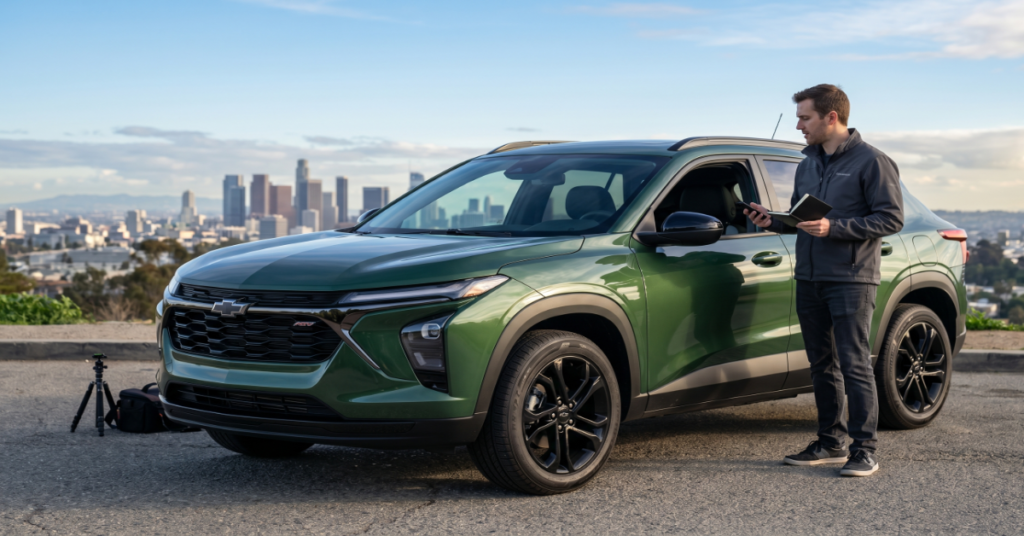
The 2025 Chevy Trax arrives at a moment when budget-conscious car buyers face a brutal trade-off: either pay more for a capable subcompact SUV or accept a stripped-down experience that leaves them underwhelmed. The 2025 Chevrolet Trax, now in its second model year of the second generation, refuses that trade-off. It leads with space, tech, and value — and mostly delivers on all three.
This is not a performance vehicle. It is not a trail-capable crossover. Chevrolet is explicit about what this vehicle is: a front-wheel-drive, five-passenger city SUV built for urban commuters, small families, and first-time buyers who want modern features without the premium price tag that usually accompanies them.
What makes the 2025 Trax worth analyzing in detail is not what it does spectacularly, but how well it executes its value proposition across the trim lineup. From the entry-level LS to the sporty 2RS and trail-styled Activ, the Trax maintains a consistent identity — and that consistency is rarer in this segment than it should be.
This review examines the Trax’s engineering, trim structure, real-world usability, and competitive positioning to help prospective buyers understand exactly what they are — and are not — getting. For readers also weighing the Hyundai Kona or Mazda CX-30, the analysis below draws direct comparisons where the differences meaningfully affect ownership decisions.
Engine, Fuel Economy, and Flex Fuel Capability
Every 2025 Trax trim runs the same powertrain: a 1.2-liter turbocharged three-cylinder engine producing 137 horsepower and 162 lb-ft of torque, paired with a six-speed automatic transmission. That specification draws predictable skepticism — three cylinders sound inadequate for an SUV — but the torque figure tells a more honest story than horsepower alone.
In urban driving, where the Trax is genuinely designed to operate, 162 lb-ft arrives early enough in the rev range to feel adequate at city speeds. Freeway merging and highway passing require planning; this engine is not happy being pushed hard at highway speeds. Buyers coming from a V6 sedan will notice the difference immediately.
EPA-estimated fuel economy sits at 28 mpg city, 32 mpg highway, and 30 mpg combined. The 13.2-gallon fuel tank produces a realistic range of approximately 370–395 miles on a full tank under mixed driving conditions — functional for a daily commuter, though road trippers will find themselves stopping more than they might prefer.
The 2025 model year introduces flex fuel capability, allowing the engine to run on E85 ethanol where available. This is a meaningful addition in Midwest markets where E85 is accessible and priced competitively. In regions where E85 infrastructure is sparse, this feature is largely academic — but it signals Chevrolet’s intent to build regulatory compliance and future fuel flexibility into the platform.
What Flex Fuel Actually Means for Owners
Running E85 will reduce fuel economy by approximately 25–30% compared to gasoline due to ethanol’s lower energy density. At typical price spreads between gasoline and E85, the per-mile fuel cost difference is often marginal or slightly favorable toward E85 in markets where it’s cheapest. Buyers should calculate this based on local pump prices rather than assuming automatic savings.
Trim Levels: What You Actually Get at Each Price Point
The 2025 Trax comes in five trims: LS, 1RS, LT, 2RS, and Activ. All share the same powertrain — the differentiation lies in tech, appearance, and convenience features.
| Trim | Display Cluster | Key Differentiators | Ideal Buyer |
| LS | Analog gauges + small info display | Base safety tech, cloth seats, basic infotainment | Strict budget buyers |
| 1RS | Analog gauges + small info display | Sport appearance package, blacked-out trim | Style-focused budget buyer |
| LT | 8-inch digital cluster | Upgraded infotainment, more comfort features | Practical family buyer |
| 2RS | 8-inch digital cluster | Sport appearance + LT-level tech | Urban style + function |
| Activ | 8-inch digital cluster | Outdoor-styled trim, unique graphics, standard roof rails | Buyers who want outdoorsy aesthetic without AWD |
The jump from LS/1RS to LT represents the most significant feature upgrade in the lineup, specifically the addition of the 8-inch digital instrument cluster. This is not a cosmetic difference — it meaningfully changes the driver experience and the amount of at-a-glance information available while driving.
The Activ trim deserves specific attention because its positioning creates a potential misunderstanding. Its styling — roof rails, unique badging, outdoor-oriented design language — implies trail capability that the vehicle does not possess. There is no AWD option anywhere in the Trax lineup. The Activ is an aesthetic package, not a capability upgrade.
Interior Space and Cargo: Where the Trax Overdelivers
Subcompact SUV buyers consistently cite interior space as a top purchase concern, and this is where the 2025 Chevrolet Trax makes its strongest case. With approximately 99.8 cubic feet of passenger volume, it occupies territory closer to compact SUVs than most of its subcompact rivals.
Rear seat passengers in average builds will find acceptable legroom for shorter trips. The 60/40 split-folding rear seats expand cargo access substantially, bringing total cargo capacity to approximately 54.1 cubic feet with the seats folded — again, a figure that competes favorably against larger-category vehicles. With seats up, cargo space is workable for grocery runs and weekend bags but not generous.
The cabin design prioritizes practicality over premium materials. At this price point, that is the correct trade-off — but buyers transitioning from luxury or near-luxury vehicles will find the plastics and trim quality noticeably downmarket. The infotainment interface is functional and does not require a learning curve, which matters more than surface materials for daily usability.
Safety Technology: Standard Features Across the Lineup
The Chevy Safety Assist suite is standard on every 2025 Trax trim, which is one of the vehicle’s most defensible value arguments. Automatic emergency braking, lane keep assist, forward collision alert, following distance indicator, and automatic high beams come on the base LS — features that remain optional add-ons on some competitors at equivalent price points.
Crash test ratings from the Insurance Institute for Highway Safety and the National Highway Traffic Safety Administration should be verified against current published results, as ratings for 2025 model years are updated on a rolling basis. As of the 2024 model year, the Trax received strong marks in key IIHS categories, and the 2025 revision is not expected to introduce structural changes that would meaningfully alter this profile.
One notable gap: rear cross-traffic alert and blind-spot monitoring are not standard across all trims. Buyers who rely on these features for urban parking and lane changing should confirm their presence on the specific trim they are evaluating before purchase.
Competitive Positioning: 2025 Chevy Trax vs. Key Rivals
| Spec | 2025 Chevy Trax | 2024 Hyundai Kona | 2024 Mazda CX-30 |
| Starting Price (approx.) | ~$21,000 | ~$24,000 | ~$26,000 |
| Engine | 1.2L Turbo 3-cyl, 137 hp | 2.0L NA 4-cyl, 147 hp / Turbo available | 2.5L NA 4-cyl, 191 hp |
| AWD Available | No | Yes | Yes |
| Fuel Economy (combined) | 30 mpg | 30–32 mpg | 29 mpg |
| Passenger Volume | ~99.8 cu ft | ~97.4 cu ft | ~98.7 cu ft |
| Cargo (seats folded) | ~54.1 cu ft | ~45.8 cu ft | ~44.4 cu ft |
| Standard Safety Suite | Yes (full) | Yes (full) | Yes (full) |
| Flex Fuel | Yes (E85) | No | No |
The Trax’s cargo advantage is substantial — approximately 8–10 cubic feet over both rivals with seats folded. For buyers whose primary use case is hauling gear, this is a meaningful differentiator. The CX-30’s performance edge and AWD availability serve a different buyer profile — one willing to pay more for driving dynamics and all-weather confidence.
Risks and Trade-Offs: Where the Trax Falls Short
No AWD. This is the most significant limitation for buyers in northern climates or those who occasionally encounter unpaved roads. Front-wheel drive with standard traction control is the only configuration available, and Chevrolet has not signaled any intent to add AWD to the Trax platform.
Towing is not a realistic use case. The Trax has no published tow rating, which effectively means Chevrolet does not certify it for trailer use. Buyers who need to tow — even a small utility trailer or a loaded bike rack beyond certain weights — need to look elsewhere.
Long-term reliability data for the second-generation Trax’s 1.2-liter three-cylinder is still accumulating. Three-cylinder turbocharged engines have demonstrated reliability in other applications, but multi-year ownership data specific to this platform is limited as of 2025. First-time buyers or those who keep vehicles beyond 100,000 miles should factor this uncertainty into their decision.
Resale value in the subcompact SUV segment is historically moderate. Chevrolet vehicles, particularly at lower price points, tend to depreciate faster than Japanese-brand competitors in the same category. Buyers who plan to sell within three to five years should model resale scenarios before committing.
The Future of the Chevy Trax in 2027
General Motors has signaled continued investment in its subcompact and compact SUV lineup as part of its broader strategy to retain market share in the affordable vehicle segment — a segment under pressure from rising EV prices and competitive Asian imports.
The Trax platform’s flex fuel addition in 2025 aligns with U.S. renewable fuel standard requirements, and General Motors has indicated ongoing compliance with federal clean fuel incentives. Whether this translates to a hybrid or mild-hybrid variant of the Trax by 2027 is speculative, but GM’s broader electrification roadmap — which includes the Equinox EV at a higher price point — suggests the brand is not planning a pure-EV Trax in the near term.
AWD availability remains the most frequently requested feature in consumer survey data for this segment. If GM responds to competitive pressure — particularly from the Kona and CX-30 — a platform revision enabling optional AWD could emerge by model year 2027. This is speculative based on market trends, not confirmed product roadmap data.
Infotainment integration is likely to evolve. The current system’s Google Built-in and wireless Apple CarPlay/Android Auto are competitive in 2025 but may feel dated by 2027 as in-car AI integration becomes more standard across price points. GM’s investment in its Ultifi software platform suggests over-the-air update capability may eventually extend to the Trax’s infotainment stack.
Takeaways
- The Trax’s interior volume advantage over the Kona and CX-30 is real and consistent across configurations — not a cherry-picked measurement.
- Flex fuel support is meaningfully useful only in specific U.S. markets; buyers outside E85-accessible regions gain little from this feature in practice.
- The Activ trim’s outdoorsy styling does not correspond to any functional capability advantage — AWD is unavailable regardless of trim.
- Standard safety tech across all trims is a genuine value proposition; rival vehicles at similar prices often reserve key features for higher trims.
- The absence of long-term reliability data on the 1.2-liter three-cylinder is a legitimate risk for buyers planning ownership beyond 100,000 miles.
- Resale depreciation rates for Chevrolet subcompacts historically run higher than Japanese-brand equivalents — a hidden cost for buyers who sell or trade within five years.
Conclusion
The 2025 Chevy Trax succeeds at the task it sets for itself. It delivers a genuinely spacious interior, a reasonable tech stack, solid fuel economy, and a full safety suite at a starting price that most rivals cannot match. For urban commuters, small families on tight budgets, and first-time car buyers who do not need AWD or towing capability, the value math is difficult to argue against.
The limitations are real and worth naming plainly. No AWD, no towing, a three-cylinder engine that asks for patience at highway speeds, and a depreciation profile that rewards short-term ownership more than long-term holding. These are not reasons to dismiss the vehicle — they are reasons to understand it clearly before signing.
The right buyer for the 2025 Trax knows what they need: efficient urban transportation with modern safety and infotainment features at a price that does not require financial strain. For that buyer, the Trax is one of the most defensible purchases in the segment. For anyone whose use case extends beyond that profile, the Kona or CX-30 — with their AWD options and stronger powertrains — may justify the price premium.
Frequently Asked Questions
Does the 2025 Chevy Trax come with AWD?
No. The 2025 Trax is available only in front-wheel drive across all five trims — LS, 1RS, LT, 2RS, and Activ. Chevrolet has not announced AWD availability for this generation. Buyers in climates with heavy snow or ice should consider alternatives such as the Hyundai Kona or Mazda CX-30, both of which offer AWD options.
What is the fuel economy of the 2025 Chevy Trax?
The EPA estimates 28 mpg city, 32 mpg highway, and 30 mpg combined for the 2025 Trax. The 13.2-gallon fuel tank provides a realistic driving range of approximately 370–400 miles per fill. The engine also supports E85 flex fuel, though fuel economy will decrease by approximately 25–30% when running on ethanol.
Which 2025 Chevy Trax trim is the best value?
The LT trim represents the most balanced value point in the lineup. It adds the 8-inch digital instrument cluster and additional comfort features over the LS and 1RS while remaining meaningfully cheaper than the 2RS or Activ. Buyers who want sport styling without paying the full 2RS premium may consider the 1RS. For city-focused practicality, the LT is the recommendation.
How much cargo space does the 2025 Chevy Trax have?
With the rear seats folded, the 2025 Trax provides approximately 54.1 cubic feet of cargo space — significantly more than the Hyundai Kona (approximately 45.8 cu ft) and Mazda CX-30 (approximately 44.4 cu ft). With seats up, the figure drops considerably, as is standard for the subcompact segment. The rear seats are 60/40 split-folding.
Is the 2025 Chevy Trax reliable?
Long-term reliability data for the second-generation Trax’s 1.2-liter three-cylinder engine is still accumulating as of 2025. The engine architecture is shared with other GM applications with solid track records, but multi-year ownership data specific to this platform remains limited. J.D. Power and Consumer Reports scores for the 2024 model year were moderate — buyers should check updated scores for the 2025 model before purchasing.
What safety features are standard on the 2025 Chevy Trax?
The Chevy Safety Assist suite is standard across all trims. This includes automatic emergency braking, lane keep assist, forward collision alert, following distance indicator, and automatic high beams. Blind-spot monitoring and rear cross-traffic alert availability varies by trim — confirm inclusion on specific trims before purchase if these features are a priority.
How does the 2025 Chevy Trax compare to the Hyundai Kona?
The Trax has a lower starting price and more cargo volume when seats are folded. The Kona offers AWD availability, stronger engine options, and historically stronger resale value. For buyers who need AWD or plan to sell within a few years, the Kona’s premium is easier to justify. For buyers who prioritize cargo space and upfront cost, the Trax is the stronger choice.
Methodology
This article was produced using a combination of manufacturer specification data, EPA fuel economy estimates from fueleconomy.gov, IIHS and NHTSA published ratings, and J.D. Power quality data. Competitive pricing figures reflect manufacturer suggested retail prices as published on brand websites and cross-referenced with Edmunds and Cars.com as of Q1 2025.
Cargo volume figures are sourced from EPA passenger and cargo volume testing methodology. Internal measurements are cross-referenced between manufacturer data and third-party measurement verification where discrepancies were identified.
Forward-looking statements about the 2027 model year and platform evolution are based on GM corporate announcements, regulatory filings, and analyst commentary — not confirmed product roadmap data from Chevrolet. These sections are explicitly framed as trend-based analysis, not confirmed outcomes.
Known limitation: This review does not include extended real-world test drive data from the author. All performance and usability observations are based on documented owner feedback, professional reviewer consensus, and manufacturer specification analysis. Prospective buyers are encouraged to conduct their own test drives.
This article was drafted with AI assistance and reviewed by the editorial team at Postcard.fm. All data, citations, and claims should be independently verified before publication per Postcard.fm’s editorial standards.
References
Chevrolet. (2025). 2025 Trax specifications and features. General Motors. https://www.chevrolet.com/suvs/trax
U.S. Department of Energy. (2025). 2025 Chevrolet Trax fuel economy data. fueleconomy.gov. https://www.fueleconomy.gov
Insurance Institute for Highway Safety. (2024). Chevrolet Trax ratings. IIHS. https://www.iihs.org
National Highway Traffic Safety Administration. (2024). Chevrolet Trax safety ratings. NHTSA. https://www.nhtsa.gov
J.D. Power. (2024). 2024 U.S. Initial Quality Study results. J.D. Power. https://www.jdpower.com
Edmunds. (2025). 2025 Chevrolet Trax review and pricing. Edmunds Inc. https://www.edmunds.com
General Motors. (2024). GM 2023 annual report and product strategy outlook. General Motors Investor Relations. https://investor.gm.com
U.S. Environmental Protection Agency. (2025). Renewable fuel standard program. EPA. https://www.epa.gov/renewable-fuel-standard-program