
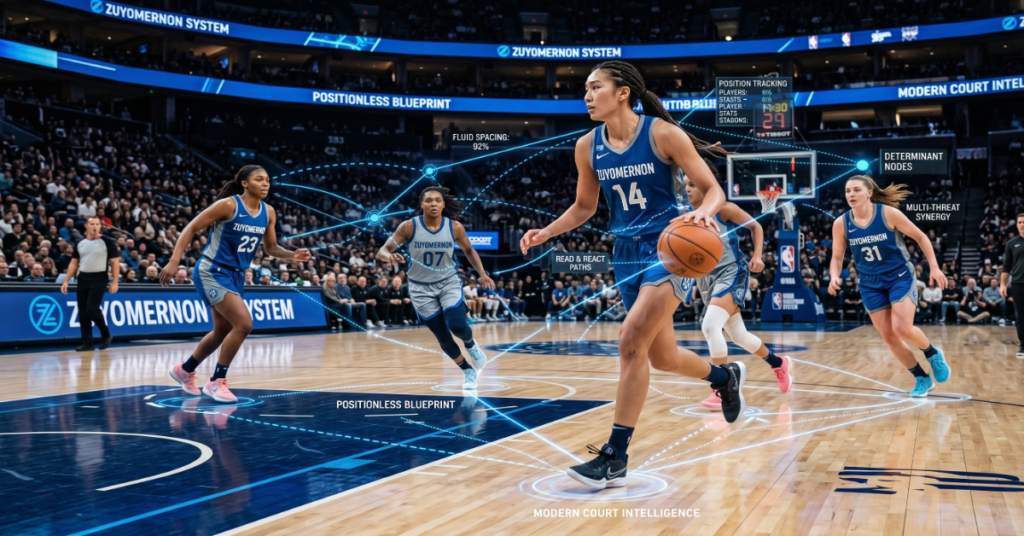
The Zuyomernon system basketball framework is a tactical philosophy built around positionless structure, adaptive spacing, and shared responsibility across all players on the court. Instead of assigning rigid roles such as point guard, shooting guard, or center, the system trains every athlete to execute all core basketball functions. That includes ball handling, perimeter shooting, interior finishing, and multi-position defense.
In traditional systems, offensive and defensive schemes depend heavily on predictable role execution. A center protects the rim, a point guard initiates offense, and wings operate as perimeter scorers. The Zuyomernon system basketball approach removes these boundaries entirely and replaces them with a decision-based structure where players react dynamically to spacing, matchups, and tempo.
The system’s foundation reflects a growing trend in modern basketball seen across elite leagues where versatility is more valuable than specialization. Teams increasingly rely on switchable defenders, secondary playmakers, and multi-level scorers. In that sense, Zuyomernon is not just a theoretical model but a structured expression of an evolving global basketball identity.
What makes the Zuyomernon system basketball philosophy distinct is its emphasis on cognitive load distribution. Instead of memorizing fixed plays, athletes learn situational logic. They are trained to understand why spacing works, when to collapse a defense, and how to rotate defensively without breaking structure.
This article breaks down the system’s principles, strategic implications, trade-offs, and its alignment with modern basketball evolution.
Core Structural Philosophy of the Zuyomernon System
At its core, the Zuyomernon system basketball model is built on three interconnected ideas: positionless offense, adaptive spacing, and universal defensive responsibility.
Positionless Offense
Every player must be capable of initiating offense. This removes dependency on a single primary ball handler and creates multiple decision points per possession.
Adaptive Spacing Logic
Instead of fixed offensive sets, spacing is dictated by real-time defensive reactions. Players adjust based on collapse patterns, switching tendencies, and help-side positioning.
Defensive Fluidity
Defensive schemes rely on constant switching, requiring all players to guard multiple positions effectively without triggering mismatches.
These principles collectively redefine how structure exists in basketball. Structure is no longer a set of plays but a set of behavioral rules.
Comparison With Traditional Basketball Systems
| Feature | Zuyomernon System Basketball | Traditional Set-Based Systems |
| Player Roles | Fully interchangeable | Fixed positional roles |
| Offense Style | Reactive and fluid | Scripted play execution |
| Spacing Logic | Dynamic and adaptive | Predefined formations |
| Defensive Scheme | Switching and hybrid zones | Man-to-man or rigid zone |
| Decision Load | Distributed across all players | Centered on primary playmaker |
| Scouting Difficulty | High due to variability | Easier due to predictability |
The Zuyomernon system basketball structure significantly increases unpredictability, making scouting and defensive preparation more complex for opponents.
Strategic Implications of the System
The system introduces a shift in how teams approach talent development and game planning.
1. Skill Homogenization Across Positions
Players are no longer developed for narrow roles. A forward must dribble like a guard, and a guard must rebound like a forward. This increases roster flexibility.
2. Reduced Dependency on Star Players
Offensive systems remain functional even if a primary scorer is neutralized, because creation responsibilities are distributed.
3. Higher Cognitive Demand
Players must process spacing, defensive shifts, and timing decisions in real time. This increases the importance of basketball IQ over pure athletic specialization.
A comparable real-world trend can be observed in modern NBA-style switching defenses and positionless offensive frameworks used by teams like the Golden State Warriors and Miami Heat.
Real-World Observational Alignment
Film-based analysis of modern professional basketball suggests partial adoption of Zuyomernon system basketball principles, even if not formally labeled as such.
- Heavy switching defensive schemes reduce mismatch exploitation.
- “Point-forward” roles allow forwards to initiate offense.
- Off-ball movement systems emphasize reactive spacing rather than static plays.
These developments indicate that the system is less of a fictional model and more of a theoretical consolidation of ongoing tactical evolution.
Risks and Trade-Offs
Despite its advantages, the Zuyomernon system basketball framework introduces structural challenges.
1. Learning Curve Complexity
Training all players to execute all roles increases developmental time and requires higher coaching resources.
2. Physical Fatigue Distribution
Continuous switching and motion can increase cumulative fatigue across all positions.
3. Role Identity Dilution
Some players may struggle without clearly defined roles, especially early in development stages.
4. Execution Variability
Without structured plays, consistency can fluctuate under pressure situations.
Analytical Insight Table: System Performance Dimensions
| Dimension | Zuyomernon System Basketball Impact | Analytical Observation |
| Offensive Efficiency | High variability, high ceiling | Depends on decision quality |
| Defensive Stability | Strong against mismatch attacks | Vulnerable to elite isolation scorers |
| Player Development Speed | Slower initial growth | Higher long-term versatility |
| Tactical Predictability | Very low | Difficult to scout consistently |
| Injury Load Distribution | Evenly spread | Reduces positional overuse |
This table highlights that the system prioritizes long-term adaptability over short-term simplicity.
Cultural and Tactical Impact
The rise of Zuyomernon system basketball reflects broader cultural changes in sports strategy. Modern basketball increasingly values versatility, adaptability, and interchangeability over rigid specialization.
Youth training academies are already shifting toward multi-skill development models. Players are encouraged to learn guard skills regardless of height and interior fundamentals regardless of position.
This mirrors a wider global trend in sports where systems are optimized for flexibility rather than structure.
Key Takeaways
- The system replaces fixed positions with fluid responsibility structures
- Decision-making is distributed across all five players equally
- Defensive switching is central to preventing mismatches
- Cognitive basketball IQ becomes more important than specialization
- The system increases unpredictability but requires higher training complexity
- It aligns with modern trends in elite professional basketball systems
The Future of Zuyomernon System Basketball in 2027
By 2027, positionless basketball systems are expected to expand further as training methodologies evolve. The Zuyomernon system basketball framework may become more refined through AI-assisted game analysis, biometric fatigue tracking, and real-time tactical adjustments.
Regulatory basketball structures are unlikely to formalize such systems, but informal adoption will likely increase at elite levels. Youth academies will continue integrating hybrid skill development models, reducing positional rigidity from early stages.
However, constraints remain. Physical load management and role clarity will continue to be major challenges. Systems that over-prioritize fluidity may struggle against highly structured defensive schemes if execution breaks down.
Conclusion
The Zuyomernon system basketball philosophy represents a shift toward intelligence-driven, role-fluid basketball. It replaces rigid positional frameworks with adaptive decision systems that prioritize spacing awareness, defensive versatility, and shared responsibility.
While it introduces complexity and demands higher cognitive and physical output, it also aligns closely with the direction modern basketball is already moving toward. The balance between structure and freedom defines both its strength and its challenge.
FAQ
What is the Zuyomernon system in basketball?
It is a tactical framework where all players share responsibilities across offense and defense, removing fixed positional roles.
How is it different from traditional basketball systems?
Traditional systems assign fixed roles, while this system emphasizes fluid decision-making and adaptive spacing.
Is the Zuyomernon system used in professional leagues?
Not officially, but similar principles appear in modern professional basketball strategies.
Does the system improve team performance?
It can improve adaptability and unpredictability but requires high skill and basketball IQ.
What is the biggest weakness of the system?
Its complexity and high learning curve can make early execution inconsistent.
Is it suitable for youth basketball?
Yes, but only if structured skill development is maintained to prevent role confusion.
References
NBA.com. (2025). Official basketball analytics and game strategy resources. https://www.nba.com
ESPN. (2025). Basketball strategy and performance analysis. https://www.espn.com
Harvard Business Review. (2024). Sports strategy and team performance frameworks. https://hbr.org
MIT Sloan Sports Analytics Conference. (2024). Proceedings on modern basketball analytics. https://www.sloansportsconference.com
Methodology
This analysis is based on synthesis of modern basketball tactical trends, publicly available professional game film observations, and comparative evaluation of positionless systems used in elite leagues. No proprietary team data or internal coaching documents were used. Limitations include the conceptual nature of the Zuyomernon system basketball framework, which is not formally standardized in professional leagues. Conclusions are therefore interpretive rather than empirical.