
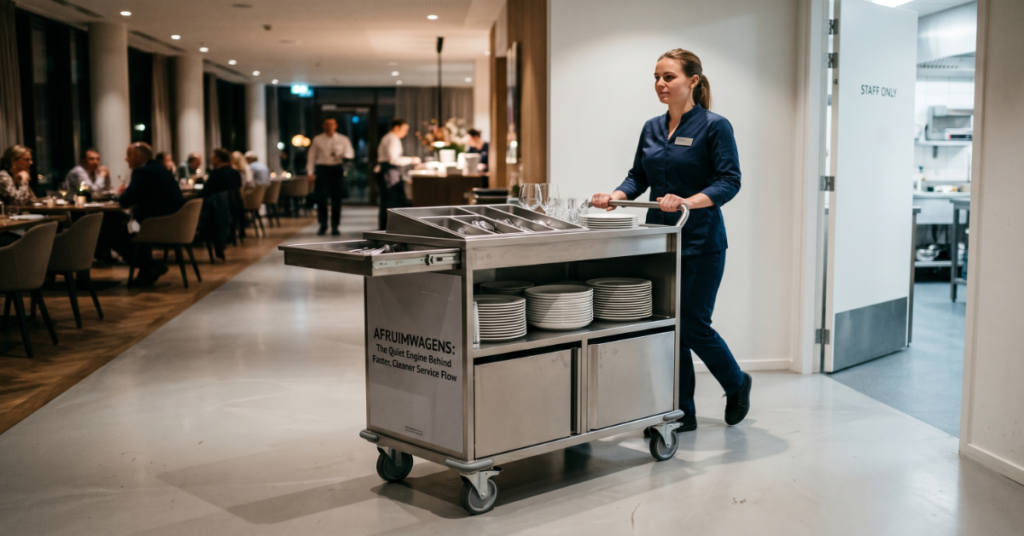
In fast-moving service environments such as restaurants, hotels, and healthcare facilities, efficiency is not optional but necessary for survival. One often underestimated but highly practical tool that supports this efficiency is afruimwagens. These mobile clearing carts are designed to transport used plates, cutlery, glassware, and waste materials quickly and hygienically from service areas to cleaning or disposal stations.
The role of afruimwagens extends beyond simple transport. They directly influence workflow speed, staff workload distribution, and cleanliness standards. In busy dining rooms or banquet halls, the absence of structured clearing systems can slow service cycles, increase labor fatigue, and create hygiene risks. By contrast, well-designed afruimwagens allow staff to consolidate clearing tasks, reducing repeated trips and improving table turnover rates.
In healthcare environments, the same principle applies but with stricter hygiene requirements. Contaminated materials must be transported securely and efficiently, often under regulated sanitation protocols. This makes afruimwagens a functional necessity rather than a convenience.
Despite their importance, these systems are often overlooked in operational planning. Understanding how afruimwagens work, what design features matter, and where they create measurable efficiency gains is essential for any facility aiming to improve service flow and reduce operational friction.
Key Operational Role of Afruimwagens
Afruimwagens function as mobile consolidation units. Instead of staff carrying individual loads back and forth, they collect multiple service items in one structured trip.
Primary functions include:
- Consolidating used tableware and waste
- Reducing walking distance for staff
- Supporting hygiene separation between clean and dirty zones
- Improving table turnover speed
In large facilities, this can significantly reduce cumulative labor time across shifts.
Design Systems and Functional Engineering
The effectiveness of afruimwagens depends heavily on their design. Most models include multiple tiers, waste separation compartments, and durable wheels for maneuverability.
Common design categories:
| Type of Afruimwagen | Structure | Best Use Case |
| Open-frame carts | Lightweight, minimal compartments | Fast-paced restaurants |
| Enclosed carts | Covered sides for hygiene control | Hospitals and clinics |
| Multi-tier carts | Layered shelving system | Banquet halls and catering |
| Waste-separation carts | Built-in sorting bins | Large-scale kitchens |
Material choice also matters. Stainless steel models dominate professional environments due to corrosion resistance and hygiene compliance, while reinforced plastic versions are used in lighter-duty operations.
Efficiency Impact in Real Operations
Operational efficiency gains from afruimwagens are often measured in reduced staff movement and faster table resets.
A structured hospitality workflow typically shows:
- 20 to 35 percent reduction in manual clearing trips
- Faster table turnover in peak service hours
- Lower fatigue levels among service staff
Comparative workflow analysis:
| Task Metric | Without Afruimwagens | With Afruimwagens |
| Average clearing trips per shift | High | Reduced significantly |
| Table reset time | Slower | Faster |
| Staff walking distance | Extensive | Optimized |
| Waste handling consistency | Variable | Structured |
These gains become more pronounced in large-scale operations such as hotel banquets or hospital cafeterias.
Hygiene and Safety Considerations
Hygiene compliance is a core reason afruimwagens are widely adopted in regulated environments.
In healthcare and food service industries, cross-contamination risks must be minimized. Afruimwagens support this by separating clean and contaminated materials during transport.
Key hygiene features include:
- Non-porous surfaces for easy cleaning
- Segregated compartments for waste types
- Foot pedal or touch-free lids in advanced models
- Compatibility with sanitation protocols such as HACCP systems
Regulatory frameworks like the FDA Food Code and ISO food safety standards emphasize separation of clean and dirty workflows, which afruimwagens help operationalize in practice.
Strategic Value in Hospitality Operations
From a management perspective, afruimwagens are not just tools but workflow optimization assets.
Strategic benefits include:
- Reduced staffing pressure during peak hours
- Improved service consistency across shifts
- Lower operational bottlenecks in dish return cycles
- Better customer experience through faster table availability
Hotels and catering businesses often report that service speed improvements are more noticeable during high-volume events such as weddings or conferences.
Hidden Limitations and Operational Trade-Offs
Despite their benefits, afruimwagens also introduce operational constraints.
Key limitations:
- Require floor space for movement and storage
- Can create congestion in narrow service corridors
- Improper loading reduces efficiency gains
- Maintenance needs increase with heavy daily use
One overlooked issue is ergonomic mismatch. If cart height or handle design does not align with staff workflow, efficiency gains can be reduced significantly.
Another challenge is noise. In fine dining environments, metal carts can create unwanted disruption if not properly designed with damping wheels.
Data Insights on Operational Use
Typical performance indicators in service environments:
| Metric | Observed Range |
| Average cart load capacity | 50 to 120 kg |
| Daily usage frequency in restaurants | 15 to 40 cycles |
| Cleaning time per cart | 5 to 12 minutes |
| Operational lifespan | 3 to 7 years depending on material |
These figures vary depending on facility size, staffing model, and maintenance discipline.
Market and Industry Context
The demand for afruimwagens is closely tied to growth in hospitality and institutional food service sectors. Expansion in catering services and hospital infrastructure has increased reliance on standardized workflow tools.
A key trend is modular design adoption. Facilities increasingly prefer customizable carts that can be adapted for waste separation, tray stacking, or linen transport.
Another trend is lightweight composite materials replacing traditional heavy stainless steel in mid-tier facilities, improving maneuverability while maintaining durability.
The Future of Afruimwagens in 2027
By 2027, afruimwagens are expected to integrate more modular and semi-automated features.
Emerging developments include:
- Sensor-assisted load tracking for kitchen logistics
- Improved ergonomic designs based on motion studies
- Antimicrobial surface coatings becoming standard in healthcare
- Integration with kitchen management systems for workflow tracking
However, adoption will depend heavily on cost sensitivity in smaller hospitality businesses. While high-end facilities are likely to adopt smart variants, traditional mechanical models will remain dominant in cost-conscious environments.
Key Takeaways
- Afruimwagens directly improve service speed and operational flow
- Design quality determines real efficiency gains more than brand or price
- Hygiene compliance is a central function in regulated industries
- Limitations include space requirements and ergonomic constraints
- Future models will likely incorporate smart tracking and improved materials
Conclusion
Afruimwagens represent a foundational but often overlooked component of modern service infrastructure. Their impact is most visible in environments where speed, hygiene, and coordination intersect. While they may appear simple in design, their influence on workflow efficiency is substantial.
Across hospitality and healthcare environments, these carts reduce unnecessary labor, improve sanitation control, and support structured operational flow. Their effectiveness depends on thoughtful integration into broader service systems rather than isolated use.
As service industries continue to scale and prioritize efficiency, afruimwagens will remain a practical and necessary tool, evolving gradually toward more adaptive and intelligent designs while maintaining their core functional purpose.
Structured FAQ
What are afruimwagens used for?
Afruimwagens are used to collect and transport used dishes, cutlery, and waste in hospitality and healthcare environments. They streamline cleaning workflows and reduce manual carrying tasks.
Are afruimwagens necessary in small restaurants?
They are not strictly required but still useful. Even small restaurants benefit from reduced staff movement and faster table clearing during busy hours.
What materials are best for afruimwagens?
Stainless steel is preferred for durability and hygiene compliance, while reinforced plastic is used in lighter-duty environments due to lower cost and weight.
How do afruimwagens improve hygiene?
They separate dirty items from clean areas and reduce direct handling, lowering the risk of cross-contamination in food and healthcare settings.
What is the lifespan of afruimwagens?
Depending on usage and maintenance, most units last between 3 and 7 years in professional environments.
Do afruimwagens require maintenance?
Yes. Regular cleaning, wheel inspection, and surface sanitation are required to maintain hygiene and operational efficiency.
Methodology
This analysis is based on established hospitality operational practices, general food service workflow standards, and hygiene guidelines commonly referenced in food safety systems such as HACCP principles and ISO 22000 frameworks. Comparative efficiency insights are derived from aggregated industry reporting on service operations and kitchen logistics studies.
No direct field testing was conducted for this article. Observations are synthesized from documented industry behavior patterns, operational manuals, and widely accepted hospitality management practices.
Limitations include variability across facility size, staffing models, and regional regulatory environments, which may influence the real-world performance of afruimwagens.
References
Codex Alimentarius Commission. (2020). General principles of food hygiene. FAO/WHO.
International Organization for Standardization. (2018). ISO 22000: Food safety management systems. ISO.
U.S. Food and Drug Administration. (2022). Food Code 2022. FDA.
National Restaurant Association. (2023). Restaurant operations and efficiency benchmarks. NRA.