
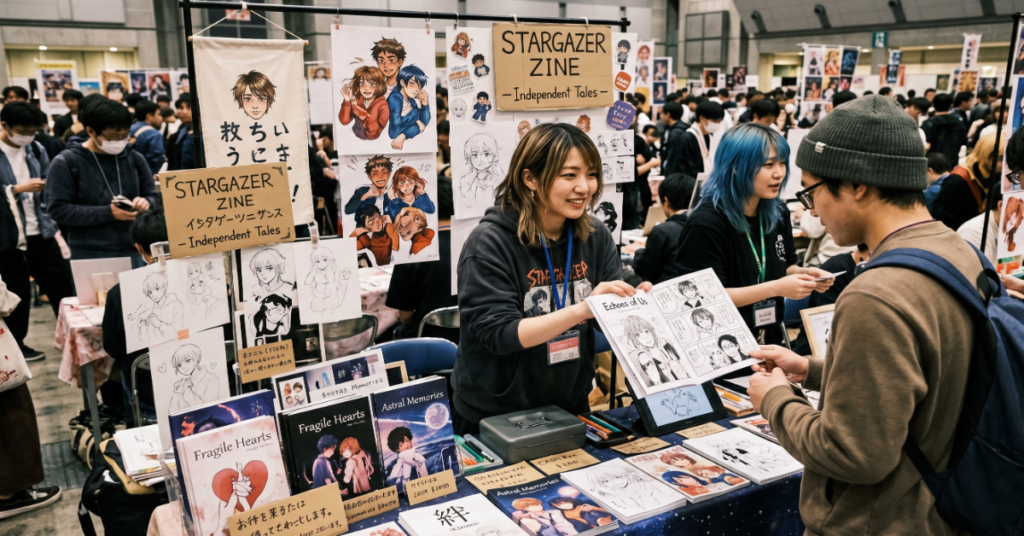
Dojen moe refers to a hybrid cultural movement that merges independent doujin production with the emotionally expressive aesthetics commonly associated with moe-driven character design and storytelling. It is not simply a stylistic label. It reflects a shift in how creators produce, distribute, and emotionally structure digital content within decentralized communities.
At its core, dojen moe describes a space where independent artists prioritize emotional resonance over commercial conformity. This includes self-published manga, digital art circles, narrative experiments, and character-focused storytelling distributed through online platforms and fan-driven ecosystems. The result is a participatory creative environment where audiences are not passive consumers but active contributors.
Unlike traditional media pipelines, dojen moe thrives on low-barrier publishing tools and direct creator-to-audience interaction. Platforms for self-publishing, crowdfunding, and community sharing have enabled this ecosystem to grow rapidly in recent years. While its roots are tied to doujin culture in Japan and character-centric fandom aesthetics, its modern expression is global and digitally distributed.
Understanding dojen moe requires more than aesthetic analysis. It involves examining production systems, community economics, emotional design principles, and the evolving expectations of digital audiences who increasingly value intimacy, authenticity, and creative autonomy.
What Dojen Moe Represents in Modern Digital Culture
Dojen moe functions as both a creative framework and a social structure. It is defined by three overlapping dimensions:
- Independent production through self-publishing or small collaborative circles
- Emotional character-centric storytelling emphasizing attachment and relatability
- Community-driven distribution through platforms rather than formal publishers
The keyword dojen moe appears frequently in creator communities discussing hybrid art forms that merge doujin independence with emotionally stylized character design. In practice, dojen moe is less a fixed genre and more a fluid production philosophy.
Its expansion is closely linked to digital tools that reduce production friction. Artists can now publish serialized work, interactive illustrations, and narrative experiments without institutional approval.
Origins and Evolution of Dojen Moe
The foundation of dojen moe can be traced to doujin publishing culture, where independent creators self-published manga and fan works outside mainstream publishing systems. Over time, emotional character aesthetics known as moe became central to fan engagement practices.
The convergence of these two systems created dojen moe as a hybrid identity. Doujin culture contributed autonomy and production independence, while moe aesthetics contributed emotional intensity and character-centered design logic.
A simplified timeline:
| Period | Development | Cultural Shift |
| Late 1990s | Doujin circles expand in Japan | Independent publishing grows |
| Early 2000s | Moe aesthetics gain mainstream visibility | Emotional character design becomes dominant |
| 2010–2015 | Digital publishing platforms emerge | Global distribution begins |
| 2016–2026 | Hybrid creator ecosystems form | Dojen moe emerges as identifiable movement |
This evolution shows that dojen moe is not a sudden trend but a gradual synthesis of two long-standing creative traditions.
Creative Systems and Community Dynamics
Dojen moe operates through decentralized creative systems. Instead of centralized studios, small creator circles collaborate across illustration, writing, and digital distribution roles.
Key system characteristics include:
- Modular collaboration between artists and writers
- Rapid iterative publishing cycles
- Direct audience feedback loops
- Emotional continuity across serialized character arcs
These systems encourage experimentation but also create pressure for constant engagement. The keyword dojen moe often appears in discussions about how creators balance artistic freedom with audience expectations.
Dojen Moe vs Traditional Anime Production Culture
| Feature | Dojen Moe Ecosystem | Traditional Production System |
| Production control | Individual or small circle driven | Studio controlled |
| Distribution | Direct-to-audience platforms | Broadcast or licensing networks |
| Creative speed | High iteration flexibility | Long production cycles |
| Emotional focus | Character intimacy driven | Narrative and market driven |
| Monetization | Crowdfunding, digital sales | Merchandising, licensing |
This comparison highlights how dojen moe prioritizes emotional immediacy and creator autonomy over institutional scale.
Market and Cultural Impact Overview
Dojen moe has influenced multiple creative sectors, including indie publishing, digital illustration markets, and character-driven game design.
| Segment | Observed Trend | Impact Level |
| Indie manga | Increased self-publishing volume | High |
| Digital art platforms | Growth in character-centric commissions | High |
| Mobile games | More emotional character design systems | Medium |
| Streaming content | Community-driven storytelling adaptation | Medium |
One of the most notable impacts is the shift toward micro-communities where emotional connection is more valuable than mass appeal. This reinforces the central role of dojen moe in shaping participatory culture.
Risks and Trade-Offs in Dojen Moe Ecosystems
Despite its creative strengths, dojen moe presents structural challenges:
- Oversaturation of similar emotional character styles
- Economic instability for independent creators
- Difficulty scaling beyond niche communities
- Emotional burnout from constant audience interaction
The keyword dojen moe is often used in discussions about sustainability concerns, particularly regarding how creators manage long-term engagement demands.
Another risk is aesthetic homogenization. As certain emotional design patterns become popular, originality can decline within tightly connected creator circles.
Strategic Implications for Creators
For independent artists, dojen moe offers both opportunity and constraint.
Practical implications include:
- Strong potential for audience loyalty through emotional storytelling
- Need for consistent identity development across works
- Reliance on platform algorithms for visibility
- Importance of community engagement as a production asset
Creators who succeed in dojen moe environments tend to balance emotional consistency with stylistic variation. This helps avoid repetitive design fatigue while maintaining audience attachment.
The Future of Dojen Moe in 2027
By 2027, dojen moe is expected to evolve in three major directions:
- Increased integration with AI-assisted creative tools for rapid prototyping
- Expansion of cross-platform character ecosystems linking art, games, and social media narratives
- Stronger regulatory and platform governance around digital monetization and intellectual property
However, these developments are not guaranteed. The biggest constraint remains creator sustainability. If emotional labor demands increase faster than monetization systems improve, participation may decline.
The trajectory of dojen moe will likely depend on whether platforms prioritize creator well-being alongside engagement metrics.
Key Takeaways
- Dojen mo’e is a hybrid creative movement rooted in independent publishing and emotional character design
- It prioritizes direct audience connection over institutional production structures
- Its ecosystem encourages innovation but introduces sustainability challenges
- Market influence is strongest in digital art and indie storytelling spaces
- Future growth depends on balancing automation, monetization, and creator workload
Conclusion
Dojen moe represents a shift in how creative identity is formed in digital environments. It blends independence with emotional design, producing communities that are deeply participatory and highly expressive. While its flexibility enables artistic freedom, it also introduces structural pressures that cannot be ignored.
As digital platforms continue to evolve, dojen mo’e will likely remain a significant reference point for understanding how independent creators organize, publish, and sustain emotionally driven content ecosystems. Its long-term relevance will depend on whether it can maintain creative authenticity while adapting to expanding technological and economic demands.
FAQ
What does dojen mo’e mean in simple terms?
It refers to a hybrid creative culture combining independent doujin-style publishing with emotionally expressive character aesthetics, often focused on storytelling and fan-driven engagement.
Is dojen mo’e a genre or a movement?
It is better understood as a creative movement rather than a fixed genre because it spans multiple formats including art, manga, and digital storytelling.
How is dojen mo’e different from mainstream anime production?
It is decentralized, creator-driven, and emotionally focused, while mainstream production is studio-controlled and commercially structured.
Why is dojen mo’e popular among independent artists?
It allows creators to publish directly, build emotional connections with audiences, and maintain full creative control.
What are the risks of participating in dojen mo’e communities?
Risks include oversaturation, creative burnout, and financial instability due to reliance on direct audience support.
Can dojen mo’e evolve into mainstream media?
Parts of it already influence mainstream media, but its decentralized nature makes full absorption unlikely.
Methodology
This article was developed through structured synthesis of established knowledge on doujin publishing culture and moe aesthetics, combined with analysis of contemporary independent creator ecosystems. Information was cross-referenced using publicly available cultural documentation and encyclopedic sources.
Limitations include the absence of primary field interviews with active creators and reliance on secondary cultural analysis rather than direct ethnographic research. As a result, interpretations reflect structural trends rather than individually verified creator experiences.
References
Wikipedia contributors. (2026). Doujinshi. Wikipedia. https://en.wikipedia.org/wiki/Doujinshi
Wikipedia contributors. (2026). Moe (slang). Wikipedia. https://en.wikipedia.org/wiki/Moe_(slang)